Anorectal Malformation (Imperforate Anus): Causes, Types, Treatment & Outlook

Updated: 2 days ago
Medically reviewed by Dr. Baraa Alnahhal, MD · Last reviewed: September 2026
TL;DR
An anorectal malformation is a congenital condition in which a baby's rectum and anus do not form properly before birth. It affects about 1 in 5,000 babies born in the United States and is more common in boys. Most cases are treated with surgery within the first few days of life, and most babies heal well. Without treatment, the condition can cause intestinal blockages that make passing stool difficult or impossible.
Quick Answer — What is an anorectal malformation? • An anorectal malformation means a baby's rectum and anus did not form properly before birth — the anus may be narrowed, missing, blocked by tissue, or connected to other organs. • It occurs in about 1 in 5,000 babies born in the United States and is more common in boys. • Surgery within the first few days of life is the standard treatment, with most babies healing well and having no complications. • Some children need long-term help with constipation or bowel control, which bowel management programs can address.
What Is an Anorectal Malformation?
An anorectal malformation is a condition in which the rectum and anus of the developing fetus do not form properly before birth. The anus and rectum are the lower portions of the digestive tract.
The word "anorectal" simply combines "anus" and "rectum." The rectum is the last part of the large intestine, just above the anus, and the anus is the opening where stool passes. During a bowel movement, stool travels from the rectum through the anus and out of the body — so problems with either structure disrupt bowel movements.
Babies with an anorectal malformation may have a narrowed or missing anus, a layer of tissue blocking the anus or rectum, or irregular connections between the rectum and other parts of the body.
Without treatment, babies can develop intestinal blockages that make it difficult or even impossible to pass stool. But these conditions are typically treated shortly after birth with good results — usually, a surgeon repairs the malformation when the baby is a few days old.
Answer nugget: An anorectal malformation is a congenital condition in which the rectum and anus do not form properly before birth; without treatment it can cause intestinal blockages that make passing stool difficult or impossible.

How Common Are Anorectal Malformations?
Anorectal malformations are rare. They occur in about 1 in 5,000 babies born in the United States.
They are also more common in male children than in female children. And the condition can recur in families: parents who have already had one child born with an anorectal malformation have about a 1 in 100 chance of having another child with the condition.
Statistic | Value |
Prevalence in the United States | About 1 in 5,000 babies |
More common in | Male children |
Recurrence risk for future siblings | About 1 in 100 |
What Are the Types of Anorectal Malformation?
There are several types of anorectal malformation, defined by how the rectum and anus are affected.
Type | What happens |
Cloaca | The urinary tract and rectum share a single opening |
Fistulas | The rectum connects to other parts of the body — the urethra, bladder, vagina, or perineum (skin between the anus and genitals) — through an irregular passage |
Imperforate anus | The rectum and anus are not connected |
What Are the Symptoms of an Anorectal Malformation?
A healthcare provider usually spots an anorectal malformation during the newborn exam, noticing a narrow or missing anus, or an anal opening in an atypical location.
If the malformation is not spotted right away, babies may show warning signs that stool cannot pass normally:
Sign | What to look for |
Inability to pass stool | Constipation, or no stool passing at all |
Stool in the wrong place | Stool leaking from the vagina or visible in the urine |
Urine in the wrong place | Urine coming from the anus |
Answer nugget: Anorectal malformations are usually spotted during the newborn exam as a narrow, missing, or misplaced anal opening; if missed, babies may show inability to pass stool, stool in the vagina or urine, or urine passing from the anus.

What Causes an Anorectal Malformation?
Experts do not know exactly what causes an anorectal malformation. Some believe that gene changes (mutations) that develop before birth may play a role.
Do Children With Anorectal Malformations Have Other Health Problems?
Sometimes. Children with anorectal malformations may also have other health issues, which is why providers often look for additional conditions when one is diagnosed:
Associated condition | Description |
Down syndrome | A genetic condition caused by an extra copy of chromosome 21 |
Gastrointestinal (GI) diseases | Other digestive tract conditions |
Spinal conditions | Abnormalities of the spine |
Townes-Brocks syndrome | A genetic condition causing an imperforate anus and irregularly shaped hands and ears |
Urinary tract problems | Issues affecting the bladder or urinary system |
VATER syndrome (VACTERL association) | A disorder affecting multiple body systems, including the spine, heart, digestive system, kidneys, and limbs |
How Is an Anorectal Malformation Diagnosed?
Healthcare providers diagnose an anorectal malformation during a physical exam of the newborn. They may then use imaging tests to get a closer look or confirm the diagnosis:
Imaging test | How it works |
Barium enema | A fluid inserted through the rectum coats the inside of the digestive organs so they show up clearly on an X-ray |
Barium swallow (esophagram) | The baby swallows a fluid that coats the digestive organs for X-ray imaging |
CT scan | Computers and X-rays take pictures of the inside of the body |
MRI | Magnets and radio waves see inside the body |
Ultrasound | High-frequency sound waves look at internal organs |
X-ray | Low doses of radiation take pictures of the inside of the body |
How Are Anorectal Malformations Treated?
Providers usually treat anorectal malformations with surgery. The approach depends on the type and extent of the malformation.
Simple Malformations
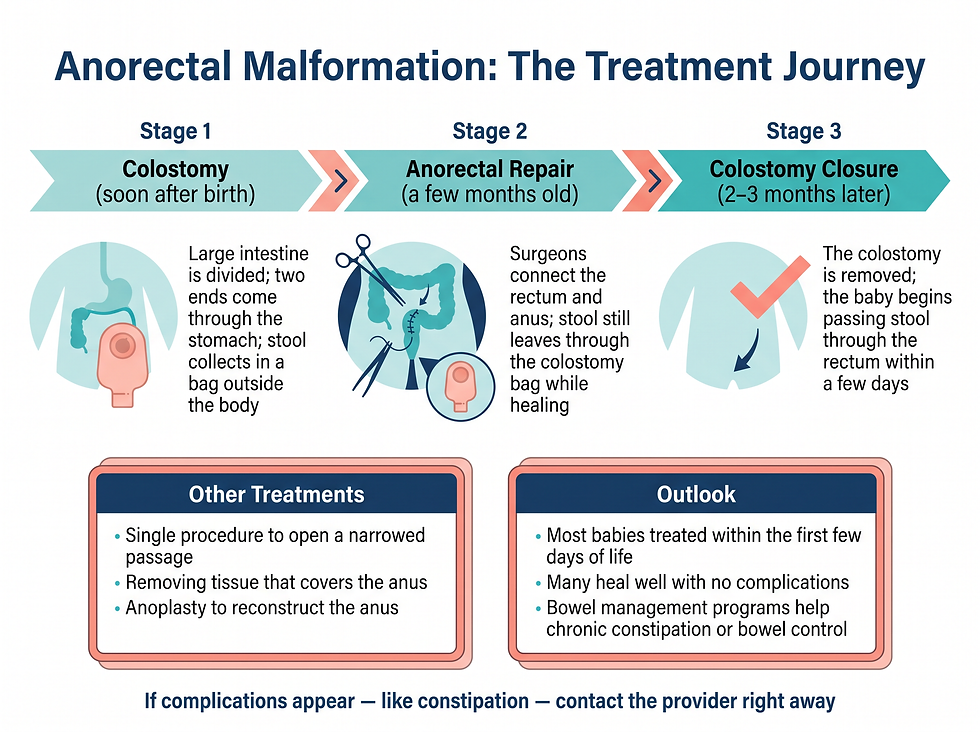
For some babies, a single procedure is enough: the surgeon may open a narrowed passageway, remove the tissue covering the child's anus, or perform an anoplasty to reconstruct the anus.
Imperforate Anus: A Three-Stage Process
If a baby has an imperforate anus, surgeons perform a series of procedures to join the rectum and anus:
Stage | When | What happens |
Colostomy | Soon after birth | The surgeon divides the large intestine and brings the two ends through openings in the baby's stomach; babies wear collection bags outside their body where stool and mucus pass through |
Anorectal repair | A few months old | Surgeons connect the rectum and anus; stool continues to leave the body through the colostomy bag while the baby heals |
Colostomy closure | About 2–3 months after the second surgery | The colostomy bags are removed; children begin passing stool through their rectum within a few days |
Are There Complications of Treatment?
Children who had surgery to repair an anorectal malformation may have more difficulty with toilet training than other children. Some have difficulty controlling their bowel movements or experience long-term (chronic) constipation.
Adults who had anorectal malformation surgery as babies may also experience sexual dysfunction later in life.
What Is the Outlook for Anorectal Malformations?
Most babies born with anorectal malformations are treated within the first few days of life. Many children heal well from surgery and have no complications.
Some children have long-term constipation or difficulty controlling their bowels after surgery. Specialized treatment — like a bowel management program — can help.
Scenario | Expected outcome |
Typical course | Treated within the first few days; many heal well with no complications |
Some children | Long-term constipation or difficulty controlling bowels; bowel management programs can help |
Without treatment | Intestinal blockages make passing stool difficult or impossible |
Can an Anorectal Malformation Be Prevented?
There is no way to prevent a child from being born with an anorectal malformation. However, parents can help their child live a high quality of life after treatment.
If a child experiences complications of treatment, such as constipation, they should see their provider right away. The provider may prescribe laxatives, dietary changes, or other treatments to relieve symptoms, and may recommend a bowel management program if the child has trouble controlling bowel movements.
When Should You Call Your Child's Healthcare Provider?
Contact your child's healthcare provider right away if your baby shows any of the following:
Warning sign | Why it matters |
Doesn't pass any stool | May signal intestinal blockage |
Has constipation | A common complication needing treatment |
Passes stool from the vagina | Indicates a fistula-type connection |
Passes stool in their urine | Indicates an abnormal rectal connection |
Passes urine from the anus | Indicates an abnormal connection |
When you do see a provider, useful questions to ask include: What tests do you use to diagnose an anorectal malformation? Does my child need surgery? What are the signs of complications after surgery? How can I help prevent constipation in my baby? And how do I know if my child needs a bowel management program?
Conclusion
An anorectal malformation means a baby is born with an anus or rectum that did not develop properly before birth. For any parent, hearing that their newborn has a congenital condition is frightening — but the medical picture is genuinely reassuring. Surgery within a few days of birth usually treats the problem, the exact procedure depends on the type and extent of the malformation, and most babies heal well after treatment.
The condition is rare — about 1 in 5,000 U.S. births — and it cannot be prevented. What parents can control is vigilance: noticing warning signs early and keeping up with follow-up care, including bowel management support when constipation or bowel control challenges persist.
Take action today: If your newborn does not pass stool, has constipation, passes stool from the vagina or in their urine, or passes urine from the anus, contact a healthcare provider immediately. If your child has already had repair surgery, ask your provider about bowel management programs and ways to prevent constipation as your child grows.
Frequently Asked Questions
What is an anorectal malformation?
An anorectal malformation is a congenital condition in which the rectum and anus do not form properly before birth. The anus may be narrowed, missing, blocked by a layer of tissue, or irregularly connected to other parts of the body.
How common is an anorectal malformation?
Anorectal malformations are rare, occurring in about 1 in 5,000 babies born in the United States. They are more common in boys than girls.
What are the types of anorectal malformation?
The main types are cloaca (urinary tract and rectum share a single opening), fistulas (the rectum connects to the urethra, bladder, vagina, or perineum through an irregular passage), and imperforate anus (the rectum and anus are not connected).
What causes an anorectal malformation?
The exact cause is unknown. Some experts believe gene changes (mutations) that develop before birth may play a role.
How is it treated?
Treatment is usually surgery. Simple cases may need a single procedure to open a narrowed passage or reconstruct the anus. Imperforate anus typically requires a three-stage process: colostomy soon after birth, anorectal repair at a few months old, and colostomy closure two to three months later.
What is the outlook after surgery?
Most babies are treated within the first few days of life and many heal well with no complications. Some children experience long-term constipation or bowel control difficulties, which bowel management programs can help address.
Can an anorectal malformation be prevented?
No. There is no way to prevent a child from being born with an anorectal malformation.
Will my child have the same risk for my next child?
Parents who have already had one child with an anorectal malformation have about a 1 in 100 chance of having another child with the condition.
References
Levitt MA, Pena A. Anorectal malformations. Orphanet J Rare Dis. 2:33 (2007). ojrd.biomedcentral.com
National Institute of Diabetes and Digestive and Kidney Diseases (NIDDK). Anorectal Malformations (Imperforate Anus). niddk.nih.gov
Medical Disclaimer: This article is for general informational purposes only and is not a substitute for professional medical advice, diagnosis, or treatment. Always seek the advice of a qualified pediatric surgeon or healthcare provider with any questions you may have about a medical condition. If your baby does not pass stool or shows signs of intestinal blockage, seek medical care immediately.
Comments