Annular Pancreas: Symptoms, Causes, Diagnosis, and Treatment Explained

Updated: 2 days ago
Medically reviewed by Dr. Baraa Alnahhal, MD · Last reviewed: September 2026
Editorial note: This article is for general education only and is not a substitute for professional medical care. If a newborn shows green or yellow vomit, feeding difficulties, or a bloated belly, seek urgent medical evaluation — bilious (bile-stained) vomiting in an infant can signal intestinal blockage and is always treated as urgent [1]. This article describes a congenital (present-at-birth) condition; nothing in it suggests parents did anything wrong, because this condition forms before birth for reasons doctors cannot prevent.
TL;DR
Annular pancreas is a rare birth condition where a ring of pancreatic tissue wraps around the first part of the small intestine (the duodenum), squeezing it and blocking food. It affects about 1 in 20,000 newborns. Babies may vomit bile or struggle to feed; adults often stay symptom-free until their 30s–60s, when pain, nausea, and fullness appear. Surgery that bypasses the blockage — rather than cutting the ring itself — is the standard treatment, and outlook after surgery is good for most babies [1] [2].
Quick Answer
Annular pancreas is a congenital anomaly in which a band of pancreatic tissue encircles the duodenum (the first section of the small intestine), narrowing or blocking the passage of food from the stomach. It occurs in roughly 1 in 20,000 births — about 3.4 per 100,000 people in the largest U.S. imaging study — and explains around 30% of congenital duodenal obstructions in newborns. It forms during fetal development when the pancreatic buds fail to rotate and fuse normally, and it is not caused by anything a parent did. Infants typically present with bile-stained (green or yellow) vomit, feeding difficulty, and a bloated belly, while adults often stay symptom-free for decades and may only notice upper abdominal pain, early fullness, nausea, or vomiting in their 30s to 60s. The standard treatment is bypass surgery (duodenoduodenostomy, duodenojejunostomy, or gastrojejunostomy), which routes food around the narrowed segment, and the outlook is good for babies who receive surgery.
What Exactly Is Annular Pancreas?
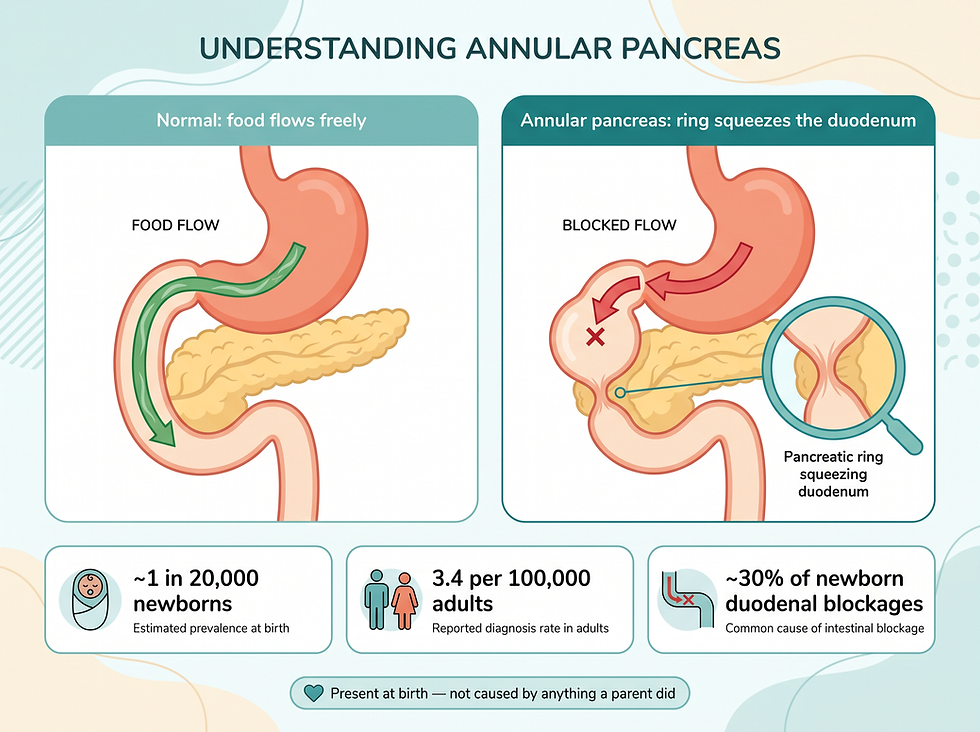
The pancreas is a gland behind the stomach that releases digestive enzymes and insulin. The duodenum is the C-shaped first section of the small intestine that receives food from the stomach. In annular pancreas, a ring or collar of pancreatic tissue wraps around the duodenum and squeezes it, making the passage so narrow that food and fluid cannot move through normally [1].
"Annular" is simply the medical word for ring-shaped. The affected tissue is normal, healthy pancreatic tissue — the problem is where it sits, not what it is made of.
Term | Plain-Language Meaning |
Annular pancreas | A ring of pancreas tissue squeezing the duodenum |
Duodenum | First part of the small intestine, receiving food from the stomach |
Congenital | Present from birth, formed during fetal development |
Duodenal obstruction | A blockage that stops food passing through the duodenum |
Bilious vomiting | Vomit containing bile — green or yellow; urgent in infants |
Polyhydramnios | Excess amniotic fluid in pregnancy, a possible prenatal clue |
Annular pancreas is rare. The largest U.S. population study — covering more than 6 million adults who had abdominal imaging between 2015 and 2020 — found it in about 3.4 per 100,000 people, or roughly 3 in 100,000 [2]. In newborns, it occurs in about 1 in 20,000 births [3]. Older autopsy studies found it in about 3 of every 20,000 autopsies, and in adults it is often discovered by accident during imaging done for other reasons [4].
Who Gets Annular Pancreas?
Annular pancreas forms during fetal development, so everyone who has it is born with it. It shows up in two distinct age windows, giving it a "bimodal" pattern: either in the first days of life, or in adulthood [4].
Group | Typical Timing | Why |
Newborns | First days of life | Tight ring blocks the duodenum completely |
Children | Occasionally | Partial blockage becomes apparent as feeding grows |
Adults | Usually 20s–60s, often 30s–60s | Partial ring slowly causes symptoms over decades |
Adults found incidentally | Any age | Imaging done for unrelated reasons |
The ring itself comes in two forms. About 25% of cases form a complete ring fully encircling the duodenum; about 75% form a partial ring [5]. In roughly 85% of diagnosed cases, the band sits above the papilla of Vater, the spot where pancreatic and bile ducts empty into the intestine [4].
What Causes Annular Pancreas?
Annular pancreas happens while the pancreas is forming in the womb, during weeks 4 to 8 of pregnancy. Normally, the pancreas develops from two buds — a ventral (front) bud and a dorsal (back) bud. The ventral bud is supposed to rotate around the duodenum and fuse with the dorsal bud to form one organ [4] [6].
In annular pancreas, that rotation goes wrong. The leading theories are that either the left part of the ventral bud fails to disappear and the right part fails to rotate, or that the ventral bud stretches and wraps around the duodenum instead of fusing normally [4] [6]. Researchers have confirmed through tissue studies that the ring tissue comes from the ventral bud. The exact cause is unknown, and no genetic test exists — but this is a random developmental event, not anything a parent caused [1].
Annular pancreas shows up more often alongside certain other birth conditions:
Associated Condition | Connection |
Duodenal atresia | A completely closed duodenum; frequently co-occurs |
Down syndrome (trisomy 21) | Most common chromosomal association |
Esophageal atresia | Blocked food pipe |
Heart abnormalities | Congenital heart defects |
Anorectal malformations | e.g., imperforate anus |
Pancreas divisum | Pancreatic ducts fail to fuse |
Meckel's diverticulum | Small intestinal outpouching |
Malrotation | Intestines rotate abnormally |
In the largest U.S. imaging study, adults with annular pancreas were also more likely to have a history of acute or chronic pancreatitis, gastritis, jaundice, and gastrointestinal outlet obstruction [2]. One meta-analysis found duodenal atresia (8.4%) and cardiovascular anomalies (8.7%) among the more common comorbidities [7].
What Are the Symptoms?
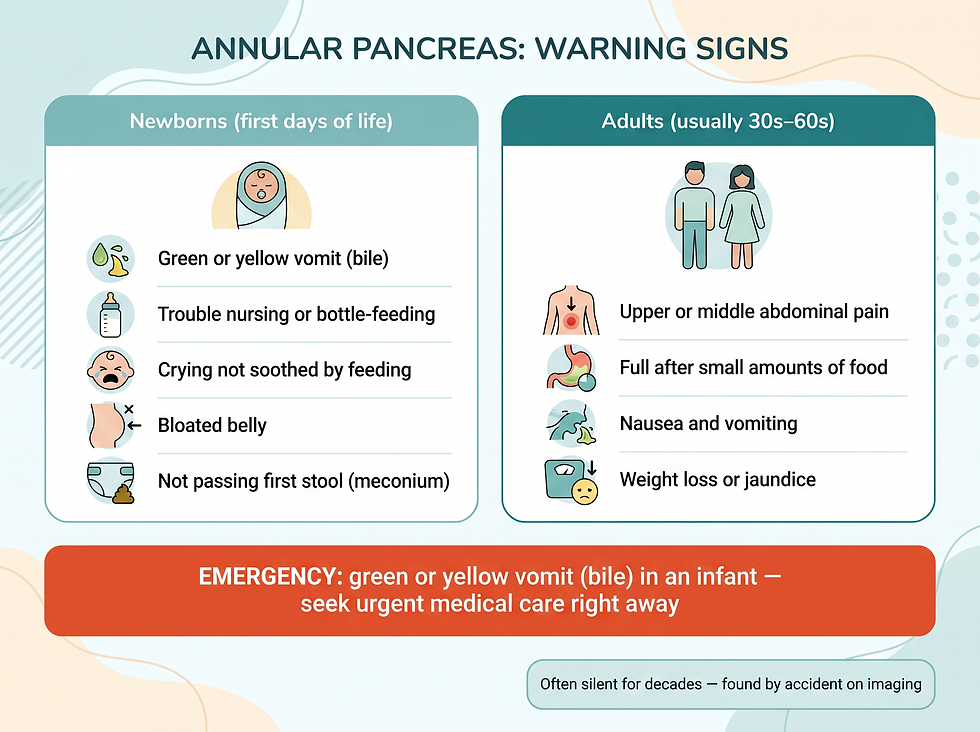
Symptoms differ sharply between newborns and adults. In babies, the ring often blocks the duodenum fully, so food cannot pass at all. In adults, the ring is usually partial, and symptoms may not appear for decades [1] [4].
Symptoms in Newborns
Symptom | What It Looks Like |
Bile in vomit | Green or yellow vomit — always urgent in infants |
Feeding difficulty | Trouble nursing or taking a bottle |
Crying not soothed by feeding | Baby remains distressed after feeds |
Bloated belly | Abdominal swelling after attempted feeds |
Not passing meconium | No first stool in the expected timeframe |
Symptoms in Adults
Symptom | Description |
Abdominal pain or cramps | Upper and middle abdomen |
Early fullness | Feeling full after eating only small amounts |
Nausea and vomiting | Often after meals |
Weight loss | From difficulty keeping food down |
Jaundice | Yellowing skin/eyes if bile ducts are compressed |
Why does this matter beyond discomfort? Without treatment, the persistent blockage can lead to complications including pancreatitis (pancreas inflammation), peptic ulcer disease, bile duct obstruction, jaundice, liver disease, and — rarely — pancreatic cancer [1]. Pancreatitis in annular pancreas usually stays confined to the ring area and the nearby head of the pancreas, because scarring prevents pancreatic juices from draining properly [4].
How Is Annular Pancreas Diagnosed?
There is no blood test or genetic test for annular pancreas. Diagnosis is made with imaging, and the tests used depend on age [4].
Age / Stage | Diagnostic Approach |
Pregnancy (prenatal) | Ultrasound may detect polyhydramnios (excess amniotic fluid), a clue the fetus's duodenum is blocked |
Newborns | Abdominal X-ray may show the classic "double bubble" sign — a dilated stomach plus dilated duodenum — though this sign is not perfectly specific |
Adults | Endoscopic ultrasound (EUS), ERCP (endoscopic retrograde cholangiopancreatography), or MRCP (MRI of the bile and pancreatic ducts) |
Any age | CT scan showing tissue encircling the duodenum |
Clinicians may run additional tests to rule out other conditions that cause the same symptoms, such as other causes of intestinal blockage or pancreatitis [1]. In adults, MRCP is considered particularly useful because it visualizes the abnormal duct pathways without invasive procedures [5].
Is There Treatment for Annular Pancreas?
Treatment depends on the situation. Adults with no symptoms may not need any treatment at all unless complications such as pancreatitis develop. When symptoms or complications appear, the standard approach is surgery [1].
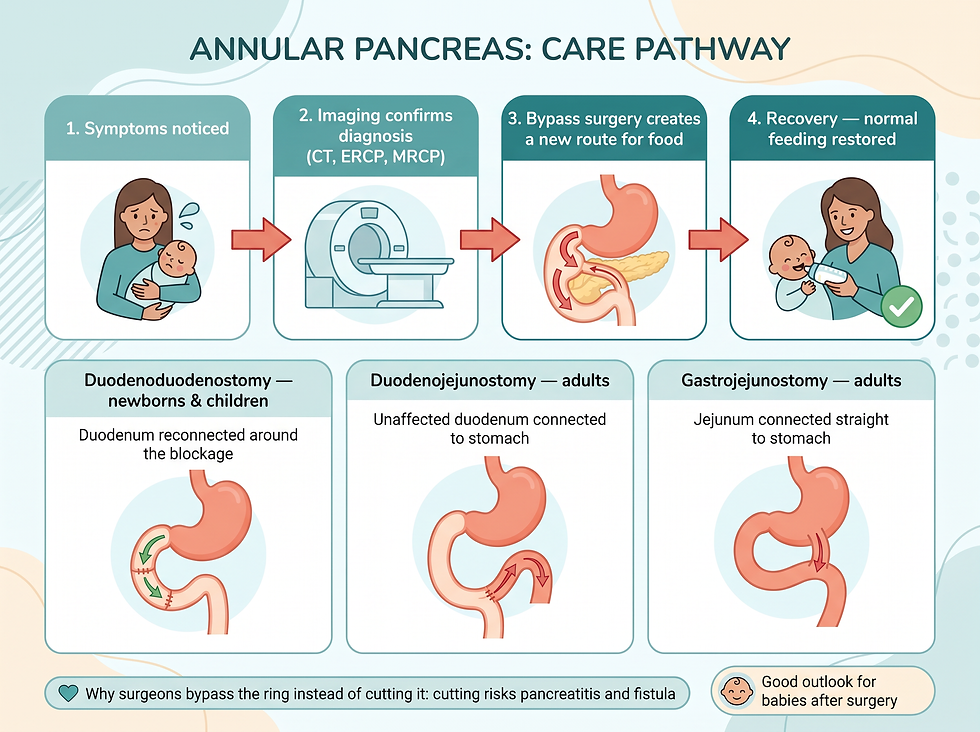
Importantly, surgery does not cut away the ring of pancreatic tissue. Cutting through pancreatic tissue can damage the ducts and trigger pancreatitis, pancreatic fistula, or a repeat blockage. Instead, surgeons create a new route for food that bypasses the narrowed segment entirely [5].
Surgery | How It Works | Typical Use |
Duodenoduodenostomy | The duodenum is divided around the blockage and reconnected so food bypasses the affected segment | Routine in newborns and children |
Duodenojejunostomy | An unaffected section of duodenum is connected to the stomach | Adults (duodenum is less mobile) |
Gastrojejunostomy | The jejunum (middle small intestine) is connected directly to the stomach, skipping the duodenum entirely | Adults, often with vagotomy to prevent ulcers |
What Is the Outlook?
The outlook is good for babies who have surgery. Surgery restores normal feeding and growth in most cases [1].
For adults, the outlook depends on which complications have already developed — the condition itself is fixed with bypass surgery, but damage such as chronic pancreatitis or liver disease may require ongoing management [1]. After bypass surgery, many adults report full symptom relief, and because the ring is left in place rather than removed, the risk of postoperative pancreatic complications is lower than with older "cut the ring" techniques [5].
There is no way to prevent annular pancreas. It forms during fetal development for reasons medical science does not fully understand, and nothing a parent does or does not do causes it [1].
Key Takeaways
Annular pancreas is a rare congenital condition in which a ring of pancreatic tissue squeezes the duodenum and blocks food. It affects about 1 in 20,000 newborns and is found in roughly 3.4 per 100,000 adults who undergo abdominal imaging. Bile-stained vomit in a newborn is always an emergency signal. Adults may carry the condition silently for decades. Bypass surgery — never cutting the ring — is the standard treatment, and babies who receive surgery generally have a good outlook.
If you or your baby shows signs of this condition, talk to a healthcare provider. Surgery can restore normal digestion — and for infants with green or yellow vomit, care should be sought right away.
Frequently Asked Questions
1. What is annular pancreas in simple terms?
Annular pancreas means a ring of pancreatic tissue wraps around the first part of the small intestine (the duodenum) and squeezes it, so food has trouble passing from the stomach. It is present at birth and is not cancer [1].
2. Is annular pancreas serious in babies?
It can be. A complete blockage causes bilious (green or yellow) vomiting, feeding failure, and can cause a newborn to lose weight and become dehydrated quickly. Bilious vomiting in an infant is always treated as an urgent medical situation, and surgery to bypass the blockage is standard and usually successful [1] [3].
3. Can adults have annular pancreas?
Yes. Many adults carry a partial ring silently for decades and learn they have it only when imaging for another issue reveals it. When it does cause symptoms — usually in the 30s to 60s — it produces upper abdominal pain, early fullness, nausea, and vomiting [1] [2].
4. What causes annular pancreas — is it the parents' fault?
No. It forms during weeks 4–8 of fetal development when the pancreatic buds fail to rotate and fuse normally. The exact reason is unknown, and nothing a parent did or ate caused it [1] [4] [6].
5. How common is annular pancreas?
It is rare: about 1 in 20,000 newborns, and about 3.4 per 100,000 adults in the largest U.S. imaging study. It accounts for roughly 30% of congenital duodenal obstructions in newborns [2] [3] [4].
6. How is annular pancreas diagnosed?
Through imaging, not blood tests. Prenatal ultrasound may spot excess amniotic fluid; newborns may show a "double bubble" sign on X-ray; adults are typically diagnosed with CT, endoscopic ultrasound, ERCP, or MRCP [1] [4].
7. What surgery treats annular pancreas?
Bypass surgery: duodenoduodenostomy (reconnecting the duodenum around the blockage, common in babies), duodenojejunostomy, or gastrojejunostomy (connecting small intestine directly to the stomach, common in adults). Surgeons avoid cutting the ring itself to protect the pancreatic ducts [1] [5].
8. Can annular pancreas be prevented?
No. It develops before birth for reasons doctors cannot yet prevent. The best response is prompt recognition — urgent care for bilious vomiting in infants, and evaluation of persistent upper abdominal symptoms in adults [1].
References
Annular Pancreas — Cleveland Clinic, medically reviewed, last updated 07/02/2025. https://my.clevelandclinic.org/health/diseases/annular-pancreas
The Epidemiology of Annular Pancreas in the United States: A Population-based Study — Alkhayyat M, et al. J Clin Gastroenterol. 2022. https://pubmed.ncbi.nlm.nih.gov/33769394/
Annular pancreas in neonates; Case series and review of literatures — Ali Almoamin HH, et al. Afr J Paediatr Surg. 2022. https://pubmed.ncbi.nlm.nih.gov/35017379/
Annular Pancreas — StatPearls (NCBI Bookshelf, NIH), updated November 23, 2025. https://www.ncbi.nlm.nih.gov/books/NBK559236/
Laparoscopic treatment of annular pancreas in adults: report of a case — Noh TH, et al. Korean J Hepatobiliary Pancreat Surg. 2012. https://pmc.ncbi.nlm.nih.gov/articles/PMC4575014/
Development and Congenital Anomalies of the Pancreas — Tadokoro H, et al. Anat Res Int. 2011. https://pmc.ncbi.nlm.nih.gov/articles/PMC3335650/
Exploring the clinical characteristics and prevalence of annular pancreas: a meta-analysis — Plutecki D, et al. HPB. 2024. https://www.hpbonline.org/article/S1365-182X(24)00006-6/pdf
Adult-Onset Annular Pancreas: When to Intervene? — Ali IM, et al. Cureus. 2024. https://pubmed.ncbi.nlm.nih.gov/39318953/
Annular pancreas: Beneath the intestinal obstruction—A case report — Ahmetgjekaj I, et al. Radiol Case Rep. 2023. https://pmc.ncbi.nlm.nih.gov/articles/PMC9898573/
Congenital Duodenal Obstruction: Atresia, Stenosis, and Related Conditions — Alshehri A. IntechOpen. 2024. https://www.intechopen.com/chapters/86818
Comments