Anisocytosis Causes, Symptoms, Diagnosis, and Treatment — A Complete Guide

Updated: 2 days ago
Medically reviewed by Dr. Baraa Alnahhal, MD · Last reviewed: September 2026
Editorial note: This article is for general education only and is not a substitute for professional medical advice. If your blood test shows unusual results or you feel unwell, talk to a licensed healthcare provider. Never start, stop, or change medications or supplements without your provider's guidance.
TL;DR
Anisocytosis means your red blood cells come in mixed sizes instead of the usual uniform size. It is a lab finding, not a disease — most often it signals anemia, which is usually treatable. The RDW (red blood cell distribution width) number on a routine complete blood count flags it. Treatment targets the underlying cause, such as iron, folate, or vitamin B12 deficiency.
Quick Answer
What does anisocytosis mean? Anisocytosis describes red blood cells that vary in size, shown by a high RDW (above roughly 12–15%) on a routine blood count. It is a description, not a diagnosis — often linked to anemia, which is commonly caused by iron, folate, or B12 deficiency. Symptoms mirror anemia (fatigue, shortness of breath, pale skin), and treatment depends on the cause, with many causes fully reversible.
What Exactly Is Anisocytosis?
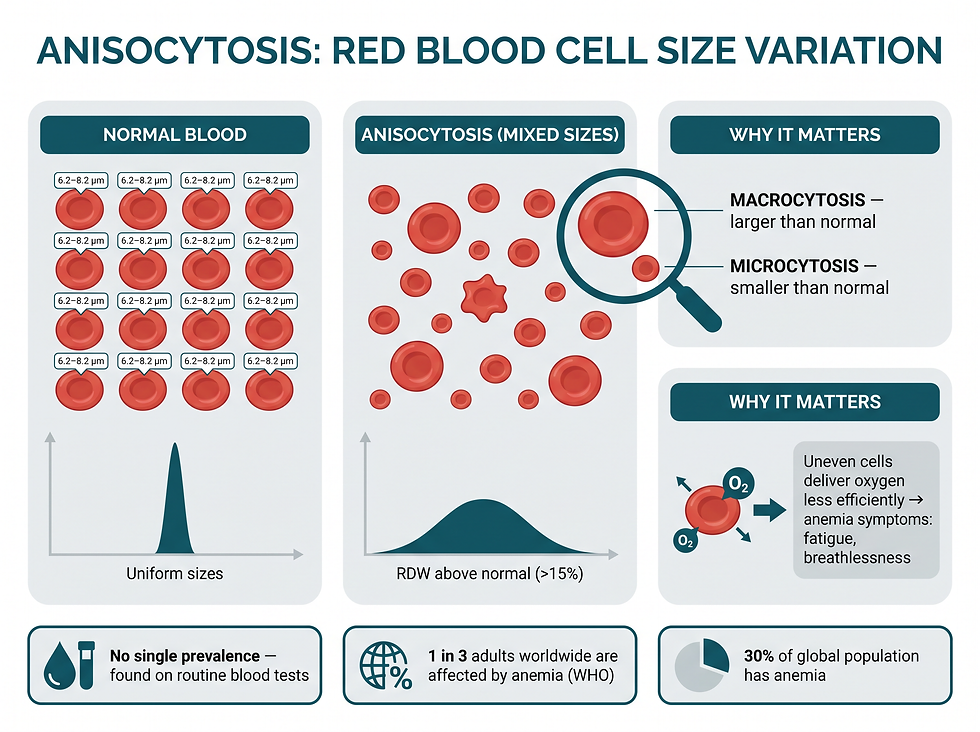
Anisocytosis (pronounced "a-nuh-soe-sai-TOW-suhs") is the medical word for red blood cells of unequal sizes [1].
The word breaks down easily. Aniso means unequal. Cytosis refers to cells — here, red blood cells. Healthy red blood cells are normally uniform, shaped like rounded discs and roughly 6.2 to 8.2 micrometers across [1] [2]. That consistency matters: uniform, flexible cells slip through the body's tiniest capillaries and deliver oxygen efficiently.
When cell sizes scatter, the mix can carry oxygen less effectively. That shortfall shows up as anemia, with symptoms like fatigue and breathlessness [1].
It helps to remember two things right away. First, anisocytosis is a description, not a diagnosis. Second, it may or may not point to a condition needing treatment [1].
Related Terms You May See on Your Report
Term | Meaning |
Anisocytosis | Red blood cells of unequal sizes |
Poikilocytosis | Red blood cells of irregular shapes |
Macrocytosis | Red blood cells larger than normal |
Microcytosis | Red blood cells smaller than normal |
A person can have a mix — some cells larger than normal, some smaller [1].
How Common Is It?
There is no single population prevalence, because anisocytosis is a lab finding rather than a disease you can catch or prevent. It appears whenever a complete blood count (CBC) is run, and an elevated RDW shows up in a large share of people with anemia. The World Health Organization estimates that anemia affects roughly 30% of people worldwide, with iron deficiency responsible for about half of those cases — the most common driver of varied red cell sizes [3] [4].
What Are the Symptoms of Anisocytosis?
Anisocytosis itself has no unique symptoms. You typically feel the symptoms of the underlying anemia, if the size variation is significant enough to affect oxygen delivery [1].
Symptom | What It Feels Like |
Weakness or fatigue | Unusual tiredness, low energy |
Shortness of breath (dyspnea) | Feeling winded doing everyday tasks |
Fast or irregular heartbeat (arrhythmia) | Racing or irregular pulse |
Pulsatile tinnitus | A "whooshing" sound in one ear |
Headache | Recurrent or pressure-type |
Dizziness | Lightheadedness, unsteadiness |
Pale skin | Loss of normal color in skin or nail beds |
Chest pain | Pressure or tightness — always evaluate urgently |
Chest pain always deserves prompt medical evaluation. While anemia can cause it, it can also signal a cardiac emergency [1].
Why Size Variation Causes These Symptoms
Red blood cells are the body's oxygen couriers. Every organ runs on the energy oxygen releases inside cells. A mixed-size population — many cells too small, too large, or misshapen to flow smoothly — moves less oxygen per pass [1] [5]. Organs compensate by asking the heart to pump harder and faster, which produces the palpitations and breathlessness above.
What Causes Anisocytosis?
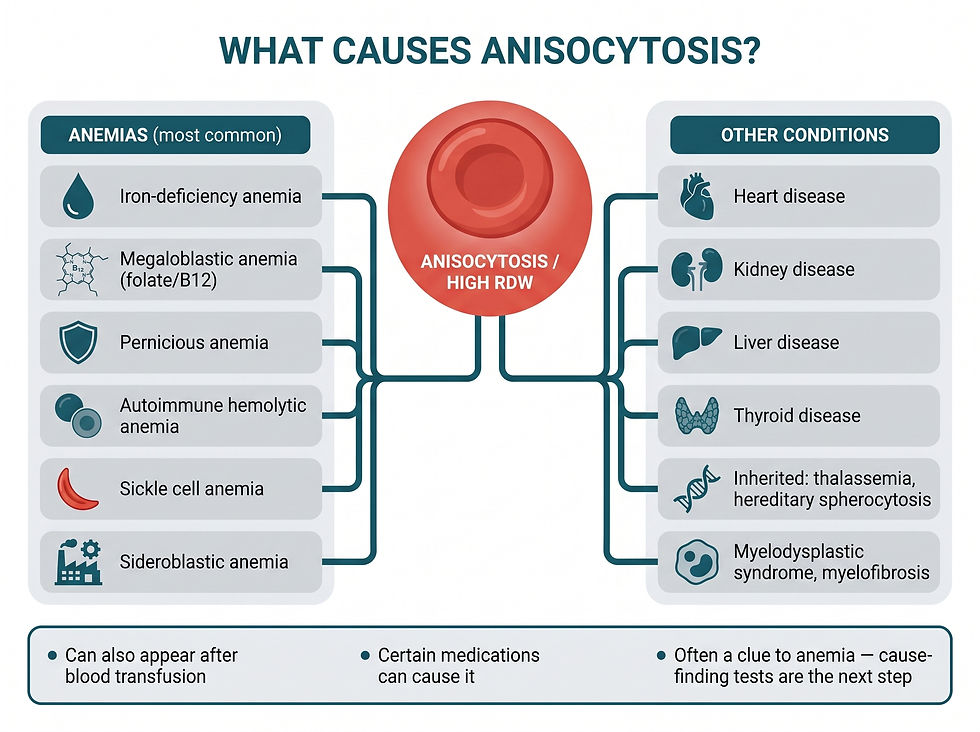
Anisocytosis is most often a sign of anemia — and different anemias have different causes. It can also flag conditions that may not involve anemia at all [1].
Anemias Associated with Anisocytosis
Associated Anemia | Typical Driver |
Iron-deficiency anemia | Low iron; often produces small cells |
Megaloblastic anemia | Folate or B12 shortage; produces large cells |
Pernicious anemia | B12 not absorbed (autoimmune cause) |
Autoimmune hemolytic anemia | Immune system destroys red cells |
Sickle cell anemia | Inherited abnormal hemoglobin |
Sideroblastic anemia | Bone marrow can't use iron properly |
Anemia during pregnancy is common and can show up as anisocytosis on routine bloodwork. Supporting both your body and a growing fetus raises iron demand, and your pregnancy provider can adjust diet or supplements [1].
Other Conditions Associated with Anisocytosis
Varied red cell sizes can also surface alongside colon cancer, heart disease, hereditary spherocytosis, kidney disease, liver disease, myelodysplastic syndrome, myelofibrosis, thyroid disease, and thalassemia [1]. Anisocytosis may appear after a blood transfusion, and certain medications can cause it as well [1].
What the RDW Number Tells You
The RDW (red blood cell distribution width) is the CBC value that quantifies size variation. A normal RDW sits around 12% to 15%, though reference ranges vary slightly by lab [1] [2]. Research also cites a normal band of roughly 11.5%–14.5% depending on the laboratory method, and lab-specific ranges such as 11.8%–14.5% for adult males and 12.2%–16.1% for adult females [5] [6]. A number above the normal band signals more size variation than expected. A low RDW is not linked to any known condition [2].
How Is Anisocytosis Diagnosed?
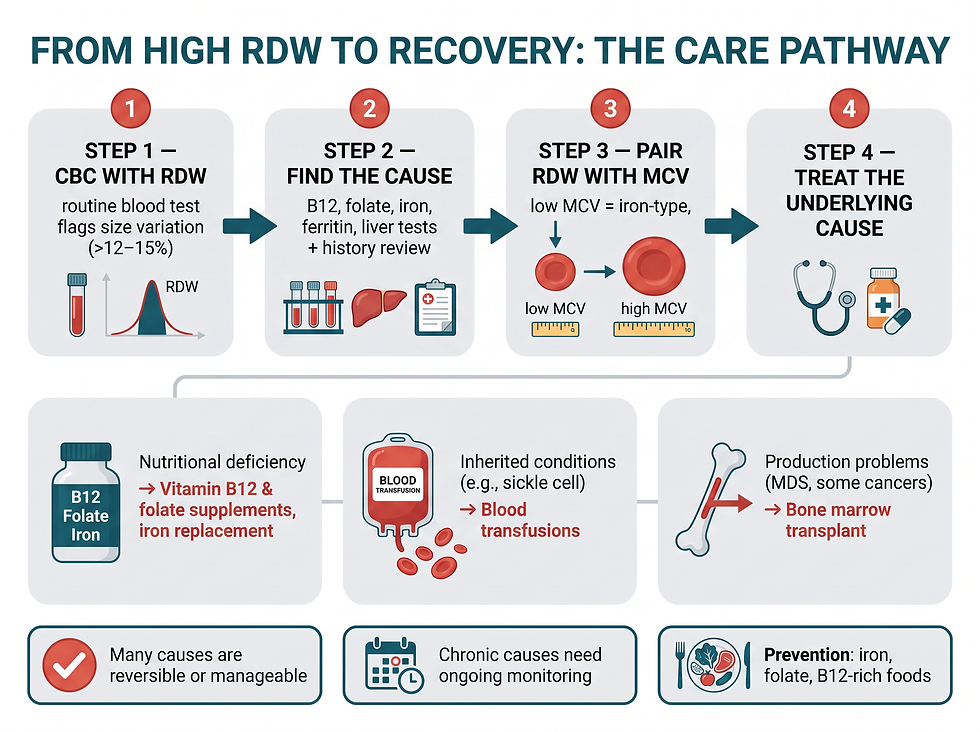
Two tests identify anisocytosis. They are often used together [1].
The Two Identification Tests
Test | How It Works |
Complete blood count (CBC) with RDW | Automated test; RDW flags how much cell sizes vary |
Peripheral blood smear (PBS) | Lab technologist views a blood smear under a microscope to see size variation directly |
Finding the Root Cause
Because anisocytosis is a clue rather than a conclusion, your provider will dig deeper [1]. They will review your symptoms, medical history, prescriptions, supplements, and diet. Typical follow-up checks include vitamin B12 and folate levels, iron levels, ferritin (the protein that stores iron), and liver function. Other tests follow as needed [1].
Putting RDW and MCV Together
Providers pair the RDW with the MCV (mean corpuscular volume), the average cell size. The combination narrows the cause [2] [6].
RDW | MCV | Typical Pattern |
High | Low | Microcytic anemia, often iron deficiency |
High | High | Macrocytic anemia, often folate/B12 deficiency |
High | Normal | Early mixed deficiency or hemolysis |
Normal | Low | Chronic-disease anemia or thalassemia trait |
Normal | High | Aplastic anemia or chronic liver disease |
What Are the Complications?
Untreated, some underlying conditions behind anisocytosis can cause harm. Some forms of anemia can lead to organ damage over time. In children, untreated anemia can contribute to developmental delays [1].
During pregnancy, mild anemia is common, but more severe anemia can lead to complications such as preterm labor without treatment [1].
The good news: once a provider identifies the cause of the size variation, they can prescribe treatments aimed at preventing these complications [1].
Is There Treatment for Anisocytosis?
Yes — but treatment targets the cause, not the cell-size finding itself [1].
Treatment Options by Cause
Cause | Typical Treatment |
Nutritional deficiency (iron, folate, B12) | Vitamin B12 and folate supplements; iron replacement |
Inherited conditions like sickle cell disease | Blood transfusions |
Red blood cell production problems (myelodysplastic syndromes, some cancers) | Bone marrow transplant |
Many causes are reversible or manageable with treatment. Conditions like cancer or sickle cell disease need careful ongoing monitoring instead [1].
The Prognosis Connection
Several studies show that elevated RDW can predict a worse outlook in certain conditions, including COVID-19, heart disease, kidney disease, liver disease, and stroke [1]. In a large diabetes cohort study, patients in the highest RDW quartile faced roughly 2.4 times the all-cause mortality risk of those in the lowest quartile after adjusting for 17 factors [7]. Researchers estimate each 1% rise in RDW increases mortality risk by about 14% [8]. These are association findings — an elevated RDW flags illness severity; more research is needed to understand the exact relationship [1].
Can Anisocytosis Be Prevented?
Not all causes are preventable — inherited and autoimmune causes certainly are not. But you can lower the risk of the nutritional causes [1].
The Three Key Nutrients
Nutrient | Common Food Sources |
Vitamin B12 | Dairy products, meats, fortified cereals |
Folate | Fruits, vegetables, nuts, seeds, fortified cereals |
Iron | Meats, beans, vegetables, fortified breads and cereals |
What's the Outlook?
Most often, reassuring. As the Cleveland Clinic's patient note puts it:
"Anisocytosis may sound like a serious diagnosis, but it's just a word that describes size variation in your red blood cells. Don't be concerned if you learn from your blood test results that you have anisocytosis. There are many reasons why red blood cell sizes may vary." [1]
Many causes are reversible or manageable with treatment. Chronic or serious underlying conditions need ongoing care instead [1].
Key Takeaways
Anisocytosis is a descriptive lab finding — unequal red blood cell sizes — flagged by an elevated RDW on a routine blood count. It most often points to anemia, frequently from iron, folate, or B12 deficiency. Symptoms are those of anemia: fatigue, breathlessness, palpitations, pale skin. Two simple tests confirm it, and treatment fixes the underlying cause — with many causes fully reversible. If your RDW came back high, don't panic; do follow up, because the number is a clue worth reading.
Talk to your healthcare provider about any anemia symptoms or abnormal blood results. Annual checkups with routine bloodwork remain one of the cheapest, most effective ways to catch treatable causes early.
Frequently Asked Questions
1. What does it mean if my blood test shows anisocytosis?
It means your red blood cells vary in size more than normal, usually flagged by a high RDW on your complete blood count. It is a description, not a disease — most often it points to anemia, which is usually treatable.
2. Is anisocytosis dangerous?
Not by itself. The significance depends on the cause. Nutritional anemias are very treatable. Rarely, it signals a more serious condition, which is exactly why follow-up testing matters.
3. What is a normal RDW range?
Most labs consider roughly 12% to 15% normal, though ranges vary slightly between laboratories. Your report always includes your lab's own reference range [1] [2].
4. Can anisocytosis go away on its own?
If the cause is a correctable nutritional deficiency, treating it typically resolves the finding. Causes like inherited conditions or chronic illness need ongoing management rather than a simple fix.
5. What is the most common cause of anisocytosis?
Iron-deficiency anemia is the most common driver worldwide. Folate and vitamin B12 deficiencies are also frequent causes [1] [3].
6. Can anisocytosis cause cancer?
No. Anisocytosis cannot cause cancer. In some cases, cancer can cause anisocytosis — the finding can be a clue, never the culprit.
7. Should I be worried about a high RDW?
A single high RDW is a signal to follow up, not a reason to panic. Many benign, reversible causes sit behind it. See your provider to pair the RDW with other values and find the cause.
8. What foods help fix anisocytosis?
If your cause is nutritional, foods rich in iron (meats, beans, fortified cereals), folate (leafy greens, fruits, nuts), and vitamin B12 (dairy, meats, fortified cereals) support healthy red blood cell production — always alongside your provider's plan [1].
References
Anisocytosis: Causes, Meaning & Treatment — Medically reviewed, last updated 05/15/2023. https://my.clevelandclinic.org/health/diseases/24997-anisocytosis
RDW Blood Test: What It Is, Procedure & Results — Medically reviewed, last updated 04/07/2026. https://my.clevelandclinic.org/health/diagnostics/22980-rdw-blood-test
WHO Anaemia statistics — World Health Organization fact data on global anemia prevalence. https://www.who.int/news-room/fact-sheets/detail/anaemia
Iron deficiency anaemia — World Health Organization overview of iron deficiency as the leading cause of anemia. https://www.who.int/health-topics/anaemia
Red blood cell distribution width: biomarker for red cell dysfunction and critical illness outcome — Said AS, et al. Pediatr Crit Care Med. 2017. https://pmc.ncbi.nlm.nih.gov/articles/PMC5291765/
Red Cell Distribution Width (RDW) Test — Healthline, medically reviewed. https://www.healthline.com/health/rdw-blood-test
Red Cell Distribution Width Is Associated with All-Cause and Cardiovascular Mortality in Patients with Diabetes — Al-Kindi SG, et al. Biomed Res Int. 2017. https://pmc.ncbi.nlm.nih.gov/articles/PMC5735623/
Red cell distribution width as a bellwether of prognosis — Lichtman MA. Blood Cells Mol Dis. 2024. https://www.sciencedirect.com/science/article/abs/pii/S1079979624000627
Clinical and prognostic significance of anisocytosis measured as a red cell distribution width in patients with colorectal cancer — Kust D, et al. QJM. 2017. https://academic.oup.com/qjmed/article/110/6/361/2875722
Anisocytosis is associated with short-term mortality in COVID-19 — Hornick A, et al. Pathog Immun. 2020. https://pubmed.ncbi.nlm.nih.gov/33089037/
Comments