Angioid Streaks: Symptoms, Causes, and What They Mean for Your Eyes

Updated: 2 days ago
Medically reviewed by Dr. Baraa Alnahhal, MD · Last reviewed: September 2026
Angioid streaks are jagged, blood-vessel-like lines under the retina caused by tiny tears in Bruch's membrane, the thin lining of the choroid. They are usually present in both eyes, cause no symptoms for most people, and are typically discovered by chance during a routine eye exam. They often point to an underlying body-wide condition — providers remember the main risk factors with the acronym PEPSI, led by pseudoxanthoma elasticum. There is no treatment for the streaks themselves (monitoring is standard), but complications like choroidal neovascularization and subretinal hemorrhage — the two things that can actually damage vision — can be treated with laser, photodynamic therapy, or anti-VEGF injections.
Quick Answer
What they are: Jagged lines underneath the retina caused by splits in Bruch's membrane, the inside lining of the choroid between the retina and the sclera.
Symptoms: Typically none — a provider sees the blood-vessel-like streaks during an eye exam; the person usually has no symptoms.
Common associations: The "PEPSI" risk factors — pseudoxanthoma elasticum (most common), Ehlers-Danlos syndrome, Paget's disease of the bone, sickle cell disease, and idiopathic hemoglobin or collagen conditions — plus aging and eye injury.
Treatment: There is no treatment for angioid streaks themselves; providers monitor them and treat complications (new blood vessels or bleeding under the retina) with photocoagulation, PDT, or anti-VEGF injections.
What Are Angioid Streaks?
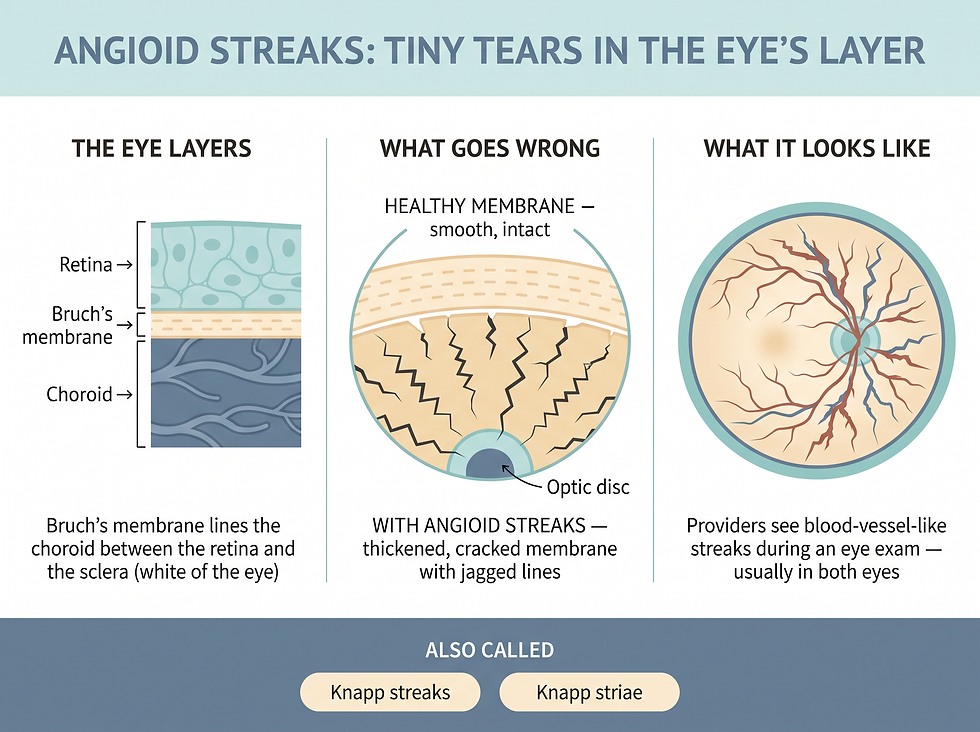
Angioid streaks are jagged lines underneath your retina. They don't usually cause symptoms, but your eye care specialist can see the blood-vessel-like streaks during an eye exam. People who get angioid streaks usually have them in both eyes.
You may also hear them called Knapp streaks or Knapp striae.
Key Fact | Detail |
Definition | Jagged lines underneath the retina caused by tears in Bruch's membrane |
Also called | Knapp streaks, Knapp striae |
Location | Under the retina, in the choroid layer of the eye |
Symptoms | Typically none; found on eye exam |
Laterality | Usually both eyes |
Danger level | Not dangerous by themselves |
How Do Angioid Streaks Form in the Eye?
Angioid streaks point outward from your optic disc — the last part of the optic nerve before your brain. They happen when there are tears in tissue called Bruch's membrane, the inside lining of your choroid between your retina and your sclera (the white of your eye). Your choroid contains vessels that allow blood and nutrients to flow through your eye.
In some people, the membrane can become thick and prone to cracking. In other cases, eye injuries cause the splits.
What Are the Symptoms of Angioid Streaks?
Angioid streaks typically don't cause symptoms. However, complications related to angioid streaks could cause vision loss.
This is the key distinction to understand: the streaks themselves are silent, but what can grow through them — new, unruly blood vessels, or bleeding under the retina — is what threatens vision.
What Causes Angioid Streaks?
Angioid streaks happen because of splits in Bruch's membrane. In some people, the membrane becomes thick and prone to cracking. In some cases, eye injuries cause them.
What Are the Risk Factors?
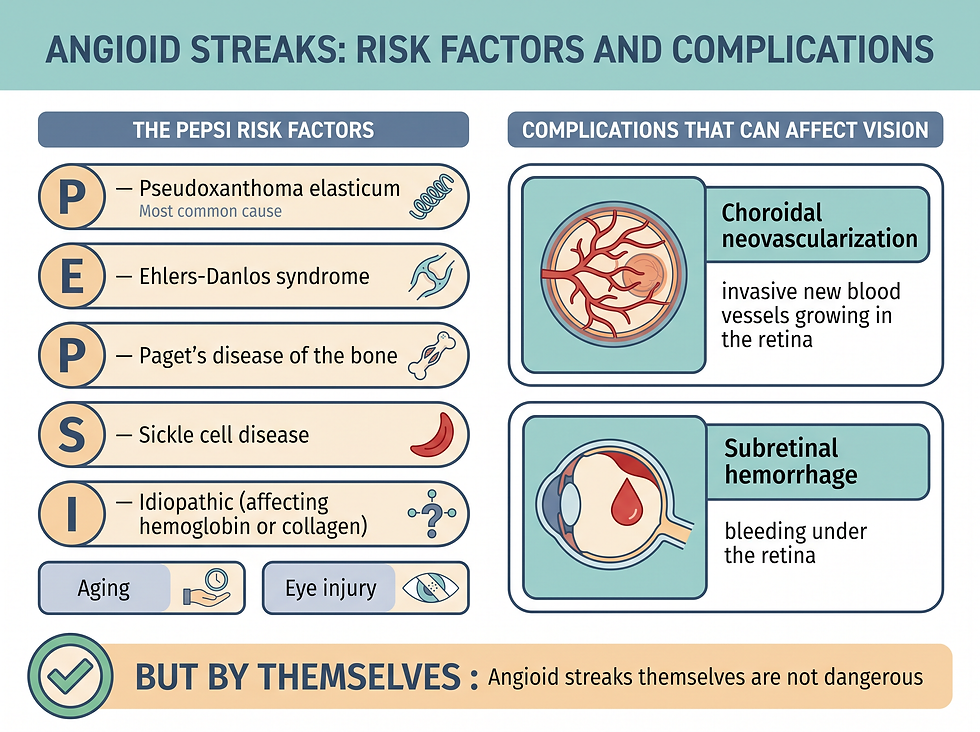
Angioid streak risk factors include certain other health conditions. Providers use the acronym PEPSI to remember the main list:
Letter | Condition | Details |
P | Pseudoxanthoma elasticum | Inherited disease causing mineral buildup in the body's elastic fibers; the most common condition associated with angioid streaks |
E | Ehlers-Danlos syndrome | A connective tissue disorder |
P | Paget's disease of the bone | A chronic bone condition |
S | Sickle cell disease | A hemoglobin-related blood disorder |
I | Idiopathic conditions | Spontaneous or unknown-cause conditions affecting hemoglobin in the blood or collagen, the building block of connective tissue |
Other risk factors include aging and eye injury.
Because pseudoxanthoma elasticum is the most common associated condition, finding angioid streaks on an eye exam can be the first clue to a body-wide connective tissue or blood disorder — which is why further evaluation often follows the discovery.
What Are the Complications?
Possible complications of angioid streaks that can distort or reduce your vision include:
Complication | What It Is |
Choroidal neovascularization | Invasive new blood vessels growing in the retina |
Subretinal hemorrhage | Bleeding under the retina |
These are the two events providers watch for during monitoring, because both can distort or reduce vision.
How Are Angioid Streaks Diagnosed?
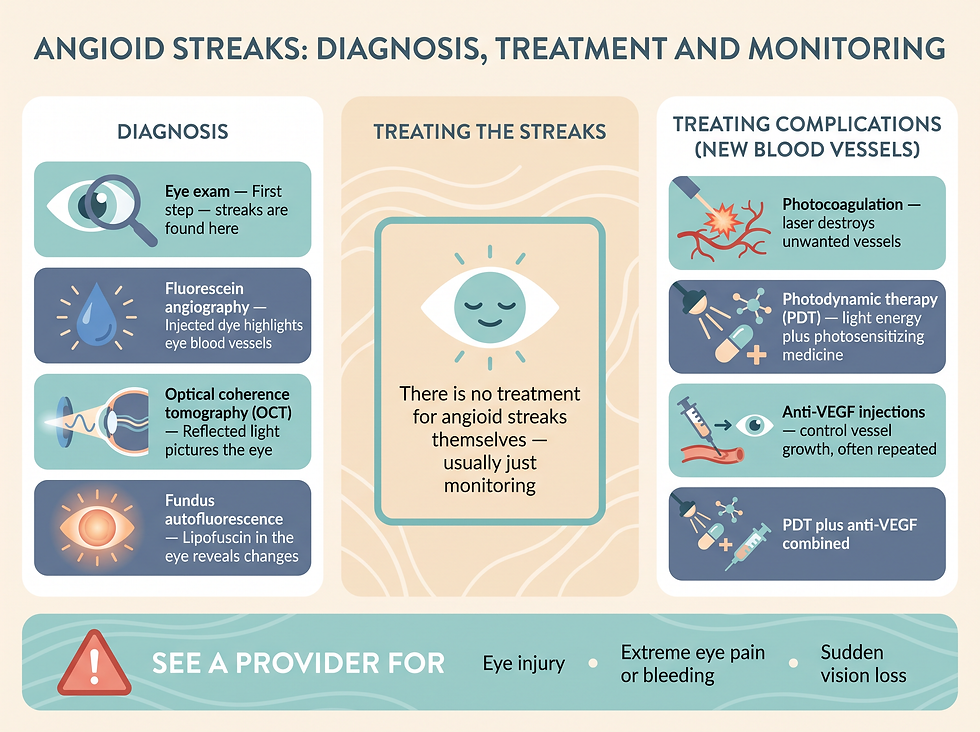
An eye care specialist will give you an eye exam. This may be enough for your provider to suspect angioid streaks, but you'll likely have other tests. These help with diagnosing angioid streaks, systemic diseases, and complications. Your provider may repeat these tests to watch your condition over time.
Test | How It Works |
Eye exam | The first step — streaks are found here |
Fluorescein angiography | Uses an injected dye to make the blood vessels in your eyes more visible |
Optical coherence tomography (OCT) | Uses reflected light to take pictures of your eyes |
Fundus autofluorescence | Uses lipofuscin — a substance already in your body — to show changes in your eye |
How Are Angioid Streaks Treated?
There is no treatment for angioid streaks themselves. Your provider may need to treat complications or other conditions related to angioid streaks.
Treatments for complication-related new blood vessels
If you have new and unruly blood vessels (choroidal neovascularization), your provider might suggest:
Treatment | How It Works |
Photocoagulation | Uses lasers to destroy unwanted blood vessels |
Photodynamic therapy (PDT) | Combines light energy and photosensitizing medicines to treat the vessels |
Anti-VEGF medications | Injected into the vitreous humor of your eye to control vessel growth; repeated injections are likely |
Combined PDT + anti-VEGF | Both approaches used together |
Possible side effects and complications
Laser photocoagulation may give you clearer vision in the short term, but it may have the unintended effect of destroying tissue. Complications can include retinal bleeding and loss of central vision.
Anti-VEGF medications: Side effects are usually short-lived and include eye pain, irritation, discharge, and seeing floaters or specks. There is also a very low chance of a serious eye infection following each injection.
Photodynamic therapy: Side effects include a temporary increased risk of sunburn and the possible creation of a blind spot. Complications include allergic reactions to photosensitizing medicines and, rarely, the creation of more unruly blood vessels.
What Is the Long-Term Outlook?
Angioid streaks by themselves aren't dangerous. If you have an eye injury, you should see an eye care provider for treatment. If you have angioid streaks due to systemic conditions, you should follow your healthcare provider's treatment suggestions for the condition and any needed therapy for your eyes.
The realistic summary: the streaks themselves are a monitoring situation, not a treatment situation. The vision risk comes from what may develop around them, and that is what treatment targets.
Can Angioid Streaks Be Prevented?
You can't prevent angioid streaks that happen because of conditions that affect your whole body. You may be able to avoid angioid streaks that happen because of eye injuries. You may lower your risk by wearing protective eye gear when you're:
Situation | Protective Gear Reason |
Working around machinery or flying debris | Things can fly up and hit your eye |
Riding a motorcycle | Impact and debris exposure |
Participating in rougher sports | Direct trauma risk |
Doing yard work | Flying objects risk |
When Should You See a Healthcare Provider?
You should see an eye care provider for regular appointments. If you have an eye condition or a disease that can affect your eyes, you may need more frequent appointments.
If you have any issues with your eyes, including eye pain or changes in vision, see an eye care provider.
Contact your provider or go to an emergency room if you have an eye injury, extreme pain or bleeding in your eye, or a sudden loss of vision.
How Are Angioid Streaks Different from Lacquer Cracks?
Both lacquer cracks and angioid streaks show up as lines in your eyes during an examination, but they tend to look different and are caused by different things:
Feature | Lacquer Cracks | Angioid Streaks |
Typical patient | Very nearsighted (myopic) people | People with certain diseases or eye damage |
Cause | High myopia (severe nearsightedness) | Bruch's membrane splits; systemic conditions or trauma |
Differentiation | Imaging tests may be needed if the appearance isn't clear | Imaging tests may be needed if the appearance isn't clear |
Questions to Ask Your Eye Care Provider
Why do I have angioid streaks?
What type of treatment do I need?
What are the side effects of these treatments?
How often should I have appointments?
What other providers do I need to see?
What new or worsening symptoms should I look out for?
What's my prognosis (outlook)?
Conclusion
Angioid streaks sit at an unusual intersection of eye health and whole-body medicine. The jagged lines themselves — tears in Bruch's membrane that point outward from the optic disc — are silent, symptom-free, and not dangerous on their own. Most people discover them by accident during a routine eye exam, and the standard response is monitoring rather than treatment.
The real clinical importance lies in two directions. First, the streaks frequently signal a systemic condition — pseudoxanthoma elasticum, Ehlers-Danlos syndrome, Paget's disease, sickle cell disease, or idiopathic hemoglobin or collagen disorders — which means an eye exam finding can trigger a wider medical workup. Second, the complications that can grow through the damaged membrane, choroidal neovascularization and subretinal hemorrhage, are what can actually distort or reduce vision, and these are treatable with photocoagulation, photodynamic therapy, or anti-VEGF injections.
If you have been diagnosed with angioid streaks, keep your regular eye appointments and ask your provider about an imaging baseline (OCT, fluorescein angiography, or fundus autofluorescence). If you have never been diagnosed but live with one of the PEPSI conditions — especially pseudoxanthoma elasticum or sickle cell disease — mention it at your next eye exam. And seek urgent care for any eye injury, extreme eye pain, bleeding in the eye, or sudden vision loss.
FAQ
What are angioid streaks?
Angioid streaks are jagged lines underneath the retina caused by tears in Bruch's membrane, the inside lining of the choroid between the retina and the sclera. They are also called Knapp streaks or Knapp striae.
Do angioid streaks cause symptoms?
Typically no. A provider can see the blood-vessel-like streaks during an eye exam, but the person usually has no symptoms. Complications related to angioid streaks — not the streaks themselves — could cause vision loss.
Are angioid streaks dangerous?
Angioid streaks by themselves are not dangerous. The vision risk comes from complications: choroidal neovascularization (new blood vessels growing in the retina) and subretinal hemorrhage (bleeding under the retina).
What causes angioid streaks?
They result from splits in Bruch's membrane, which can become thickened and prone to cracking in some people. Eye injuries can also cause them.
What are the PEPSI risk factors?
P — pseudoxanthoma elasticum (the most common associated condition), E — Ehlers-Danlos syndrome, P — Paget's disease of the bone, S — sickle cell disease, I — idiopathic conditions affecting hemoglobin or collagen. Aging and eye injury are also risk factors.
How are angioid streaks diagnosed?
An eye exam finds the streaks, followed by imaging tests such as fluorescein angiography, optical coherence tomography, and fundus autofluorescence.
Can angioid streaks be treated?
There is no treatment for angioid streaks themselves — monitoring is standard. Complications are treated with photocoagulation, photodynamic therapy, anti-VEGF injections, or a combination of PDT and anti-VEGF.
Can angioid streaks be prevented?
Streaks caused by body-wide conditions cannot be prevented. Injury-related streaks may be avoided by wearing protective eye gear during machinery work, motorcycling, rough sports, and yard work.
What is the difference between lacquer cracks and angioid streaks?
Lacquer cracks appear in the eyes of very nearsighted (myopic) people, while angioid streaks result from certain diseases or eye damage. Both appear as lines during an examination, and imaging tests may be needed to tell them apart.
References
Cleveland Clinic, "Angioid Streaks," medically reviewed, last updated 11/13/2023.
StatPearls, "Angioid Streaks," National Library of Medicine.
EyeWiki (American Academy of Ophthalmology), "Angioid Streaks."
National Organization for Rare Disorders, "Pseudoxanthoma Elasticum (PXE)."
Disclaimer: This article is for general educational purposes only and is not a substitute for professional medical advice, diagnosis, or treatment. Always consult a qualified healthcare provider for guidance specific to your situation.
Comments