Anal Herpes: Symptoms, Transmission, and How Antiviral Treatment Manages Outbreaks

Updated: 1 hour ago
Medically reviewed by Dr. Baraa Alnahhal, MD · Last reviewed: October 2026
TL;DR: Anal herpes is a sexually transmitted infection caused by the herpes simplex virus (HSV) that produces clusters of painful blister-like sores on and around the anus. Sores can also form inside the anus or rectum and may trigger HSV-associated proctitis. There is no cure: the virus lies dormant in nearby nerves for life and reactivates periodically, with recurrent outbreaks typically lasting one to two weeks. Antiviral medications clear outbreaks and reduce their frequency, and daily suppressive therapy can lower the risk of spreading the virus to partners.
Quick Answer
What it is: An STI in which HSV causes blister-like sores on the skin around the anus; sores may also form inside the anus or rectum.
Main symptom: A cluster of painful sores near the anus; first infections may also bring fever, headache, painful urination, and tender swollen groin lymph nodes.
Can you get it without anal sex? Yes — genital herpes can spread to the anal area because the virus sleeps in nerves close to both regions.
Treatment: Antiviral medications clear outbreaks but do not eliminate HSV; recurrent outbreaks usually last 1 to 2 weeks.
What the research says
Daily suppressive antiviral therapy cuts outbreaks and transmission. In a trial of 1,484 couples, once-daily valacyclovir reduced symptomatic transmission to partners (4 of 743 vs 16 of 741; HR 0.25), lowered recurrences (0.11 vs 0.40 per month) and cut viral shedding (2.9% vs 10.8% of days). (Corey et al., N Engl J Med, 2004)
HSV-2, the usual cause of anogenital herpes, is extremely common. Global estimates for 2012 put 417 million people aged 15-49 (11.3%) living with HSV-2, with about 19.2 million new infections each year. (Looker et al., PLoS One, 2015)
What Is Anal Herpes?
Anal herpes is a type of herpes simplex virus (HSV) infection that causes blister-like sores to develop on the skin surrounding your anus. Sores may also form inside your anus or rectum.
An anal herpes infection can sometimes lead to HSV-associated proctitis, which is inflammation in your rectum that is due to the herpes virus.
There is no cure for anal herpes, but antiviral medications can treat outbreaks. If you are concerned you have anal herpes, reach out to a healthcare provider. They will do exams and testing to diagnose the condition, prescribe medications to treat it, and explain what to expect in terms of recurrent outbreaks.
Key Fact | Detail |
Cause | Herpes simplex virus (HSV) |
Type | Sexually transmitted infection (STI) |
Location | Skin around the anus; may also occur inside the anus or rectum |
Possible complication | HSV-associated proctitis (rectal inflammation) |
Cure | None — antivirals manage outbreaks |

What Are the Symptoms of Anal Herpes?
The main symptom of anal herpes is a cluster of painful sores near your anus. If sores develop inside your anus (anal canal), you may not be able to see them, but you may notice pain or discomfort.
When HSV first infects your body, you may notice fever, headache, pain or discomfort when you pee (dysuria), and swollen lymph nodes in your groin area that are tender to the touch. Not everyone gets symptoms — it is possible to be infected with HSV and not realize it.
Symptom | When It Appears |
Cluster of painful sores near the anus | During outbreaks |
Pain or discomfort inside the anus | When sores form in the anal canal (may not be visible) |
Fever | Often at initial infection |
Headache | Often at initial infection |
Painful urination (dysuria) | Often at initial infection |
Tender swollen lymph nodes in the groin | Often at initial infection |
What Does Anal Herpes Look Like?
Anal herpes sores look a lot like genital herpes. They start as small, blister-like bumps (discolored or white) that form in a cluster. They break open and ooze fluid before healing and scabbing over.
Why Do Outbreaks Keep Coming Back?
After HSV enters your body, it lies dormant in nearby nerves. Your provider might refer to this as the virus "going asleep." But it never fully goes away. HSV can reactivate or "wake up" at various times throughout your life and cause new outbreaks.
Before visible sores appear — up to 48 hours — you may feel generally unwell, with possible fever, headache, and swollen lymph nodes. You may also notice itching or tingling in the skin around your anus. Sores then develop, break open, ooze fluid, and heal. Recurrent outbreaks usually last one to two weeks.
How Do You Get Anal Herpes?
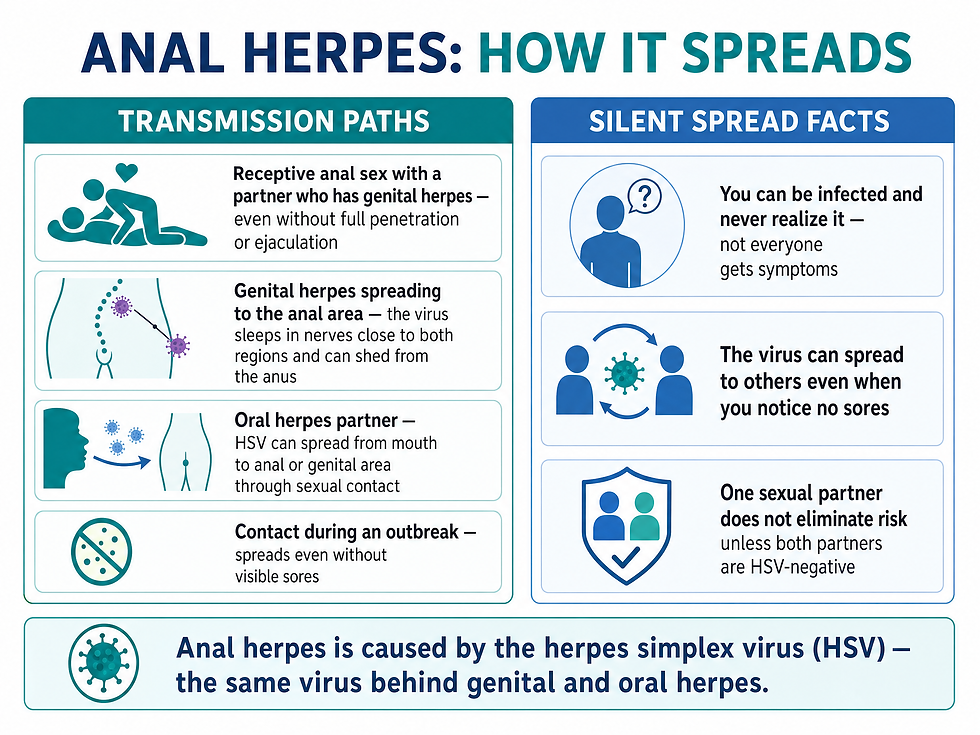
Anal herpes is a sexually transmitted infection. You can get anal herpes if you have anal-receptive sex with a partner who has genital herpes.
Importantly, you can also get an anal herpes infection without a history of anal sex. This can occur if you have genital herpes. After the initial infection, the virus goes to sleep in nerves near your genitals — and these nerve cells also happen to be close to your anus. When the virus wakes up, it can shed from your anal area as well as your genital area.
Even if you do not notice sores, the virus can still spread to others through sexual contact until it goes back to sleep again.
Transmission Route | Key Detail |
Receptive anal sex with a partner who has genital herpes | True even if the penis does not fully enter the anus or there is no ejaculation |
Genital herpes spreading to the anal area | Virus sleeps in nerves near both regions and sheds from the anus upon reactivation |
Oral herpes partner | HSV can spread from the mouth to the anal or genital area through sexual contact |
Contact during an outbreak | Spreads even without visible sores |
How Is Anal Herpes Diagnosed?
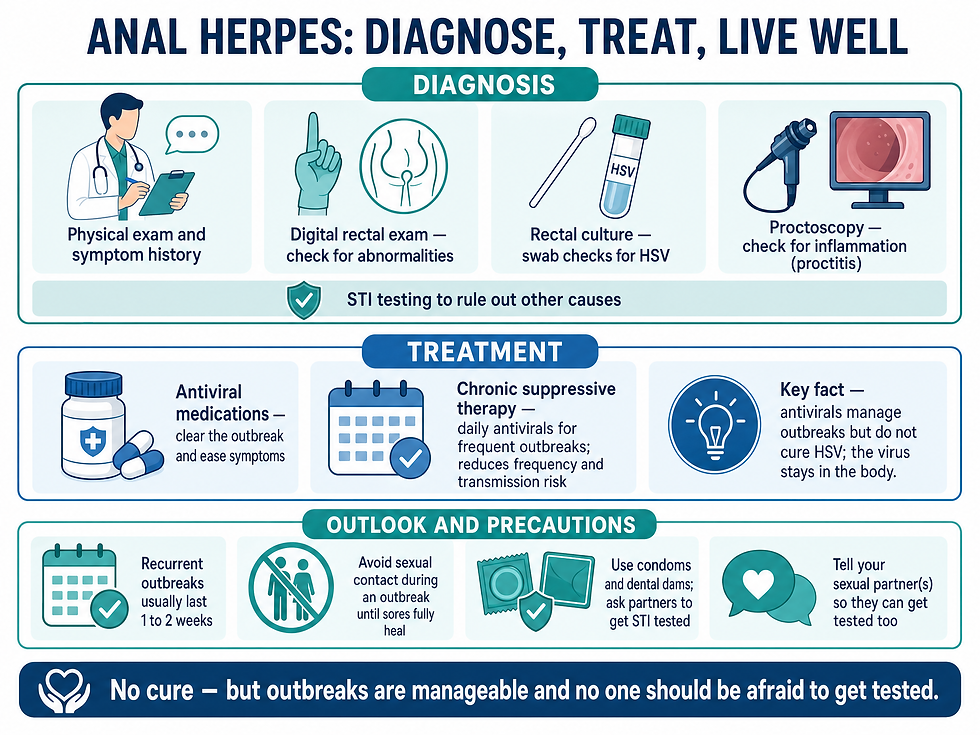
Your provider will diagnose anal herpes by talking to you about your symptoms and doing a physical exam. They may also perform one or more additional tests.
Test | How It Works |
Digital rectal exam | A gloved, lubricated finger checks the anus and rectum for abnormalities |
Rectal culture | A cotton swab collects fluid from inside the rectum; a lab checks for HSV |
Proctoscopy | A device is gently inserted to check for inflammation (proctitis) or other issues |
STI testing | Rules out other causes and checks overall sexual health |
The more information you share with your provider, the more they can help. Sharing your recent sexual history allows your provider to do appropriate testing and recommend treatment accordingly.
What Is the Treatment for Anal Herpes?
Providers prescribe antiviral medications to treat anal herpes. Your provider will tell you which medications to take and for how long. Taking them should clear up the outbreak and help you feel better.
Antivirals do not get rid of HSV from your body. The virus will always remain in your body and may reactivate later, causing other outbreaks.
If you get frequent outbreaks, your provider may recommend chronic suppressive therapy. This means taking antivirals on a regular basis even when you do not have an outbreak. Doing so can reduce how often outbreaks occur and lower the risk of spreading HSV to sexual partners.
Treatment Approach | How It Works |
Antiviral medications (episodic) | Taken during an outbreak; clears sores and eases symptoms |
Chronic suppressive therapy | Daily antivirals even without outbreaks; reduces outbreak frequency and transmission risk |
Supportive care | Using protection; avoiding sexual contact during an outbreak until sores fully heal |
What Can I Expect if I Have Anal Herpes?
There is no cure for anal herpes. You may have more outbreaks in the future. Antivirals can manage your outbreaks and help you feel better, and your provider can tell you more about what to expect and how to take care of yourself.
While it might be tough to do, you need to tell your sexual partner(s) about any STIs you have, including anal herpes, and ask them to be open and honest with you too. Use protection for all sexual activity, and avoid sexual contact (even protected) during an outbreak until the sores are fully healed.
How Can I Prevent an Anal Herpes Infection?
HSV spreads through sexual contact even when a person does not have symptoms. The only ways to completely prevent anal herpes are to avoid sexual activity, or to have only one sexual partner (who is also only with you) when you have both tested negative for HSV.
Otherwise, you can lower your risk by:
Prevention Step | How It Protects |
Using condoms and dental dams | Barriers reduce HSV transmission during sexual contact |
Avoiding contact with a partner who has an outbreak | Active sores are the highest-risk period |
Asking partners to do STI testing (and doing the same) | Knowing each partner's HSV status reduces silent-spread risk |
Telling your partner(s) about your own STIs | Allows both partners to make informed choices |
When Should I See My Healthcare Provider?
Contact your provider if you have symptoms of anal herpes or think you might be infected; if your sexual partner was diagnosed with anal herpes, genital herpes, or any other STI (even if you do not have symptoms); if you want STI testing of any type; or if you have questions or concerns about your treatment plan.
An STI diagnosis does not mean your sex life is over or that you are not worthy of love — it just means you have to take some precautions first. Talking about STIs is never easy, but reaching out to a healthcare provider ensures you get the proper diagnosis and treatment.
Conclusion
Anal herpes is a common, manageable reality for millions of people. The virus behind it — HSV — produces painful sores on and around the anus, can cause proctitis, and settles permanently in nearby nerves, reactivating in outbreaks that typically last one to two weeks.
The core facts are empowering. You can develop anal herpes even without any history of anal sex, because genital HSV shares nerve pathways with the anal area. Diagnosis is straightforward through physical exam, rectal culture, proctoscopy, and broader STI testing. And while no cure exists, antiviral medications clear outbreaks quickly, and chronic suppressive therapy can meaningfully reduce both outbreak frequency and transmission risk to partners.
The same honesty that makes treatment work also makes prevention work: disclosing your status, using barriers, and testing before new sexual relationships are the three habits that keep HSV from silently spreading.
CTA: If you notice a cluster of painful sores near your anus, or your partner has been diagnosed with genital herpes, contact a healthcare provider promptly for testing and treatment. Earlier antiviral treatment shortens outbreaks and reduces transmission risk — and an STI conversation with your provider is confidential, nonjudgmental, and often the best health decision you can make.
FAQ
What is anal herpes?
Anal herpes is a sexually transmitted infection caused by the herpes simplex virus (HSV). It causes blister-like sores on the skin surrounding the anus, and sores may also form inside the anus or rectum. In some cases it leads to HSV-associated proctitis, inflammation of the rectum caused by the virus.
What are the symptoms of anal herpes?
The main symptom is a cluster of painful sores near the anus. Sores inside the anal canal may not be visible but cause pain or discomfort. A first infection may also bring fever, headache, painful urination, and tender swollen lymph nodes in the groin.
Can you get anal herpes without anal sex?
Yes. If you have genital herpes, the virus sleeps in nerves near your genitals that are also close to your anus. When it reactivates, it can shed from the anal area as well — meaning genital herpes can cause anal herpes outbreaks without any history of anal sex.
How do you get anal herpes?
Anal herpes spreads through sexual contact where an infected part of a partner's body touches the anal area — most commonly receptive anal sex with a partner who has genital herpes, even without full penetration or ejaculation. A partner with oral herpes can also transmit HSV to the anal or genital area.
Is anal herpes curable?
No. There is no cure for anal herpes. HSV remains in the body's nerves for life and can reactivate periodically. However, antiviral medications clear outbreaks, and chronic suppressive therapy reduces outbreak frequency and the risk of spreading the virus to partners.
How long does an anal herpes outbreak last?
Recurrent outbreaks usually last one to two weeks. Sores start as small blister-like bumps, break open and ooze fluid, then heal and scab over. Warning signs — itching, tingling, feeling unwell — may appear up to 48 hours before sores form.
How is anal herpes diagnosed?
Providers diagnose it through symptom history and physical exam, and may add a digital rectal exam, rectal culture (a swab tested for HSV), proctoscopy to check for rectal inflammation, and general STI testing to rule out other causes.
Can you spread anal herpes without symptoms?
Yes. HSV can spread to others through sexual contact even when you notice no sores, and some people are infected and never realize it. Using protection, avoiding contact during outbreaks, and STI testing for both partners all lower transmission risk.
References
Cole S. Herpes Simplex Virus: Epidemiology, Diagnosis, and Treatment. Nurs Clin North Am. 2020 Sep;55(3):337-345. https://pubmed.ncbi.nlm.nih.gov/32762854/
Corey L. Herpes Simplex Virus Infections. In: Loscalzo J, Fauci A, Kasper D, Hauser S, Longo D, Jameson J. eds. Harrison's Principles of Internal Medicine. 21st ed. McGraw-Hill Education; 2022.
de Vries HJC, Nori AV, Kiellberg Larsen H, et al. 2021 European Guideline on the management of proctitis, proctocolitis and enteritis caused by sexually transmissible pathogens. J Eur Acad Dermatol Venereol. 2021 Jul;35(7):1434-1443. https://pubmed.ncbi.nlm.nih.gov/34057249/
Goulart A, Pinto J, Leão P. Anal herpes. BMJ Case Rep. 2017 Jun;2017:bcr2017220856. https://pubmed.ncbi.nlm.nih.gov/28663248/
Hughes Y, Lewis DA. HSV-associated proctitis presenting without perianal lesions: why testing and empirical treatment may be important. BMJ Case Rep. 2021 Jan;14(1):e237247. https://pubmed.ncbi.nlm.nih.gov/33431534/
Planned Parenthood. Oral & Genital Herpes. https://www.plannedparenthood.org/learn/stds-hiv-safer-sex/herpes
Corey L, Wald A, Patel R, Sacks SL, Tyring SK, Warren T, et al. Once-daily valacyclovir to reduce the risk of transmission of genital herpes. N Engl J Med. 2004;350(1):11-20. PMID: 14702423. doi:10.1056/NEJMoa035144
Looker KJ, Magaret AS, Turner KM, Vickerman P, Gottlieb SL, Newman LM. Global estimates of prevalent and incident herpes simplex virus type 2 infections in 2012. PLoS One. 2015;10(1):e114989. PMID: 25608026. doi:10.1371/journal.pone.0114989
Disclaimer: This article is for general educational purposes only and is not a substitute for professional medical advice, diagnosis, or treatment. Always consult a qualified healthcare provider for guidance specific to your situation.



Comments