Amebiasis (Amoebic Dysentery): The Parasite That Causes Bloody Diarrhea — Transmission, Treatment, and Recovery

Updated: 2 days ago
Medically reviewed by Dr. Baraa Alnahhal, MD · Last reviewed: September 2026
Editorial note: This article is for general education only. It is not medical advice, a diagnosis, or a treatment plan. If you have persistent diarrhea, bloody stools, fever, or belly pain — especially after travel to areas where amebiasis is common — see a healthcare provider for testing and treatment. Always consult a qualified healthcare professional for personal medical decisions.
TL;DR
Amebiasis (amoebic dysentery) is a gut infection caused by the parasite Entamoeba histolytica, spread by swallowing food, water, or surfaces contaminated with infected feces. Most infected people have no symptoms at all but can still spread the parasite. Symptomatic cases cause belly pain, diarrhea, fever, and bloody stools. When it spreads to the liver or brain, it can be life-threatening. Treatment with antibiotics and antiparasitic drugs cures most cases, and careful hygiene plus safe food and water practices prevent infection.
Quick Answer: What Is Amoebic Dysentery?
Amebiasis is a parasitic infection in the gut caused by Entamoeba histolytica. It often causes no symptoms, but it can lead to belly pain, diarrhea, vomiting, and bloody stool. The parasite spreads through contaminated food, water, and surfaces. Severe amebiasis symptoms, like watery and bloody diarrhea, are called amoebic dysentery. Complications such as liver abscesses can be life-threatening, but antibiotics and antiparasitic medications treat the infection, and most people recover fully.
What Is Amebiasis (Amoebic Dysentery)?
Amebiasis is a parasitic infection in your gut caused by the parasite Entamoeba histolytica (E. histolytica). The name "amoebic dysentery" refers specifically to the severe form, when the infection causes watery, bloody diarrhea.
It may not cause any symptoms at all. Or it can lead to belly pain, diarrhea, vomiting, or other digestive symptoms. If it becomes severe or spreads to other parts of your body, such as the liver or brain, it can be life-threatening.
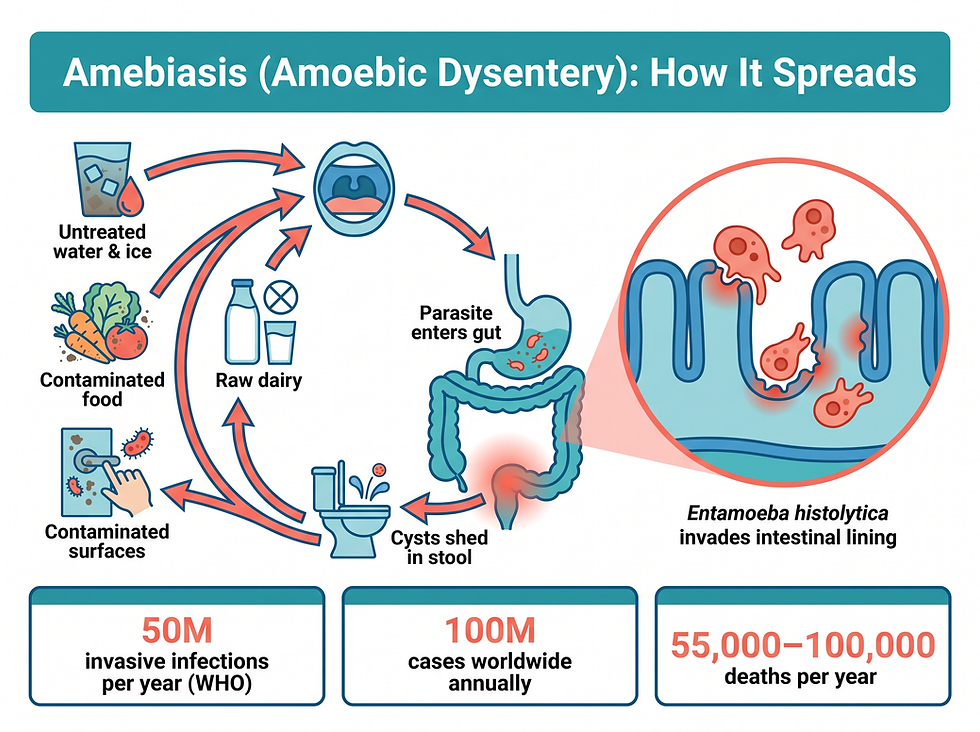
Parasites live on or in your body and use your body's nutrients to survive. E. histolytica reproduces in your digestive tract and creates cysts — tough, protective packages of the parasite. Cysts leave your body when you poop, and they are what make the infection spread to others.
How Common Is Amebiasis?
Amebiasis is found throughout the world. Global estimates vary because many cases go undetected, but the scale is large. The World Health Organization estimates up to 50 million invasive infections worldwide annually, resulting in about 70,000 deaths each year. Newer analyses put the figure even higher: roughly 100 million annual cases worldwide, with about 10% of symptomatic infections progressing to dysentery, and more than 100,000 deaths per year with 2.2 million disability-adjusted life years lost.
Global invasive infections per year: Up to 50 million (WHO estimate)
Global cases per year: ~100 million (CDC EID, 2025)
Deaths per year: ~55,000–100,000+ (Shirley 2018; Nasrallah 2022)
Symptomatic infections becoming dysentery: ~10% (CDC EID, 2025)
Prevalence in some endemic areas: Up to 50% (UpToDate, 2025)
Worldwide Entamoeba prevalence (molecular testing): 3.55% (PLOS NTDs, 2021)
The parasite is most common in Bangladesh, India, Mexico, Pakistan, and parts of Africa and South America. In some endemic regions, overall infection prevalence may reach as high as 50%. Molecular studies that distinguish the disease-causing species found an estimated worldwide prevalence of 3.55%.
For travelers, amebiasis is one of several causes of travelers' diarrhea, which affects 30–70% of travelers to high-risk destinations during a two-week trip, with a pooled incidence of about 36%.
What Are the Symptoms of Amebiasis?
Most people with amebiasis don't have symptoms — yet they can still spread the parasite. When symptoms do appear, they typically develop one to four weeks after exposure. Possible symptoms include:
Belly pain or cramping: Abdominal discomfort that may be persistent
Diarrhea: Frequent loose or watery stools
Bloody poop: Blood in stool — a sign of dysentery
Fever: Elevated body temperature
Loose stools: Unformed bowel movements
Nausea: Feeling sick to the stomach
Vomiting: Throwing up stomach contents
A useful way to think about it: most infections are silent, a minority are symptomatic, and a smaller fraction become dysentery. Only about 10% of symptomatic infections progress to the bloody-diarrhea form called amoebic dysentery.

How Do You Get Amebiasis?
The parasite spreads through the fecal-oral route — you swallow poop contaminated with the parasite. While that might seem almost impossible, it is more common than most people think. It happens through:
Contaminated food: Fruits or vegetables washed in contaminated water
Raw dairy: Unpasteurized (raw) milk, cheese, or other dairy products
Contaminated water: Including ice cubes
Contaminated surfaces: Touching objects with the parasite, then touching your mouth
Sexual transmission: Not classified as an STI, but can spread through sex when the mouth touches areas with fecal contamination
Who Is at Higher Risk?
You are at a higher risk of amebiasis infection if you:
Live in or travel to endemic areas: Bangladesh, India, Mexico, Pakistan, parts of Africa and South America
Areas without running water or modern sanitation: Contaminated water sources
Live in crowded conditions: Fecal contamination spreads more easily
Have anal sex: Fecal-oral exposure route
The parasite is found throughout the world, but its concentration in warm, crowded regions with limited sanitation is what drives the global burden.
What Are the Complications?
E. histolytica infections can cause serious complications in the digestive tract or spread to other parts of your body. When the parasite leaves the gut, it most commonly forms an abscess in the liver — and can reach the brain.
Appendicitis: Inflammation of the appendix
Toxic megacolon: Dangerous widening and paralysis of the colon
Liver or brain abscess: Pus-filled pockets where the parasite spreads
Peritonitis: Inflammation of the lining of your abdomen
Empyema: Pus in the lining of your lungs
Pericarditis: Inflammation of the sac around your heart
These complications can be fatal, which is why timely diagnosis and treatment matter even when symptoms seem mild.
How Is Amebiasis Diagnosed?
Healthcare providers diagnose amebiasis by looking at a sample of your poop (stool) under a microscope. Other tests that can help diagnose parasitic infections and their complications include:
Stool sample (microscopy): Direct detection of the parasite or cysts
Blood tests: Signs of infection and liver involvement
Sigmoidoscopy or colonoscopy: Direct view of the intestinal lining
Ultrasound: Detection of liver abscesses
Because the disease-causing E. histolytica can be hard to distinguish from harmless look-alike amoebas on microscopy alone, providers may combine several tests — and anyone who has traveled to an endemic area should be tested even without symptoms.
How Is Amebiasis Treated?
Healthcare providers treat amebiasis with antibiotics and antiparasitic medications. You might take one medication or a combination of two or more. Common medications used include:
Iodoquinol: Luminal agent for cysts
Paromomycin: Gut-directed antiparasitic
Diloxanide furoate: Luminal agent for cysts
Metronidazole: Tissue-invading disease
Tinidazole: Tissue-invading disease
Ornidazole: Tissue-invading disease
In severe cases, providers may also need surgery or fluid drainage to manage complications such as large liver abscesses.
Recovery time: you will need to take medications for a week or longer, but many people start feeling better within a few days. Make sure to take all medications as prescribed, even if you feel better.

What Is the Outlook After Treatment?
With treatment, most people recover from amebiasis. But it is important to get treatment as soon as possible — some complications can be fatal.
The prognosis is excellent when treatment starts early. Untreated, the infection can progress from silent colonization to dysentery to invasive disease, including liver abscess. This is also why providers recommend getting tested if you are at higher risk — even without symptoms. In areas where amebiasis is common, public health officials work to improve sanitation and stop the spread.
Can Amebiasis Be Prevented?
You can reduce your risk of amebiasis by following a few guidelines:
Wash hands frequently: After using the bathroom, changing diapers, and before eating or preparing food
Use bottled water in uncertain areas: For drinking, cooking, and washing vegetables
Avoid untreated water and raw milk: Includes ice cubes and unpasteurized dairy
Wash, peel, or cook produce: Fruits and vegetables before eating
For travelers, the rule of thumb is "boil it, cook it, peel it, or forget it" — and be especially careful with ice, raw salads, and tap water in endemic regions.
Key Takeaways
Amebiasis is a gut infection caused by the parasite Entamoeba histolytica. Most infected people never develop symptoms but can still spread the parasite through contaminated food, water, and surfaces — the classic fecal-oral route. About 10% of symptomatic cases progress to amoebic dysentery, marked by watery, bloody diarrhea. The parasite is most common in Bangladesh, India, Mexico, Pakistan, and parts of Africa and South America, with up to 50 million invasive infections and 55,000–100,000 deaths estimated worldwide each year. Diagnosis involves stool microscopy, blood tests, endoscopy, and ultrasound. Treatment combines antibiotics and antiparasitic medications taken for a week or longer — many people feel better within days — while severe complications like liver abscesses may require drainage or surgery. With early treatment, most people recover fully.
Prevention is simple: wash hands, use bottled water in uncertain areas, avoid untreated water and raw dairy, and wash, peel, or cook produce before eating.
If you have persistent or bloody diarrhea — especially after traveling to an endemic area — see a healthcare provider promptly, even if you feel only mildly ill. Early treatment is what keeps amebiasis from becoming life-threatening.
Frequently Asked Questions
1. Can amebiasis go away on its own?
Some mild infections may resolve, but experts advise against waiting: even symptom-free carriers can spread the parasite, and untreated infection can progress to dysentery or invasive disease such as a liver abscess, which can be fatal. Getting tested and treated promptly is the safe course.
2. What is the difference between amebiasis and amoebic dysentery?
Amebiasis is the overall infection with Entamoeba histolytica. Amoebic dysentery is the severe form, defined by watery, bloody diarrhea and other severe symptoms. Only about 10% of symptomatic infections progress to dysentery.
3. Is amebic dysentery the same as bacillary dysentery?
No. Amoebic dysentery is caused by a parasite (E. histolytica), while bacillary dysentery is caused by bacteria (such as Shigella). They share symptoms — bloody diarrhea and fever — but require different diagnostic tests and medications, so providers test stool to distinguish them.
4. Can you get amebiasis without traveling?
Yes. While the parasite is most common in Bangladesh, India, Mexico, Pakistan, and parts of Africa and South America, it exists worldwide. Local outbreaks occur through contaminated food, water, raw dairy, and surfaces, and crowded living conditions raise risk.
5. How do you get amebiasis?
By swallowing the parasite through contaminated food washed in dirty water, unpasteurized dairy, contaminated water including ice cubes, contaminated surfaces or objects touched to the mouth, and, less commonly, through sexual contact involving fecal exposure.
6. How long does it take to develop symptoms?
Symptoms typically appear one to four weeks after exposure, though many people never develop any. Symptomatic cases can last days to weeks, and treatment takes a week or longer, with many people feeling better within a few days.
7. Can amebiasis spread to the liver or brain?
Yes. The parasite can invade beyond the gut and form abscesses in the liver or brain, and cause peritonitis, empyema, or pericarditis. These complications can be life-threatening, which is why treatment should start as soon as possible.
8. How do you prevent amebiasis while traveling?
Wash hands frequently with soap, drink only bottled or treated water (including for brushing teeth and ice), avoid unpasteurized milk and raw dairy, and wash, peel, or cook all fruits and vegetables before eating them.
Related Reading on Rinnit
References
Cleveland Clinic — Amebiasis (Amoebic Dysentery). Medically reviewed; last updated 01/26/2026.
CDIPD — Amebiasis Global Impact: WHO Estimate of 50 Million Infections and 70,000 Deaths Annually.
CDC Emerging Infectious Diseases — Amebiasis in Mexico, 2014–2023 (2025).
Shirley & Shirley (2018). Amebiasis: A Review of the Global Burden, New Diagnostics, and Current Therapeutics (PMC).
Nasrallah et al. (2022). Updates on the Worldwide Burden of Amoebiasis (ScienceDirect).
UpToDate — Intestinal Entamoeba histolytica Amebiasis (2025).
Singh et al. (2021). Epidemiology of Clinically Relevant Entamoeba spp. (PLOS Neglected Tropical Diseases).
CDC Yellow Book — Travelers' Diarrhea (2026).
StatPearls/NIH NCBI — Travelers' Diarrhea (2026).
Comments