Alpers Disease: The Rare Genetic Disorder That Causes Seizures, Liver Failure, and Dementia

Updated: 2 days ago
Medically reviewed by Dr. Baraa Alnahhal, MD · Last reviewed: September 2026
TL;DR
Alpers disease is a rare genetic mitochondrial disorder that causes dementia, liver failure, and seizures. It affects about 1 in 100,000 people and usually appears in early childhood (most commonly between ages 2 and 4) or in young adults (between ages 17 and 24). There is no cure and no way to slow the disease, but nine types of symptom management — from anticonvulsant medications to feeding tubes and breathing support — can improve comfort and quality of life.
Quick Answer
What is Alpers disease? A rare, inherited mitochondrial disorder caused by POLG1 gene mutations inherited from both parents, leading to dementia, liver failure, and seizures.
Who gets it and when? About 1 in 100,000 people; symptoms can start anytime from 1 month to 36 years of age, most commonly between ages 2–4, with a second peak between ages 17–24.
How is it diagnosed? By the three hallmark signs — dementia, liver disease, and seizures — confirmed with brain MRI, genetic testing, EEG, and cerebrospinal fluid analysis.
What is the outlook? There is no cure and no treatment that slows the disease; it is usually fatal 4 to 10 years after symptoms begin, so care focuses on symptom management and quality of life.
What Is Alpers Disease?
Alpers disease is a rare mitochondrial disease — a disorder of the tiny power plants inside your cells. It affects your brain, liver, and muscles, and leads to three defining problems: dementia, liver failure, and seizures [1].
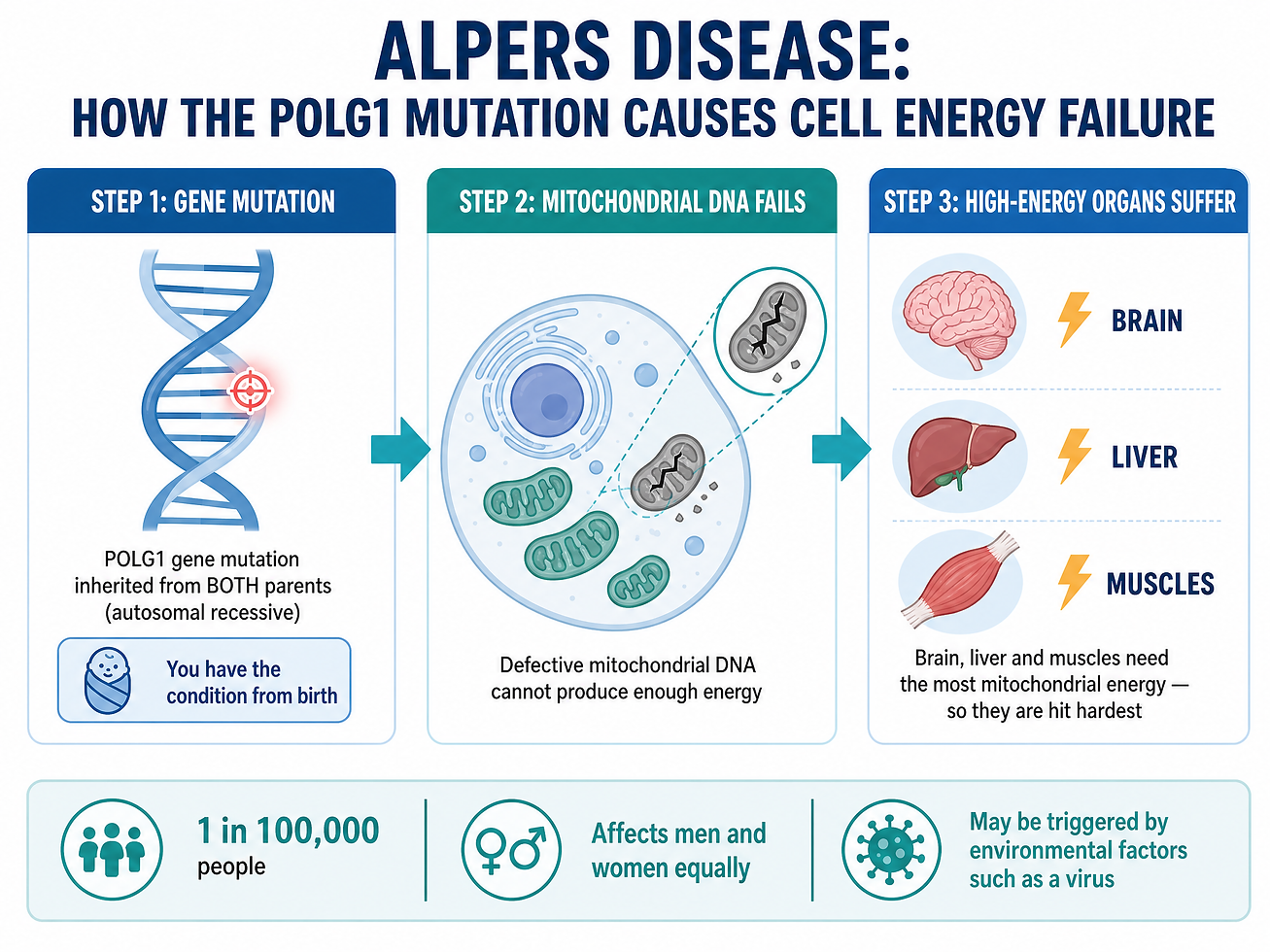
You have Alpers disease from birth because it is caused by inherited gene defects. However, people usually do not notice symptoms for weeks or years [1]. The condition is most often fatal [1].
Alpers disease goes by several other names, which are useful to know when searching medical records or research literature:
| Alternative Name | What It Tells You | | --- | --- | | Alpers-Huttenlocher syndrome | Most common alternate name, used in medical literature | | Alpers syndrome | Shortened form | | Diffuse cerebral degeneration in infancy | Describes the brain involvement and early-onset pattern | | Progressive cerebral poliodystrophy | Describes the progressive loss of grey matter | | Progressive infantile poliodystrophy | Infant-onset form of the same degeneration |
Who Might Get Alpers Disease?
Anyone who inherits the defective genes for Alpers disease can develop the condition. It affects men and women equally [1].
The condition is uncommon. Only about 1 in 100,000 people has Alpers disease, though people with Northern European ancestry have a slightly higher incidence [1].
| Key Fact | Detail | | --- | --- | | Prevalence | 1 in 100,000 people | | Sex distribution | Affects men and women equally | | Inheritance | Defective genes passed down through families | | Present at birth? | Yes — but symptoms may take weeks or years to appear | | Higher-incidence group | People with Northern European ancestry |
What Causes Alpers Disease?
A mutation in the POLG1 gene causes Alpers disease. Children inherit these gene mutations from both of their parents — and only defective POLG1 genes coming from both parents cause the disease [1]. This two-parent inheritance pattern is called autosomal recessive inheritance.
Alpers disease is a type of mitochondrial disease. The defective genes cause mitochondrial DNA to stop working as well as it should [1].
The disease hits your brain, liver, and muscles hardest for a specific reason: these organs need large amounts of mitochondrial energy to function [1]. When the mitochondria falter, the most energy-hungry organs pay the price.
Some researchers think environmental factors, such as a virus, may trigger people who have inherited the defective genes to actually develop the disease [1].
What Are the Symptoms of Alpers Disease?
Seizures — specifically refractory epilepsy that resists treatment — are usually the first symptom to appear [1]. The other main symptoms are liver disease, and a slowing of thinking (mild cognitive impairment) combined with a lessening of movements, which providers call psychomotor regression [1].
Other symptoms may include the following [1]:
| Symptom | What It Means | | --- | --- | | Seizures (refractory epilepsy) | Usually the first symptom; hard to control with medication | | Liver disease | One of the three defining features | | Psychomotor regression | Slowing of thinking plus lessening of movements | | Anxiety and depression | Mood changes that accompany the condition | | Encephalopathy | Disease of the brain itself | | Hypoglycemia | Low blood sugar | | Failure to thrive | Lack of growth in children | | Migraine headaches with hallucinations | Severe headaches accompanied by sensory disturbances | | Muscle stiffness (spasticity) | Tight, hard-to-move muscles | | Muscle twitching | Involuntary muscle movements |
What Happens as Alpers Disease Progresses?
As the condition advances, symptoms become broader and more severe [1]:
| Later-Stage Symptom | Impact | | --- | --- | | Dementia | Progressive loss of memory and cognition | | Blindness from optic atrophy | Vision loss caused by optic nerve degeneration | | Dysphagia | Difficulty swallowing, affecting nutrition and safety | | Cardiomyopathy | Disease of the heart muscle | | Ataxia | Impaired movement and coordination | | Gastrointestinal diseases | Digestive system problems | | Spastic quadriplegia | Loss of control of all four limbs, a form of cerebral palsy | | Liver cirrhosis or liver failure | Advanced, often terminal liver damage |
How Is Alpers Disease Diagnosed?
Healthcare providers usually diagnose Alpers disease by looking for its three main symptoms: dementia, liver disease, and seizures [1]. Several tests can then confirm the diagnosis.
| Diagnostic Test | What Providers Look For | | --- | --- | | Brain MRI | An increased mass of grey matter | | Genetic testing | POLG1 mutations in a blood sample | | EEG | Slowed electrical brain activity | | Cerebrospinal fluid (CSF) analysis | Cerebral folate deficiency from fluid collected via spinal tap |
A brain MRI of someone with Alpers disease shows an increased mass of grey matter [1]. Genetic testing uses a blood sample to examine the sequence of genes for the responsible mutations [1]. An EEG places electrodes on the scalp to measure the brain's electrical signals and may show a slowing of activity [1]. CSF analysis collects fluid from the lower back through a spinal tap to test for cerebral folate deficiency [1].
How Is Alpers Disease Treated?
There are no treatments to slow or stop Alpers disease. However, providers recommend treatments that manage symptoms, help patients feel more comfortable, and improve quality of life [1].
| Treatment | What It Does | | --- | --- | | Anticonvulsant medications | Lessen seizures | | Feeding tube (PEG) | Helps with nutrition and hydration | | Frequent, small, low-protein meals | Supports nutrition in a gentler pattern | | Massage | Reduces stress | | Occupational therapy | Helps with performing daily tasks | | Pain relievers and muscle relaxants | Reduce pain and muscle tightness | | Physical therapy | Treats spasticity and improves muscle tone | | Speech therapy | Supports communication and swallowing skills | | Supportive ventilation (CPAP, BiPAP, tracheostomy) | Improves breathing |
How Is the Condition Monitored?
Providers may suggest tests every few months to monitor health and adjust treatments as needed [1].
| Regular Monitoring Test | Purpose | | --- | --- | | Complete blood count (CBC) | Tracks overall blood health | | Electrolyte monitoring | Checks fluid and mineral balance | | Elevated liver enzymes test | Detects liver cell damage | | Liver function test | Assesses how well the liver is working |
As symptoms progress, other tests may be added: brainstem auditory evoked potential, repeat EEG, pulmonary function testing, sleep disorder testing (polysomnography), swallowing evaluation, and vascular ultrasound of the liver [1].
What Can I Expect If I Have (or My Child Has) Alpers Disease?
Alpers disease worsens over time. The condition is usually fatal around 4 to 10 years after symptoms start [1]. This sobering reality is why care focuses on comfort, function, and family support rather than cure.
If you know you carry the gene for Alpers disease and are considering a pregnancy, a genetic counselor can provide advice and support before conception [1].
How Can I Reduce My Risk of Alpers Disease?
Because Alpers disease is a genetic condition, you cannot reduce your risk [1]. The disorder is determined at conception by the genes inherited from both parents.
How Do I Take Care of Myself or My Child?
As the condition progresses, extra support becomes necessary. The following specialists can help you cope with the disease [1]:
| Support Resource | Role | | --- | --- | | Gastrointestinal specialist | Manages digestive complications | | Nutrition specialist | Supports feeding, growth, and low-protein meal plans | | Psychiatric specialist | Helps with anxiety, depression, and emotional coping | | Home health nurses | Manage care at home as the disease worsens | | Palliative care team | Provides support in the final stages | | Support groups | Share resources and advice for Alpers and other mitochondrial diseases |
Conclusion
Alpers disease is a rare, inherited mitochondrial disorder that strikes the body's most energy-dependent organs — the brain, liver, and muscles. It almost always begins with seizures, progresses to psychomotor regression and liver disease, and shortens life significantly, typically 4 to 10 years after symptoms begin.
What you can do now: If a child shows seizures that resist medication, unusual slowing of development, or unexplained liver problems, ask the pediatrician specifically about Alpers disease and request referral to a neurologist. For families who know they carry POLG1 mutations, speak with a genetic counselor before pregnancy — not after. And for families already on this path, building a care team early (neurology, gastroenterology, nutrition, psychiatry, home nursing, and palliative care) makes the hardest parts of the journey more manageable.
Questions to Ask Your Provider
Could these seizures be a sign of a mitochondrial disorder like Alpers disease?
Should we have genetic testing for POLG1 mutations?
What medications will best control the seizures, and what are the side effects?
When should we consider a feeding tube, and what does the process involve?
Should we meet with a genetic counselor before planning a pregnancy?
Frequently Asked Questions
Is Alpers disease inherited from one parent or both?
Alpers disease requires defective POLG1 genes inherited from both parents. A mutation from only one parent does not cause the condition.
At what age does Alpers disease usually start?
Symptoms most commonly begin between ages 2 and 4, though they can appear anytime from 1 month to 36 years of age, with a second onset peak between ages 17 and 24.
Can Alpers disease be cured or slowed?
No. There are currently no treatments that cure, slow, or stop Alpers disease. All available care focuses on managing symptoms such as seizures, spasticity, nutrition, and breathing.
What is the life expectancy for someone with Alpers disease?
The disease is usually fatal 4 to 10 years after symptoms begin. Because it worsens over time, care emphasizes comfort and quality of life.
Why do seizures happen first in Alpers disease?
Seizures (refractory epilepsy) are typically the earliest symptom because the brain depends heavily on mitochondrial energy, which the POLG1 mutation disrupts.
How is Alpers disease different from other epilepsy disorders?
Unlike most epilepsy disorders, Alpers disease combines seizures with liver disease and psychomotor regression (slowed thinking plus lessening of movement), and MRI typically shows increased grey matter.
Can Alpers disease be prevented?
No. Because it is a genetic condition, there is no way to reduce your risk. Families with known POLG1 mutations can use genetic counseling when planning pregnancies.
Who should be on the care team for Alpers disease?
A complete team includes neurologists, gastrointestinal and nutrition specialists, a psychiatrist, home health nurses as the disease worsens, a palliative care team in the final stages, and mitochondrial disease support groups for shared resources.
Related Reading
References
Cleveland Clinic — Alpers Disease: Disease Overview and Management
Cohen BH, Chinnery PF, Copeland WC — POLG-Related Disorders, GeneReviews (updated 2018)
National Institute of Neurological Disorders and Stroke — Alpers' Disease Information Page
Rose HR, Al Khalili Y — Alpers-Huttenlocher Syndrome, StatPearls (updated 2020)
Saneto RP, et al. — Alpers-Huttenlocher syndrome: A review, Pediatric Neurology (2013)
Medical Disclaimer: This article is for general informational purposes only and is not a substitute for professional medical advice, diagnosis, or treatment. Always consult a qualified healthcare provider with any questions about a medical condition, and never disregard professional medical advice or delay seeking care because of information you have read here.
Comments