
Alpers Disease: What This Rare Genetic Disorder Does to the Brain, Liver, and Muscles — and How Families Cope

Updated: 2 days ago
Medically reviewed by Dr. Baraa Alnahhal, MD · Last reviewed: September 2026
Editorial note: This article is for general education only. It is not medical advice, a diagnosis, or a treatment plan. Always consult a qualified healthcare professional for personal medical decisions.
TL;DR
Alpers disease (also called Alpers-Huttenlocher syndrome) is a rare, inherited mitochondrial disorder caused by mutations in the POLG gene — a person must inherit a defective copy from both parents to develop the disease. It attacks the brain, liver, and muscles, usually starting with hard-to-control seizures between ages 2 and 4 (or later, between 17 and 24). It affects roughly 1 in 100,000 people and is always fatal, typically 4 to 10 years after symptoms begin. There is no cure, but anticonvulsants, therapies, feeding support, and breathing devices can keep patients more comfortable — and valproic acid must be avoided, as it can trigger fatal liver failure in POLG patients.
Quick Answer: What Is Alpers Disease?
Alpers disease is a rare genetic disorder that leads to dementia, liver failure, and seizures. Symptoms usually start between ages 2 and 4 or between ages 17 and 24, and may include muscle stiffness and twitching, lack of growth, and migraines. It is caused by mutations in the POLG gene inherited from both parents. Alpers disease is always fatal, but symptoms can be managed with medications, therapy, nutrition, and breathing devices.
What Is Alpers Disease?
Alpers disease is a rare mitochondrial disease that affects the brain, liver, and muscles. It leads to three hallmark problems: dementia, liver failure, and seizures.
The condition has several other names you may encounter in medical literature: Alpers-Huttenlocher syndrome, Alpers syndrome, diffuse cerebral degeneration in infancy, progressive cerebral poliodystrophy, and progressive infantile poliodystrophy.
You can develop symptoms anytime between 1 month and 36 years of age. But symptoms usually begin in early childhood, most commonly between ages 2 and 4. Others develop the disease later, typically between ages 17 and 24.

Alpers disease results when faulty POLG genes leave mitochondria — the energy factories of cells — unable to function. The brain, liver, and muscles suffer most because they demand the most energy. The condition affects about 1 in 100,000 people and is passed down only when both parents carry the mutation.
How Rare Is Alpers Disease?
Alpers disease is exceptionally uncommon. Best estimates place the prevalence at about 1 in 100,000 people. Some epidemiological sources estimate the incidence range at 1 in 100,000 to 1 in 250,000.
Prevalence (best estimate): About 1 in 100,000
Incidence range: 1/100,000 – 1/250,000
POLG carrier rate in Northern Europeans: Up to 2%; the top 3 mutations combine for over 1%
Most common onset age: 2–4 years (range: 3 months – 36 years)
Sex distribution: Men and women equally affected
People with Northern European ancestry have a slightly higher incidence of the disease. That pattern reflects carrier frequency: up to 2% of people of Northern European descent may carry disease-causing POLG mutations, and the three most common mutations (A467T, W748S, and G848S) together exceed a 1% carrier rate in Northern European populations.
What Causes Alpers Disease?
A change (mutation) in the POLG gene causes Alpers disease. Children inherit these gene mutations from both of their parents — defective POLG genes coming from both parents cause the disease. This pattern is called autosomal recessive inheritance.
Alpers disease is a type of mitochondrial disease. The defective genes cause mitochondrial DNA to stop working properly. Because the brain, liver, and muscles all need large amounts of mitochondrial energy to function, those are the organs Alpers disease damages most.
Some researchers think environmental factors — such as a virus — may push people who inherited the defective genes into developing the disease.
POLG mutation: Fault in the gene that maintains mitochondrial DNA
Autosomal recessive: One defective copy needed from each parent
Both parents carriers: Each parent has one copy but usually no symptoms
25% chance per pregnancy: Two carriers have a 1-in-4 chance of an affected child
Environmental trigger: A virus or other factor may activate the disease in carriers (research theory)
What Are the Symptoms of Alpers Disease?
Seizures — specifically refractory epilepsy, meaning epilepsy that resists treatment — are usually the first symptom to appear. The other main symptoms are liver disease and a slowing of thinking combined with reduced movement. Together, providers call that combination psychomotor regression.
Seizures (refractory epilepsy) — usually first: Neurological
Liver disease: Hepatic
Slowing of thinking, reduced movement (psychomotor regression): Neurological
Anxiety and depression: Psychological
Encephalopathy (brain disease): Neurological
Hypoglycemia (low blood sugar): Metabolic
Failure to thrive (lack of growth): Developmental
Migraine headaches with hallucinations: Neurological
Muscle stiffness (spasticity): Motor
Muscle twitching: Motor
What happens as the disease progresses?
As Alpers disease advances, symptoms may expand to include blindness from optic atrophy, difficulty swallowing, dementia, heart muscle disease (cardiomyopathy), ataxia (movement and coordination disorders), gastrointestinal diseases, spastic quadriplegia (loss of control of arms and legs), and liver cirrhosis or liver failure.
Vision: Blindness from optic atrophy
Swallowing: Dysphagia; feeding difficulties
Cognition: Dementia
Heart: Cardiomyopathy
Movement: Ataxia; spastic quadriplegia
Digestion: Gastrointestinal diseases
Liver: Cirrhosis or liver failure

The first warning is typically seizures that resist standard treatment, alongside liver problems and psychomotor regression. Additional early signs include failure to thrive and migraines with hallucinations. As the disease advances, vision loss, swallowing difficulty, dementia, heart disease, and liver failure can develop. One critical warning: valproic acid, a common seizure drug, is contraindicated in POLG mutations because it can trigger fatal liver failure.
How Is Alpers Disease Diagnosed?
Healthcare providers usually diagnose Alpers disease by recognizing the three main symptoms: dementia, liver disease, and seizures. Several tests can then confirm the diagnosis.
Cerebrospinal fluid (CSF) analysis: Cerebral folate deficiency, found via lumbar puncture (spinal tap)
Electroencephalography (EEG): Brain electrical signals; Alpers disease may show slowed activity
Genetic testing: Blood sample sequenced for POLG gene mutations
Brain MRI: Increased mass of grey matter seen in Alpers disease
Genetic testing is the definitive confirmation, since Alpers disease is defined by POLG gene mutations. If a child has hard-to-control seizures plus any sign of liver trouble, genetic testing for POLG mutations is especially important — because the most commonly prescribed emergency seizure drug, valproic acid (Depakote), can trigger fatal liver failure in people with POLG mutations.
How Is Alpers Disease Treated?
There are no treatments that slow or stop Alpers disease. Providers instead focus on managing symptoms — helping patients stay more comfortable and improving quality of life.
Symptom treatments
Anticonvulsant medications: Lessen seizures
Feeding tube (PEG): Nutrition and hydration when swallowing fails
Frequent, small, low-protein meals: Reduce metabolic stress on the liver
Massage: Reduce stress
Occupational therapy: Maintain daily-task skills
Pain relievers and muscle relaxants: Comfort and spasticity relief
Physical therapy: Treat spasticity, improve muscle tone
Speech therapy: Communication support
Supportive ventilation (CPAP, BiPAP, tracheostomy): Improve breathing
The valproic acid warning matters here. Although anticonvulsants are a core treatment, valproic acid is contraindicated in anyone with a POLG mutation because it can cause acute, often fatal liver failure. Families should make sure every treating physician knows about the POLG diagnosis before any seizure medication is started.
Monitoring
Providers typically order tests every few months to monitor health and adjust treatments. Routine monitoring may include a complete blood count (CBC), electrolyte monitoring, liver enzyme tests, and liver function tests. Additional testing as symptoms progress may include evoked potentials, repeat EEGs, pulmonary function testing, sleep studies (polysomnography), swallowing evaluations, and liver vascular ultrasound.
CBC, electrolytes: Every few months — general health
Liver enzymes, liver function tests: Every few months — liver status
EEG, evoked potentials: As symptoms progress
Pulmonary function, sleep study: As symptoms progress
Swallowing evaluation, liver ultrasound: As symptoms progress
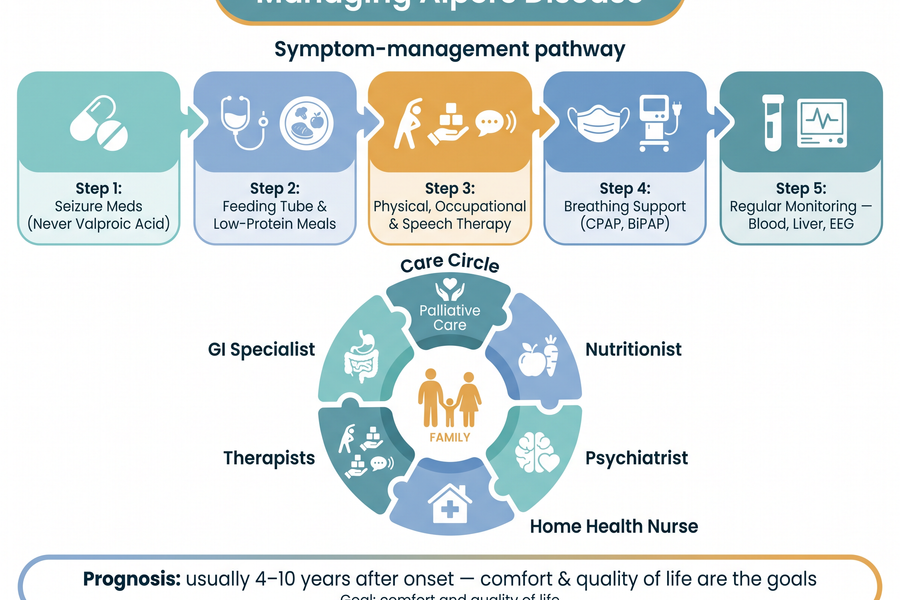
There is no cure, so care centers on comfort and quality of life: seizure medications (never valproic acid), feeding tubes, physical and occupational therapy, breathing support, and low-protein meals. A care team — including GI specialists, nutritionists, psychiatrists, home health nurses, and palliative care — surrounds the family at every stage.
What Is the Prognosis?
Alpers disease worsens over time. The condition is usually fatal around four to 10 years after symptoms start. There is no way to prevent or slow the disease, since it is entirely genetic.
If you know you carry the POLG gene and are considering pregnancy, a genetic counselor can provide advice and support about the risks and options.
Disease course: Progressive and untreatable at its root
Typical survival: 4–10 years after symptom onset
Cause of death: Usually liver failure or neurological decline
Prevention: Not possible — fully genetic
Family planning: Genetic counseling strongly recommended for carriers
How Do Families Cope?
As the condition progresses, extra support becomes necessary. Specialists in gastrointestinal issues, nutrition, and psychiatry can all help families cope. Home health nurses can manage care as the disease worsens, and a palliative care team can provide support in the final stages.
Support groups for Alpers disease and other mitochondrial diseases also help families share resources and advice. Caring for someone with Alpers disease is emotionally demanding, and care teams and support groups can assist with both physical and emotional support.
Key Takeaways
Alpers disease is a rare mitochondrial disorder — affecting roughly 1 in 100,000 people — caused by POLG gene mutations inherited from both parents. It damages the brain, liver, and muscles because these energy-hungry organs cannot tolerate failing mitochondria. The first sign is usually hard-to-control seizures, appearing most often between ages 2 and 4, alongside liver disease and psychomotor regression; later stages bring dementia, blindness, swallowing difficulty, heart disease, and liver failure. Diagnosis combines recognition of the symptom triad with CSF analysis, EEG, brain MRI, and definitive genetic testing. No treatment slows the disease, but anticonvulsants (never valproic acid), feeding tubes, physical and speech therapy, and breathing support improve comfort and quality of life. The condition is typically fatal 4 to 10 years after onset, which makes genetic counseling, multidisciplinary care teams, and support groups essential for affected families.
If your child has seizures that resist treatment or unexplained liver problems, ask a pediatric neurologist about POLG genetic testing — early confirmation prevents dangerous medications and opens the door to the right support. And if you know you carry a POLG mutation, speak with a genetic counselor before planning a pregnancy.
Frequently Asked Questions
Can Alpers disease be cured or slowed?
No. There are no treatments that slow or stop Alpers disease, because it is rooted in a genetic defect affecting mitochondrial DNA. Care focuses entirely on managing symptoms and preserving quality of life.
Is Alpers disease the same as epilepsy?
No. Seizures — usually hard-to-control, refractory epilepsy — are typically the first symptom, but Alpers disease is a multisystem mitochondrial disorder that also destroys liver function and cognition over time.
Why must valproic acid be avoided?
Valproic acid (Depakote), one of the most common seizure medications, is contraindicated in people with POLG mutations because it can trigger acute, often fatal liver failure in these patients.
Can a child be healthy if only one parent carries the gene?
Yes. Alpers disease is autosomal recessive — a child must inherit a defective POLG copy from both parents to develop the disease. Carriers with one copy typically have no symptoms.
At what age do symptoms start?
Symptoms can appear anytime from 1 month to 36 years of age, but most commonly begin between ages 2 and 4 in children; a second peak occurs between ages 17 and 24 in young adults.
How is Alpers disease diagnosed?
Providers recognize the triad of dementia, liver disease, and seizures, then confirm with cerebrospinal fluid analysis, EEG, brain MRI, and definitive genetic testing of the POLG gene.
How long do people live after diagnosis?
Alpers disease worsens over time and is usually fatal around four to 10 years after symptoms begin.
What support is available for families?
A multidisciplinary team — GI specialists, nutritionists, psychiatrists, physical and occupational therapists, home health nurses, and palliative care — supports the patient, while support groups for Alpers and other mitochondrial diseases help families share resources and emotional support.
Related Reading
References
Cleveland Clinic — Alpers Disease (medically reviewed, last updated 11/03/2021)
United Mitochondrial Disease Foundation (UMDF) — POLG-Related Disorders
NIH PMC — POLG-Related Disorders and Their Neurological Manifestations
NIH PMC — POLG1-Related Epilepsy: Review of Diagnostic and Therapeutic Findings
NIH PMC — Alpers-Huttenlocher Syndrome: A Review (Saneto & Hahn, 2013)
NIH National Organization for Rare Disorders (NORD) — Alpers-Huttenlocher Syndrome
MDPI Int. J. Mol. Sci. — Understanding the Epilepsy in POLG-Related Disease
Comments