AITL: When Your Immune System's T Cells Turn Cancerous — Symptoms, Diagnosis, and Treatment

Updated: 2 days ago
Medically reviewed by Dr. Baraa Alnahhal, MD · Last reviewed: September 2026
Editorial note: This article is for general education only. It is not medical advice, a diagnosis, or a treatment plan. If you notice new, persistent, or unexplained symptoms — such as painless swelling in your neck, armpit, or groin; recurring fever; drenching night sweats; or unexplained weight loss — see a healthcare provider promptly for evaluation.
TL;DR
Angioimmunoblastic T-cell lymphoma (AITL) is a rare, fast-growing blood cancer of the T cells — a type of white blood cell that normally fights infection [1]. In the U.S. it accounts for about 4% of all lymphomas and 1%–2% of non-Hodgkin lymphomas, mostly striking people over 65 [1]. Symptoms include painless swollen lymph nodes, fever, night sweats, skin rash, and unexplained weight loss, and diagnosis usually comes at a late stage because the symptoms mimic other conditions [1]. Treatment centers on chemotherapy with steroids, stem cell transplant, and targeted therapy. The five-year survival rate is 30%–35% [1] [4].
Quick Answer: What Is Angioimmunoblastic T-Cell Lymphoma?
Angioimmunoblastic T-cell lymphoma (AITL) is a rare, aggressive blood cancer in which T lymphocytes — the white blood cells that normally destroy viruses, bacteria, and even cancer cells — transform into malignant cells and multiply out of control [1]. It is a subtype of peripheral T-cell lymphoma, itself a form of non-Hodgkin T-cell lymphoma, and it can spread to the liver, lungs, and bone marrow [1]. Common symptoms are painless swelling in the neck, armpit, or groin, recurring fever, night sweats, and unexplained weight loss. Treatment typically involves chemotherapy combined with steroids, stem cell transplant, and targeted therapy [1].
What Exactly Is Angioimmunoblastic T-Cell Lymphoma?
Your immune system relies on T lymphocytes (T cells) — a type of white blood cell — to hunt down harmful microorganisms like viruses and bacteria, and under ordinary circumstances, to kill cancer cells too [1]. AITL happens when a single T lymphocyte transforms into a cancer cell, and more T cells follow suit, multiplying and spreading uncontrollably [1].
AITL sits under the umbrella of non-Hodgkin T-cell lymphoma and is classified as a subtype of peripheral T-cell lymphoma (PTCL) [1]. Because it attacks the lymphatic system — a core part of your immune system — it can travel beyond the lymph nodes to the liver, lungs, and bone marrow [1].
Term you might hear | What it means |
Angioimmunoblastic T-cell lymphoma (AITL) | A rare, fast-growing blood cancer of T cells [1] |
T lymphocytes (T cells) | White blood cells that normally destroy pathogens and cancer cells [1] |
Peripheral T-cell lymphoma (PTCL) | The category AITL belongs to [1] |
Non-Hodgkin lymphoma (NHL) | The broader umbrella of lymphatic cancers [1] |
Lymphatic system | The immune network the cancer attacks and spreads through [1] |
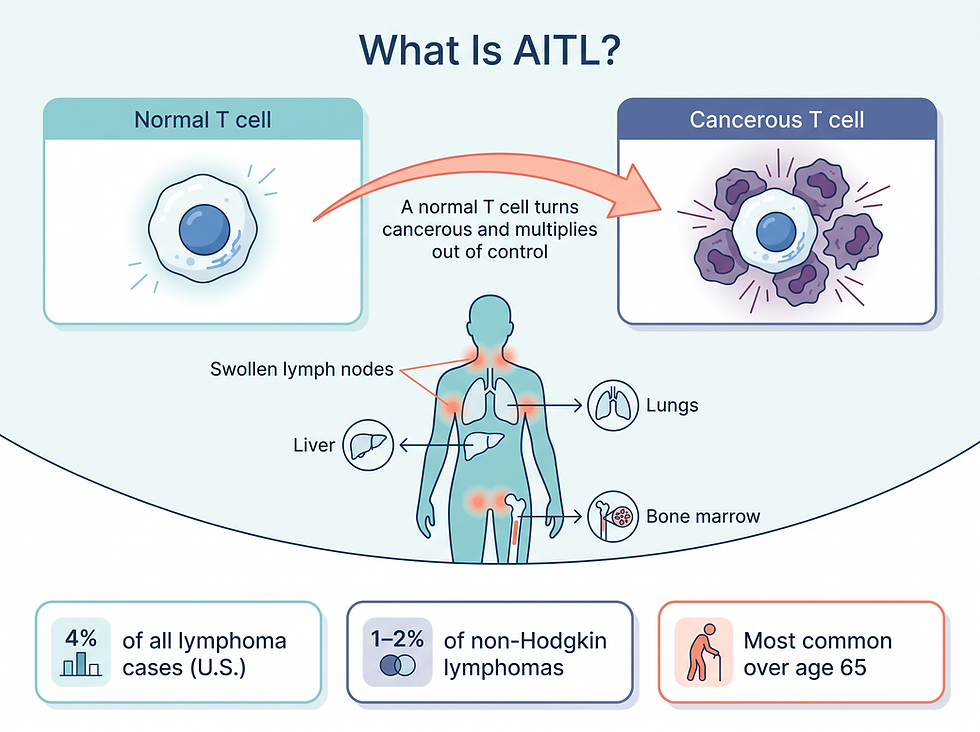
AITL develops when normal T cells — the immune cells that usually destroy viruses, bacteria, and cancer cells — transform into malignant cells that multiply uncontrollably. It is rare: about 4% of all lymphomas and 1%–2% of non-Hodgkin lymphomas in the U.S. It most often strikes people over 65, and because its symptoms mimic milder conditions, diagnosis typically happens at a late stage. Treatment relies on chemotherapy with steroids, stem cell transplant, and targeted therapy.
How Common Is AITL?
AITL is rare — but it is one of the more common subtypes within the rare world of T-cell lymphoma [1].
Measure | Estimate | Evidence |
Share of all lymphoma cases (U.S.) | About 4% [1] | U.S. clinical data [1] |
Share of all non-Hodgkin lymphomas | 1%–2% [1] [5] | U.S. clinical data [1]; international PTCL project [5] |
Share of peripheral T-cell lymphomas | ~15%–20% [5] | International T-cell Project [5] |
New cases per 100,000 people per year (U.S.) | 0.05 [5] | International PTCL project [5] |
SEER database cases (2000–2020) | 2,536 cases in 20 years [3] | SEER 17-registry analysis [3] |
Median age at diagnosis | ~65–69 years [1] [3] | U.S. clinical data [1]; SEER analysis [3] |
Male share of cases | ~55% [3] | SEER analysis [3] |
The epidemiology paints a clear picture: this is overwhelmingly a disease of older adults. In the SEER database analysis of all U.S. cases diagnosed between 2000 and 2020, the median age at diagnosis was 69 years, and roughly 55% of patients were men [3]. Interestingly, in some European data sets AITL actually ranks as the most common T-cell lymphoma subtype [8] — so within its own rare family, AITL is relatively well represented.
What Causes Angioimmunoblastic T-Cell Lymphoma?
AITL happens when your T cells become abnormal and grow out of control — but researchers do not yet know why some people develop T-cell lymphomas while others do not [1].
Proposed factor | What the evidence says |
Viral infections | A possible link exists with viruses like Epstein-Barr virus (EBV); scientists need more information about why the connection exists [1] |
Age | Most common in people over 65; median diagnosis age ~65–69 [1] [3] |
Sex | Slight male predominance in recent U.S. data (~55% male) [3]; older studies found no clear sex predilection [5] |
Genetics | Not fully established; cell of origin identified as the T follicular helper (TFH) cell [5] |
It is important to say plainly: there are no known preventable risk factors. Most people with AITL have done nothing wrong — it is, in the words of the clinical guidance, "just something that happens" [1].
What Are the Symptoms?
AITL is fast-growing, and symptoms can develop quickly — sometimes over just a few weeks [1] [6]. The most recognizable sign is painless swelling in the neck, armpit, or groin [1] [6].
Symptom | How it shows up |
Swollen lymph nodes | Painless swelling in neck, armpit, or groin — usually not painful [1] |
Fever | Unexplained fever that comes and goes without apparent cause [1] |
Night sweats | Drenching sweats at night [1] |
Skin rash or itchiness | Rashes and pruritus; autoimmune reaction plays a role [1] [6] |
Shortness of breath | Can reflect bone marrow involvement or anemia [1] [6] |
Swollen joints | Joint inflammation from the autoimmune reaction [1] [6] |
Unexplained weight loss | Losing more than one-tenth of body weight [1] [6] |
Fever, night sweats, and major weight loss are known together as "B symptoms" — a symptom cluster that doctors use when staging and treating lymphoma [6].
Why symptoms appear | What happens in the body |
Bone marrow involvement | Lymphoma cells crowd out normal blood cells, causing low counts — leading to tiredness, breathlessness, bleeding, and bruising [6] |
Organ spread | Enlarged spleen or liver can cause bloating and abdominal discomfort [6] |
Autoimmune reaction | The immune system overreacts to abnormal proteins, causing skin rashes and joint inflammation [6] |
Autoimmune disease complication | Because AITL attacks the lymphatic system, many patients develop conditions like immune thrombocytopenia or autoimmune hemolytic anemia [1] |

AITL's hallmark is painless swelling of the lymph nodes, often alongside "B symptoms" — recurring fever, drenching night sweats, and weight loss of more than 10% of body weight. Because the cancer attacks the immune system, it can also trigger autoimmune reactions (skin rashes, joint inflammation) and crowd out normal blood cells (tiredness, breathlessness, bleeding). These symptoms mimic many milder conditions, which is why most people are diagnosed at a late stage. Persistent, unexplained symptoms warrant prompt medical evaluation.
How Is AITL Diagnosed?
AITL is usually diagnosed with a lymph node biopsy [1]. If your test results show abnormal T lymphocytes, your healthcare provider will suspect AITL [1].
After confirming the diagnosis, an oncologist performs a physical examination, asks about symptoms, and reviews your health history [1]. A series of tests follows:
Test | Purpose |
Lymph node biopsy | Removes part or all of a swollen lymph node for laboratory examination — the main diagnostic test [1] [6] |
Blood tests | Check blood cell counts and organ function [1] |
Bone marrow biopsy | Checks whether lymphoma cells have reached the marrow [1] [6] |
CT scan | Maps where the cancer has spread [1] |
MRI scan | Detailed imaging of affected areas [1] |
PET scan | Detects metabolically active cancer sites throughout the body [1] [6] |
The diagnostic challenge. Diagnosing AITL — and all lymphomas — is difficult [1]. The cancer's complex nature means symptoms arrive gradually and mimic other conditions [1]. As a result, most people receive their AITL diagnosis at a late stage [1], and in the international T-cell Project cohort, 90% of patients had advanced-stage disease at diagnosis [4]. Researchers continue to search for ways to diagnose AITL earlier [1].
How Is AITL Treated?
Treatment depends on your symptoms, the severity of the disease, and your overall health [1].
Treatment | How it works |
Chemotherapy | Combinations of chemotherapy drugs plus steroids. Common regimens: CHOP and BV+CHP [1] |
Stem cell transplant | Replaces cancerous stem cells with healthy ones — from yourself (autologous) or a donor (allogeneic) [1] |
Targeted therapy | Focuses on the genetic mutations that turn healthy cells into cancer cells [1] |
Immunotherapy add-on | Rituximab may be combined with chemotherapy in some cases, forming R-CHOP [6] |
The two best-known chemotherapy regimens break down as follows:
Regimen | What the letters stand for |
CHOP | Cytoxan (cyclophosphamide), hydroxydaunorubicin (doxorubicin), Oncovin (vincristine sulfate), prednisone [1] |
BV+CHP | Brentuximab vedotin, cyclophosphamide, doxorubicin, prednisone [1] |
An autologous stem cell transplant is sometimes given after CHOP if you respond well — a consolidation step intended to reduce the chance of relapse [6]. Relapsed AITL may be treated with different chemotherapy drugs, a donor stem cell transplant, or targeted cancer drugs through clinical trials [6].
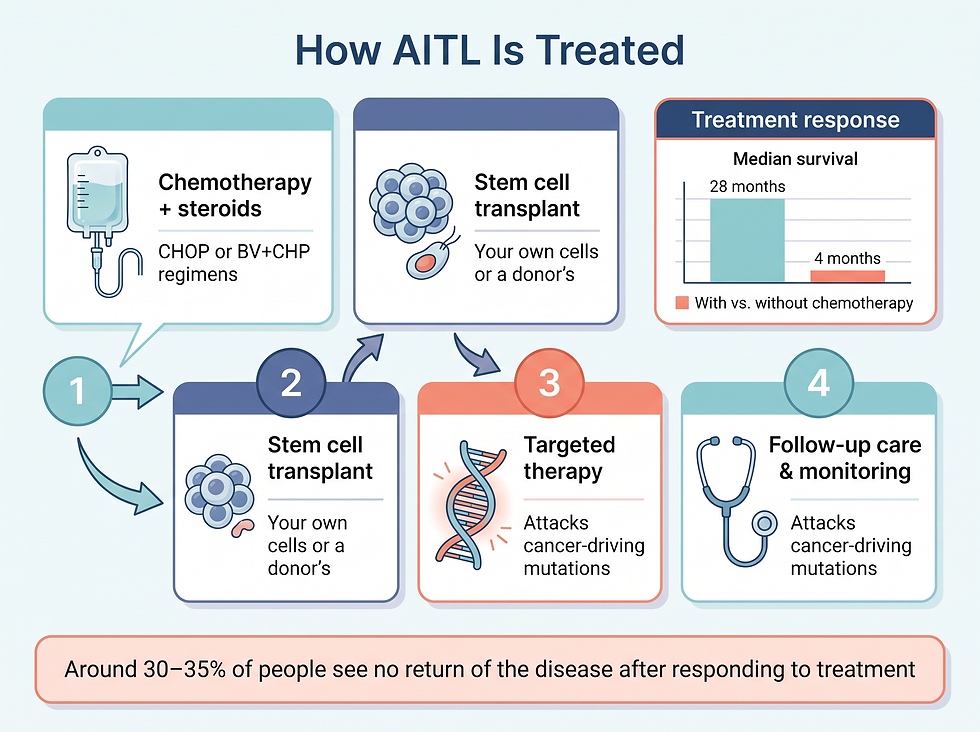
AITL treatment is tailored to disease severity and overall health. Chemotherapy with steroids — most often CHOP or BV+CHP — is the foundation. For patients who respond well, an autologous stem cell transplant may follow to help prevent relapse. Targeted therapy attacks the genetic mutations driving the cancer, and clinical trials offer access to newer drugs for relapsed disease. Outcomes are better for younger patients and those treated with chemotherapy (median survival 28 months with chemo vs. 4 months without).
What Is the Outlook?
It is honest to say AITL is an aggressive cancer. Research shows median survival after diagnosis is fewer than three years [1]. However, in approximately 30% to 35% of people, the lymphoma may not return after responding to treatment [1].
Prognosis measure | Result |
Five-year survival rate | 30%–35% [1] |
Seven-year survival rate | 29% [1] |
Five-year overall survival (international contemporary cohort) | 44% [4] |
Median survival with chemotherapy (SEER data) | 28 months vs. 4 months without [3] |
Patients without disease progression in 24 months | 5-year OS 63% (vs. 6% with early progression) [4] |
Interpreting survival rates can feel stressful and overwhelming. Remember that these numbers are only estimates, based on the prior experiences of other people with the same diagnosis [1]. Each person has a different health history and unique genetics at play — which is why survival rates cannot tell you how long you'll live or how well you'll respond to treatment [1]. If you're worried about survival rates, talk to your healthcare provider; they can help you understand what these numbers mean for your specific situation [1].
Can AITL Be Prevented?
No — there is no way to prevent AITL or other types of lymphoma. Most people with AITL have no preventable risk factors, and a cancer diagnosis doesn't mean you've done anything wrong [1].
What you can control is the health of your immune system in general:
Healthy habit | Why it matters |
Eat fruits, vegetables, whole grains, and lean proteins | Supports immune function [1] |
Maintain regular physical activity | Supports overall health [1] |
Get quality sleep | Supports immune function [1] |
Maintain a healthy weight | Reduces strain on the body [1] |
Avoid vaping and all tobacco products | Tobacco harms immune defenses [1] |
Limit alcohol | Heavy use stresses the immune system [1] |
Living With AITL: When to See a Provider
Tell your healthcare provider any time you develop sudden symptoms — a skin rash, lymph node swelling, high fever, or weight loss without trying [1].
If you're already undergoing treatment for AITL, call your oncologist right away if new symptoms develop or existing symptoms suddenly worsen. Due to the nature of this cancer, it's important to begin treatment immediately [1].
AITL affects everyone differently. Your healthcare provider is the only person who can explain what your diagnosis means for you. Some people don't want to know specifics, and that's OK too — you're in charge of your care, and only you know what's best for your mental, emotional, and spiritual health [1]. Because AITL is so rare, it can feel isolating; healthcare teams can connect you with resources and support groups where others truly understand [1] [6].
Key Takeaways
Angioimmunoblastic T-cell lymphoma (AITL) is a rare, fast-growing blood cancer of the T cells — the white blood cells that normally fight infection. It accounts for about 4% of all lymphomas in the U.S., mainly affecting people over 65, and it can spread to the liver, lungs, and bone marrow. The telltale signs are painless swelling in the neck, armpit, or groin, plus fever, night sweats, skin rash, and unexplained weight loss — symptoms that so often mimic other conditions that diagnosis usually arrives at a late stage. Treatment relies on chemotherapy with steroids (CHOP or BV+CHP), stem cell transplant, and targeted therapy, and starting treatment quickly matters. The five-year survival rate is 30%–35%, and in roughly a third of patients the cancer never returns after responding to treatment. Survival statistics are estimates — every person's biology and response is unique, and your oncology team is the best source for what these numbers mean for you. There is no way to prevent AITL, and it is not caused by anything you did.
If you have persistent, unexplained symptoms — painless swelling, recurring fever, night sweats, or unintentional weight loss — schedule an evaluation with your healthcare provider. Because AITL progresses quickly, early diagnosis gives treatment the best chance to work.
Frequently Asked Questions
Is angioimmunoblastic T-cell lymphoma rare?
Yes — very. AITL accounts for about 4% of all lymphoma cases and only 1%–2% of non-Hodgkin lymphomas in the United States [1]. Only about 2,500 cases were recorded in the national cancer database across twenty years [3]. Within that rare category, however, it is one of the more common T-cell lymphoma subtypes [1].
What causes AITL?
AITL develops when normal T lymphocytes transform into cancer cells and multiply out of control [1]. Researchers don't know exactly why this happens in some people and not others. A possible link exists with viral infections such as Epstein-Barr virus, but scientists need more research to understand the connection [1].
What are the first signs of AITL?
The most common early sign is painless swelling in the neck, armpit, or groin [1] [6]. This often accompanies recurring fever, drenching night sweats, skin rash, and unexplained weight loss — symptoms that can appear or worsen over just a few weeks [6]. Because they mimic milder illnesses, these symptoms are frequently overlooked until later stages [1].
How is AITL diagnosed?
The main diagnostic test is a lymph node biopsy — removing part or all of a swollen lymph node for laboratory examination [1] [6]. Blood tests, a bone marrow biopsy, and CT, MRI, and PET scans help determine how far the cancer has spread [1] [6].
Can AITL be cured?
There is no guaranteed cure, but treatment can be effective. Approximately 30%–35% of people with AITL have lymphoma that does not come back after responding to treatment [1]. The five-year survival rate is 30%–35% [1], and outcomes are better for younger patients and those treated with chemotherapy [3].
What treatments are available?
The mainstays are chemotherapy combined with steroids (the CHOP or BV+CHP regimens), stem cell transplant (using your own cells or a donor's), and targeted therapy that attacks the genetic mutations driving the cancer [1]. An autologous stem cell transplant may follow successful chemotherapy to help prevent relapse [6].
How long can you live with AITL?
AITL is aggressive, and research shows median survival after diagnosis is fewer than three years [1]. However, in about 30%–35% of people the lymphoma never returns after responding to treatment [1]. Survival rates are statistical estimates based on other patients' experiences — they cannot predict any individual's outcome [1].
Can AITL be prevented?
No. Most people with AITL have no preventable risk factors, and there is no way to prevent this or other lymphomas [1]. It is not something you caused. General immune-health habits — healthy diet, exercise, sleep, avoiding tobacco, limiting alcohol — support overall health but do not guarantee protection against lymphoma [1].
Comments