Adventitial Cystic Disease: The Rare Cyst That Blocks Blood Flow Behind Your Knee

Updated: 2 days ago
Medically reviewed by Dr. Baraa Alnahhal, MD · Last reviewed: September 2026
TL;DR
Adventitial cystic disease (ACD) is a rare condition in which a fluid-filled cyst forms in the adventitia — the outermost wall of an artery or vein — and can restrict or block blood flow, especially during movement or exercise. It usually affects the popliteal artery behind the knee, which supplies the knee and lower-leg muscles, and makes up only about 0.1% of all vascular diseases. The most common symptom is intermittent claudication — muscle cramps or pain that starts with exercise and eases with rest — usually in one calf. It strikes men aged 40–50 most often (men are five times more likely than women) and typically affects otherwise healthy, active people. Sometimes cysts go away on their own, but cyst removal surgery is usually the most effective treatment, with vein grafting showing the lowest recurrence risk in one limited study.
Quick Answer
What it is: Adventitial cystic disease is a rare condition in which a fluid-filled cyst forms in the adventitia, the outermost wall of an artery or vein, and can block blood flow — especially during movement or exercise. It accounts for about 0.1% of all vascular diseases.
Where it occurs: It usually affects the popliteal artery behind the knee, which supplies blood to the knee and lower-leg muscles. In about 15% of cases, cysts form in blood vessels other than the popliteal artery.
Who gets it: Men between ages 40 and 50 are most affected, and men are five times more likely than women to develop it. It tends to strike otherwise healthy, active people; obesity and high cholesterol do not increase risk.
How it is treated: Sometimes cysts resolve on their own, but cyst removal surgery is usually the most effective treatment. Needle aspiration is less invasive but cysts tend to return; severe cases may need a vein graft, synthetic patch, or bypass surgery.
What Is Adventitial Cystic Disease?
Adventitial cystic disease is a rare condition in which a cyst (fluid-filled sac) forms in an artery or vein. The cyst forms in the adventitia — the outermost wall of your blood vessels. The cyst can block blood flow in your artery or vein, especially during periods of movement or exercise.

In a normal artery, the adventitia (outermost wall), media, and intima surround an open lumen with free blood flow to the knee and lower leg. In adventitial cystic disease, a fluid-filled cyst forms inside the adventitia layer and compresses the lumen, narrowing or blocking blood flow during movement or exercise. The condition most often affects the popliteal artery behind the knee, about 15% of cysts form in other blood vessels, and it represents about 0.1% of all vascular diseases.
Where Does the Cyst Form?
The condition usually affects the popliteal artery, which supplies blood to your knee and muscles in your lower leg.
Location | How Often |
Popliteal artery (behind the knee) | The majority of cases — the artery that supplies the knee and lower leg |
Other blood vessels | About 15% of cases |
Who Does Adventitial Cystic Disease Affect?
Characteristic | Detail |
Sex | Men are five times more likely than women to develop the condition |
Age | Most common in men between 40 and 50 |
Health status | Tends to affect otherwise healthy, active people |
Vascular risk factors | No evidence that obesity or high cholesterol increase risk |
How Common Is Adventitial Cystic Disease?
Adventitial cystic disease is rare. It makes up about 0.1% of all vascular diseases.

The typical patient is a healthy, active man aged 40–50; men are five times more likely than women to be affected, and the usual vascular risk factors (obesity, high cholesterol) do not increase risk. The hallmark sensation is intermittent claudication — muscle cramps or pain from reduced blood flow that starts with movement or exercise, goes away with rest, and usually hits just one calf. Swelling can occur if the cyst forms in a vein, which is rare.
What Are the Symptoms of Adventitial Cystic Disease?
The most common symptom is intermittent claudication — muscle cramps or muscle pain due to reduced blood flow. It usually happens when you move or exercise and goes away when you rest.
A lot of people with the condition have calf muscle pain. It usually affects just one calf, but in rare cases it affects both legs.
Symptom Feature | Detail |
Type | Intermittent claudication — cramps or pain from reduced blood flow |
Trigger | Movement or exercise |
Relief | Goes away with rest |
Location | Usually one calf; rarely both legs |
If the cyst is in a vein (rare) | Swelling may occur |
What Causes Adventitial Cystic Disease?
The cause is not definitively known. Experts have a few theories:
Theory | Explanation |
Fetal development | Cells likely to cause cysts may enter blood vessels during fetal development |
Connective tissue disorders | Certain connective tissue disorders might cause cysts to form in blood vessels |
Joint proximity | Some people may be more likely to develop cysts near joints |
Trauma or repetitive stress | Damage to parts of the blood vessel may lead to cysts |
There is no evidence suggesting that adventitial cystic disease results from cardiovascular disease.
How Is Adventitial Cystic Disease Diagnosed?
It can be hard to diagnose because the condition tends to affect otherwise healthy people without risk factors for vascular disease. If you experience pain in the back of your knee or calf during exercise, talk to a healthcare provider.
Symptoms might be similar to other vascular conditions, so your provider will rule these out first:
Mimic Condition | Type |
Popliteal artery entrapment syndrome (PAES) | A different vascular condition to exclude |
Chronic exertional compartment syndrome | Another condition to exclude |
The Physical Exam
Your provider may check the pulse in your foot and popliteal artery (behind your knee) during a physical exam. There might be a blood flow blockage if your pulse is hard to detect — especially when bending your knee.
Imaging and Blood Flow Tests
Test | What It Does |
Ankle-brachial index (ABI) | Checks blood pressure in your lower legs |
CT angiogram | Evaluates blood flow and identifies blood vessel blockages |
Duplex ultrasound | Creates a moving image of blood flow through your legs |
MRI | Shows cysts in or around the blood vessels |
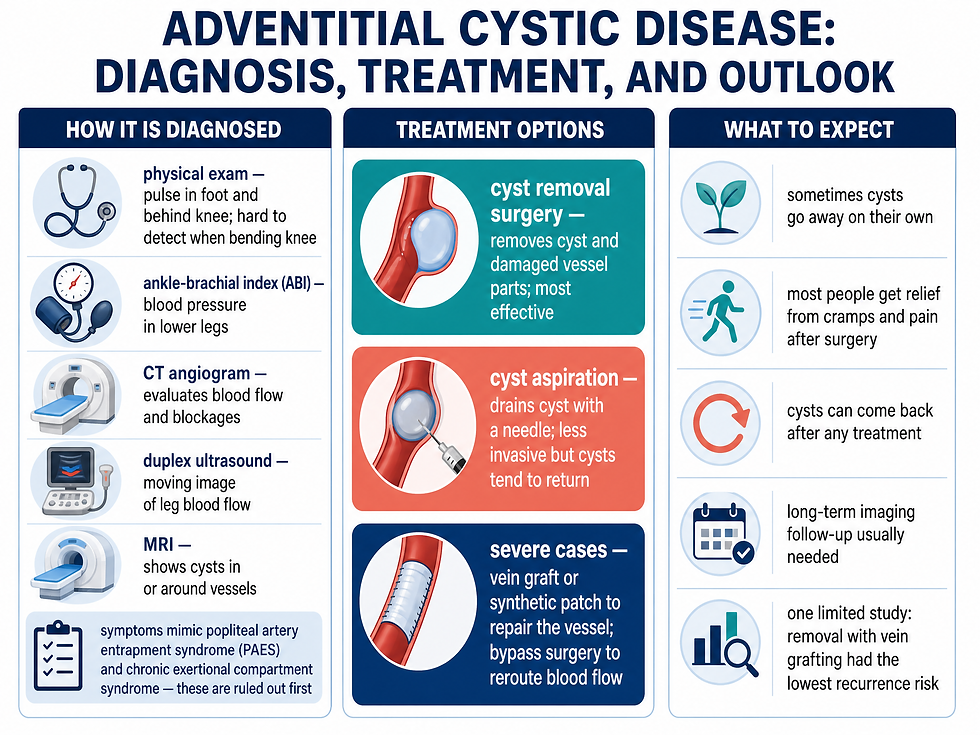
Diagnosis starts with a physical exam checking the pulse in the foot and behind the knee — a pulse that is hard to detect when bending the knee can indicate blockage — plus four tests: the ankle-brachial index, CT angiogram, duplex ultrasound, and MRI, with PAES and compartment syndrome ruled out first. Treatment ranges from cyst removal surgery (most effective), to needle aspiration (less invasive but cysts tend to return), to vein grafts, synthetic patches, or bypass surgery for severe blockage. Outlook: cysts sometimes resolve on their own, most people get relief after surgery, recurrence is possible with any treatment, long-term imaging follow-up is usually needed, and one limited study found removal with vein grafting had the lowest recurrence risk.
How Is Adventitial Cystic Disease Treated?
Sometimes, cysts go away on their own. However, cyst removal surgery is usually the most effective treatment.
Cyst Aspiration
In some cases, your provider may recommend aspirating (draining) the cyst with a needle. Cyst aspiration is less invasive than surgery, but the cysts tend to come back.
Cyst Removal Surgery
A surgeon removes the cyst and any damaged parts of your artery or vein during cyst removal surgery.
Severe Cases
A severe condition — for example, when the blood vessel is mostly blocked — may require a different procedure:
Severe-Case Option | What Happens |
Vein graft | A piece of a vein from elsewhere in your body repairs the blood vessel and restores blood flow |
Synthetic patch | Repairs the blood vessel and restores blood flow |
Bypass surgery | Reroutes blood flow around the blocked blood vessel |
What Is the Outlook for Adventitial Cystic Disease?
With any treatment, there's a possibility that the cyst can come back. Long-term monitoring with imaging exams is usually necessary after treatment.
However, most people found relief from cramps or pain after cyst removal surgery. One limited study found that cyst removal with vein grafting resulted in the lowest risk of cyst recurrence.
How Can I Prevent Adventitial Cystic Disease?
There is no way to prevent adventitial cystic disease. Talk to a healthcare provider at the first signs of leg pain, pressure, cramping, or swelling.
Living With Adventitial Cystic Disease
Questions to Ask Your Healthcare Provider
Are there ways I can reduce leg pain when I exercise?
How can I reduce the risk of the cyst coming back after treatment?
Is there any risk of developing a blood clot?
Will I need surgery to remove the cyst?
Will the cyst go away on its own without treatment?
Conclusion
Adventitial cystic disease is a puzzle wrapped in a rarity: a fluid-filled cyst growing inside the outermost wall of a blood vessel, most often the popliteal artery behind the knee, quietly throttling blood flow to the lower leg whenever you move. It accounts for only about 0.1% of vascular diseases, prefers healthy active men in their 40s and 50s, and pointedly ignores the usual vascular suspects like obesity and high cholesterol. Its signature symptom — exercise-induced calf cramping that vanishes with rest — is easy to brush off, which is exactly why diagnosis requires ruling out mimics like PAES and compartment syndrome before pulses, ABI readings, CT angiograms, ultrasounds, and MRIs find the cyst. Sometimes the cyst simply disappears. More often, surgical removal — ideally with vein grafting, which one limited study linked to the lowest recurrence risk — delivers lasting relief from cramps and pain. The one thing to remember is that no treatment eliminates the chance of return, so long-term imaging follow-up is part of the deal.
CTA: If your calf cramps with exercise and eases with rest — especially if you are a man between 40 and 50 — don't write it off as being out of shape. See a healthcare provider and mention that adventitial cystic disease is on your radar. Ask for a physical exam of your foot and knee pulses plus imaging, and if surgery is recommended, discuss whether a vein graft approach fits your case and what your long-term monitoring plan will look like.
Frequently Asked Questions
What is adventitial cystic disease?
Adventitial cystic disease is a rare condition in which a fluid-filled cyst forms in the adventitia — the outermost wall of an artery or vein. The cyst can block blood flow, especially during movement or exercise. It accounts for about 0.1% of all vascular diseases.
Where do these cysts usually form?
The condition usually affects the popliteal artery behind the knee, which supplies blood to the knee and lower-leg muscles. In about 15% of cases, cysts form in blood vessels other than the popliteal artery.
What does adventitial cystic disease feel like?
The most common symptom is intermittent claudication — muscle cramps or pain caused by reduced blood flow. It typically starts with movement or exercise, goes away with rest, and usually affects just one calf, though it can rarely affect both legs. If the cyst forms in a vein (rare), swelling may occur.
Who is most likely to get adventitial cystic disease?
It is most common in men between 40 and 50, and men are five times more likely than women to develop it. It tends to affect otherwise healthy, active people, and there is no evidence that risk factors for other vascular diseases, such as obesity or high cholesterol, increase the risk.
What causes the cysts to form?
The cause is not definitively known. Theories include cyst-forming cells entering blood vessels during fetal development, certain connective tissue disorders, a tendency to develop cysts near joints, and trauma or repetitive stress damaging blood vessel walls. There is no evidence that it results from cardiovascular disease.
How is it diagnosed?
Diagnosis begins with a physical exam checking pulses in the foot and behind the knee — a pulse that is hard to detect when bending the knee can signal blockage. Providers also rule out mimics such as popliteal artery entrapment syndrome and chronic exertional compartment syndrome, then may order an ankle-brachial index, CT angiogram, duplex ultrasound, or MRI.
How is adventitial cystic disease treated?
Sometimes cysts go away on their own, but cyst removal surgery is usually the most effective treatment, removing the cyst and any damaged vessel parts. Needle aspiration is less invasive but cysts tend to return. Severe blockages may require a vein graft, synthetic patch, or bypass surgery to restore blood flow.
Can the cyst come back after treatment?
Yes — with any treatment, the cyst can return, which is why long-term monitoring with imaging exams is usually necessary. Most people get relief from cramps and pain after cyst removal surgery, and one limited study found that removal with vein grafting carried the lowest recurrence risk.
External References
Medical Disclaimer
This article is for general informational purposes only and is not a substitute for professional medical advice, diagnosis, or treatment. Adventitial cystic disease is a rare vascular condition that can block blood flow to the lower leg, and its symptoms can mimic other serious vascular conditions such as popliteal artery entrapment syndrome and chronic exertional compartment syndrome. Only a licensed healthcare provider can make a diagnosis through physical examination, pulse assessment, and imaging studies such as ABI, CT angiography, duplex ultrasound, or MRI. Exercise-induced leg pain that improves with rest should always be evaluated rather than dismissed. Never delay seeking medical care because of something you have read here.
Comments