Adjustment Disorders: Complete Guide to Symptoms, Types, Causes & Treatment

Updated: 2 days ago
Medically reviewed by Dr. Baraa Alnahhal, MD · Last reviewed: September 2026
Quick Answer
Adjustment disorders are excessive reactions to stress that involve negative thoughts, strong emotions, and changes in behavior — reactions much more intense than would typically be expected for a given life change. Symptoms begin within three months of a stressful event and usually ease within six months after the stress ends, though ongoing stressors (like unemployment) can prolong them. The main treatment is talk therapy, sometimes combined with antidepressants or anti-anxiety medicines — and treatment often needs to be brief, because the goal is to help you regain your emotional well-being.
TL;DR
What it is: An excessive emotional or behavioral reaction to a life change or stressor — stronger than typically expected.
Timing: Symptoms start within 3 months of the stressful event and usually resolve within 6 months of it ending.
Six types: Depressed mood, anxiety, mixed, disturbed conduct, disturbed emotions and conduct, or unspecified.
Common stressors: Job loss, divorce, illness, moving, retirement, loss of a loved one — but even positive changes count.
Main treatment: Talk therapy (individual, group, or family), sometimes with short-term medicines.
The upside: It's often brief, treatable, and a stepping stone back to emotional well-being.
Adjustment Disorder at a Glance
What it is: Excessive reactions to stress involving negative thoughts, strong emotions, and behavior changes.
Trigger: Major life changes or stressors — both positive and negative.
Symptom onset: Within 3 months of the stressful event.
Typical duration: Resolves within 6 months after the stressor ends; ongoing stress can prolong it.
Six types: Depressed mood, anxiety, mixed, disturbed conduct, disturbed emotions and conduct, unspecified.
Key risk groups: People facing multiple simultaneous stressors, ongoing stressors, or with prior mental health conditions.
Main treatment: Talk therapy, sometimes antidepressants or anti-anxiety medicines.
Outlook: Often brief treatment; treatment helps restore emotional well-being.
Note: This article is for general information only and is not a substitute for professional medical advice. Always consult a qualified healthcare professional for diagnosis and treatment.
What Is an Adjustment Disorder?
Adjustment disorders are excessive reactions to stress that involve negative thoughts, strong emotions, and changes in behavior. The reaction to a stressful change or event is much more intense than would typically be expected, and this can cause significant problems in getting along with others, as well as at work or school.
Work problems, going away to school, an illness, or any number of life changes can cause stress. Most of the time, people get used to such changes within a few months. But if you have an adjustment disorder, the emotional or behavioral responses continue and can make you feel more anxious or depressed.
The encouraging truth: treatment can help you regain your emotional well-being.
Adjustment Disorder Symptoms: What to Watch For
Symptoms depend on the type of adjustment disorder and vary from person to person. The core pattern: you experience more stress than would generally be expected in response to a trying event, and this stress causes a lot of problems in your life. Adjustment disorders affect how you feel and think about yourself and the world, and they may also affect your actions or behavior.
Symptoms may include:
Feeling sad, hopeless, or not enjoying things you used to enjoy
Crying often
Worrying, or feeling anxious, nervous, jittery, or stressed out
Feeling irritable, like you can't handle anything and don't know where to start
Having trouble sleeping
Not eating enough
Having difficulty concentrating
Having difficulty with daily activities
Withdrawing from family and friends who support you socially
Not doing important things, such as going to work or paying bills
Thinking about suicide or acting on those thoughts
The Timing Rules
Two time markers are central to recognition and diagnosis:
Symptoms start within three months of a stressful event.
They last no longer than six months after the end of the stressful event.
But constant or lasting adjustment disorders can continue for more than six months — especially when the stressful event is ongoing, such as being unemployed.
When to See a Doctor
Stressors are usually temporary. You learn to cope with them over time, and symptoms usually get better when the stress eases. But sometimes the stressful event continues to be part of your life, or a new stressful situation arises and you face the same emotional struggles all over again.
Talk to your doctor or a mental health professional if you continue to struggle or if you're having trouble getting through each day. You can get treatment to help you cope better with stressful events and feel better about life again. If you have concerns about your child's behavior, talk with your child's doctor.
If you're thinking about suicide: the risk of suicide can be higher in people with adjustment disorders. In the U.S., call or text 988 to reach the Suicide & Crisis Lifeline — available 24 hours a day, every day, free and private — or use the Lifeline Chat. U.S. veterans or service members can call 988 and press 1 for the Veterans Crisis Line, text 838255, or chat online. A Spanish-language line is available at 1-888-628-9454 (toll-free).
Adjustment Disorder Causes: What Science Knows
Adjustment disorders are caused by major changes or stressors in your life. Genetics, your life experiences, and your temperament may make it more likely that an adjustment disorder happens.
Risk Factors: Who Is Vulnerable?
Stressful life events and experiences — positive and negative — may put you at risk:
Childhood stress: Major stress as a child, such as bullying or difficulties with school.
Relationship strain: Divorce or marriage problems; relationship problems or trouble getting along with others.
Major life changes: Retirement, having a baby, or moving away.
Loss and setbacks: Losing a job, loss of a loved one, or money problems.
School or work trouble: Problems in school or at work.
Trauma: Life-threatening experiences, such as physical assault, combat, or natural disaster.
Ongoing stressors: Having a medical illness or living in a neighborhood with a lot of crime.
Multiple stressors: More than one major change or bad experience happening at the same time.
Other mental health conditions: Major depression, intense anxiety, or post-traumatic stress disorder.
Notice what this list reveals: adjustment disorders are not limited to tragedy. Even positive changes — a new baby, a move to a better place, retirement — can trigger them, because any major change demands adjustment.
Complications: Why It's Worth Treating
If adjustment disorders do not resolve, they eventually can lead to more-serious mental health conditions such as:
Anxiety
Major depression
Misuse of drugs or alcohol
This is the strongest practical argument for seeking help early rather than waiting it out indefinitely.
Can Adjustment Disorders Be Prevented?
There are no guaranteed ways to prevent adjustment disorders. But social support, healthy coping skills, and learning to recover quickly from hard times may help you during periods of high stress.
If you know a stressful situation is coming — such as a move or retirement — plan ahead:
Increase your healthy habits in advance.
Ask your friends and family for support.
Remind yourself that stressful situations pass in time and that you can get through them.
Check in with your health care team or a mental health professional to review healthy ways to manage your stress.
How Adjustment Disorders Are Diagnosed
A mental health professional can find out if you have an adjustment disorder by talking with you to identify major life stressors, your symptoms, and how they affect your ability to live life. You'll likely be asked about your medical, mental health, and social history.
Established guidelines require:
Timing: Emotional or behavioral symptoms within three months of a specific stressful event.
Intensity or impact: Higher-than-expected stress in response to the event, or stress that causes a lot of problems in connections with others, or at work or school.
Exclusion: Symptoms are not due to another mental health problem or part of the typical grieving process.
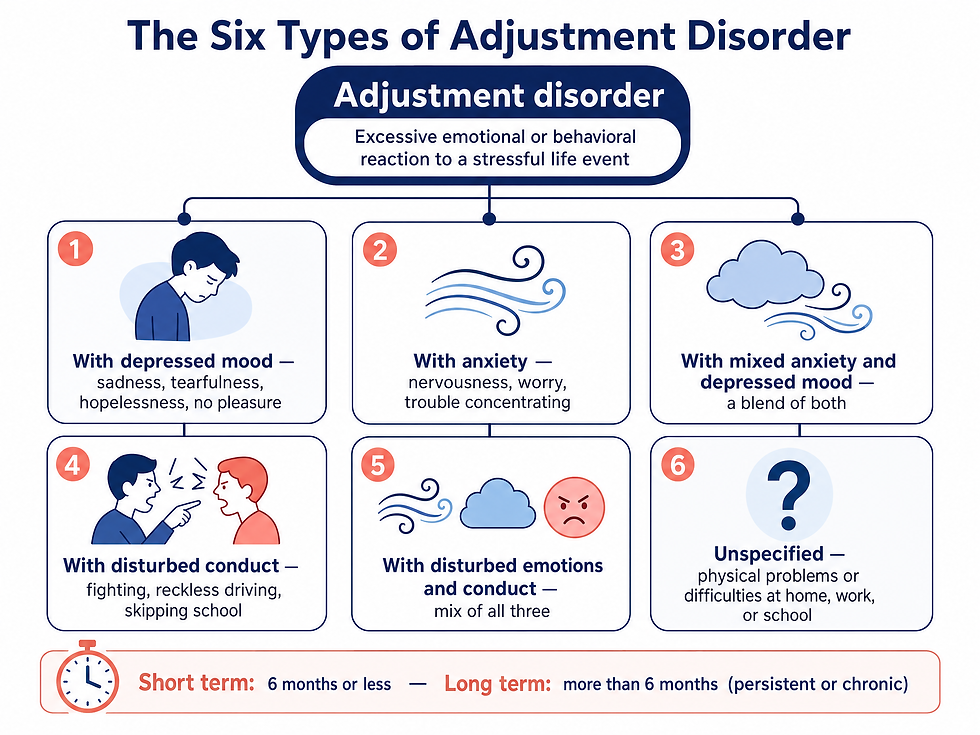
The six recognized types of adjustment disorder, plus how duration determines the short-term and long-term categories. Source: rinnit.com
The Six Types of Adjustment Disorder
With depressed mood: Feeling sad, tearful, and hopeless; very tired; taking no pleasure in things you used to enjoy.
With anxiety: Nervousness, worry, hard time concentrating or remembering, feeling overwhelmed; children may strongly fear being separated from parents and loved ones.
With mixed anxiety and depressed mood: A blend of depression and anxiety symptoms.
With disturbed conduct: Behavioral problems such as fighting or reckless driving; children and teenagers may skip school or damage or destroy property.
With disturbed emotions and conduct: A mix of depression, anxiety, and behavioral problems.
Unspecified: Symptoms don't fit the other types; often includes physical problems, problems with family or friends, or problems at work or school.
How Long It Lasts
The length of symptoms also varies, producing two duration categories:
Short term (acute): symptoms last six months or less; they should ease once the stressful event passes.
Long term (persistent or chronic): symptoms last more than six months; they continue to bother you and disrupt your life.
Adjustment Disorder Treatment: What Actually Works
Many people with adjustment disorders find treatment helpful, and they often need only brief treatment. Those with persistent adjustment disorders or ongoing stress may benefit from longer treatment. Options include talk therapy, medicines, or both.
Talk Therapy
Talk therapy (talk psychotherapy) is the main treatment for adjustment disorders. It can be provided individually, in a group, or with a family. Therapy can:
Provide emotional support
Help you get back to your typical routine
Help you learn why the stressful event affected you so much
Help you learn stress management and coping skills to deal with stressful events
Medicines
Medicines such as antidepressants and anti-anxiety drugs may be used alongside talk therapy to help with symptoms of depression and anxiety. As with therapy, you may need medicines only for a few months.
One critical safety rule: do not stop taking any medicine without talking with your health care professional first. If stopped suddenly, some medicines — certain antidepressants among them — may cause physical reactions that make you feel sick.
Building Resilience: Lifestyle and Home Strategies
Resilience is the ability to adapt well to stress, hardships, or tragedy — to bounce back after a very hard time. These strategies can help build it:
Stay connected with loved ones and friends who are positive and support you in healthy ways.
Do something that brings joy and a sense of accomplishment and purpose every day.
Live a healthy lifestyle: good sleep, a healthy diet, and regular physical activity.
Practice mindfulness, such as through journaling, prayer, or yoga.
Learn from past experiences about how to improve your coping skills.
Be hopeful about the future and try to be positive.
Stay away from alcohol, drugs, and other addictive substances.
Look for and develop your personal strengths.
Face your fears and accept challenges.
Work to achieve your goals and plan to handle problems when they occur rather than avoiding them.
Finding Support
It may help to talk things over with loved ones and friends. You can also ask for support from a faith community or find a support group for your situation.
Talking With Your Child About Stressful Events
If your child is finding it hard to adjust, gently urge your child to talk about what they're going through. Many parents assume that talking about a hard change, such as divorce, will make a child feel worse — but your child needs to be able to express feelings of grief and hear you tell them that you'll remain a constant source of love and support.

A quick reference: key facts, common symptoms, safety guidance, and treatment options for adjustment disorder. Source: rinnit.com
Preparing for Your Appointment
You may start by seeing your primary care professional or a mental health specialist for evaluation and treatment. If possible, take notes during the visit or bring along a family member or friend to help you remember information.
What You Can Do
Make a list of:
Any symptoms you have, how long you've had them, and what makes them better or worse
Key personal information, including major stresses or recent life changes — positive and negative
Medical information, including other physical or mental health conditions, all medicines, vitamins, herbs, or supplements, and their doses
Questions to ask, such as: What do you think is causing my symptoms? Are there other possible causes? Is my condition short term or long term? Do you recommend treatment, and with what approach? How soon do you expect improvement? Should I see a mental health specialist? Do you recommend temporary changes at home, work, or school? What printed materials or websites do you recommend?
What to Expect From the Doctor
Be ready to answer questions such as:
What are your symptoms, and when did you or your loved ones first notice them?
What major changes have recently occurred in your life — positive and negative?
How have you tried to cope with these changes?
How often do you feel sad, depressed, anxious, or worried? Do you think about suicide?
Do you have trouble sleeping or finishing tasks you used to manage?
Are you staying away from social or family events? Any problems at school or work?
Any impulsive decisions or reckless behavior that doesn't seem like you?
Do you drink alcohol or use recreational drugs? How often?
Have you been treated for other mental health conditions? What therapy helped most?
Frequently Asked Questions (FAQ)
What is an adjustment disorder?
An adjustment disorder is an excessive reaction to stress involving negative thoughts, strong emotions, and behavior changes — a reaction much more intense than would typically be expected for a given life change. It can cause significant problems in relationships and at work or school, and it usually develops within three months of the stressful event.
What causes an adjustment disorder?
Adjustment disorders are caused by major life changes or stressors, including both negative events (job loss, divorce, illness) and positive ones (retirement, a new baby, moving). Genetics, life experiences, and temperament can influence how likely someone is to develop one.
How long does an adjustment disorder last?
Most adjustment disorders are short term, with symptoms lasting six months or less and easing once the stressful event passes. Long-term (persistent or chronic) forms last more than six months, especially when the stressor is ongoing, such as unemployment.
What are the six types of adjustment disorder?
The types are: with depressed mood (sadness, tearfulness, hopelessness), with anxiety (nervousness, worry, trouble concentrating), with mixed anxiety and depressed mood, with disturbed conduct (fighting, reckless driving, skipping school), with disturbed emotions and conduct (a mix), and unspecified (often involving physical problems or difficulties at home, work, or school).
How is adjustment disorder treated?
Talk therapy is the main treatment, provided individually, in a group, or with a family. It offers emotional support, helps you return to routine, and builds stress management and coping skills. Antidepressants and anti-anxiety medicines may be added for a few months when depression or anxiety symptoms are significant. Many people need only brief treatment.
Can you prevent an adjustment disorder?
There are no guaranteed ways to prevent it, but social support, healthy coping skills, and the ability to recover quickly from hard times help. When a known stressor is coming, plan ahead: strengthen healthy habits, ask friends and family for support, and check in with your health care team about stress management.
Conclusion
Three lessons anchor this guide: adjustment disorders are about the reaction, not the event — the trigger can be any major life change, positive or negative; what defines the disorder is a response far stronger than expected that disrupts daily life; it has a natural timeline — symptoms start within three months and usually resolve within six months of the stressor ending, which makes it one of the most treatable and time-limited mental health conditions; and help works, and it's often brief — talk therapy is the main treatment, medicines add support when needed, and resilience-building habits keep the recovery going.
This guide walked you through the symptom picture, the timing rules, the six types, risk factors, why early treatment matters, the diagnostic criteria, every treatment option, and practical resilience strategies for you and your children. If a recent life change has been harder than you expected, the most valuable next step is a conversation with a mental health professional — because getting through it is the whole point of treatment, and you don't have to get through it alone.
References
This content is provided for general informational purposes only and is not a substitute for professional medical advice, diagnosis, or treatment. Always seek the advice of a qualified healthcare provider with any questions about a medical condition.
Comments