Acanthocytosis: Symptoms, Causes, Diagnosis, and Treatment (2026 Guide)

Updated: 2 days ago
Medically reviewed by Dr. Baraa Alnahhal, MD · Last reviewed: September 2026
TL;DR
Acanthocytosis (pronounced "uh-kan-thoh-sigh-TOH-sis") means you have acanthocytes — abnormal red blood cells with uneven, thorn-like spikes — in your blood. Most people have a few with no problems, but when too many red cells take this shape, the spleen destroys them faster than the body replaces them, causing hemolytic anemia. The three most common causes are severe liver disease, abetalipoproteinemia, and neuroacanthocytosis — the condition is usually a sign of an underlying illness rather than an illness itself. It's diagnosed with a peripheral blood smear under a microscope, treatment targets the cause, and some cases are fully reversible. Acanthocytosis linked to severe liver disease is serious — most people with spur cell anemia die within months.
Quick Answer
What is acanthocytosis?
The presence of abnormal spiky red blood cells called acanthocytes in your blood; "acanth" is Greek for thorn, and "cyte" means cell.
The spiky shape makes the spleen destroy these cells faster, which can cause hemolytic anemia if enough cells are affected.
The most common causes are severe liver disease, the genetic disorder abetalipoproteinemia, and neuroacanthocytosis — plus anorexia, hypothyroidism, kidney disease, spleen removal, and some medications.
It is diagnosed with a peripheral blood smear under a microscope, treated by addressing the underlying cause, and some forms are fully reversible.
What Is Acanthocytosis?
Acanthocytosis (pronounced "uh-kan-thoh-sigh-TOH-sis") involves having abnormal spiky red blood cells called acanthocytes in your blood. "Acan" is the Greek word for thorn, spine, or prickle, and "cyte" means cell. Instead of being round like a normal red blood cell, acanthocytes have uneven thorn-like projections.
The unusual shape makes it more likely that your spleen will destroy them. Your spleen filters your blood by destroying old and damaged blood cells — and spiky cells look damaged.
Most people have a few acanthocytes in their blood, and it doesn't usually cause problems. But if too many of your red blood cells are acanthocytes, their destruction in your spleen can leave you with too few red blood cells — a condition called hemolytic anemia.

Acanthocytosis is also a sign of several different diseases and disorders. The presence of acanthocytes in blood helps healthcare providers diagnose conditions — which is why a spiky cell finding on a blood smear is always worth a proper follow-up.
What Are the Symptoms?
Acanthocytosis can cause hemolytic anemia if your spleen destroys too many red blood cells. The main signs and symptoms of that anemia are:
Jaundice: Yellowing of your skin and eyes
Fatigue: Severe exhaustion
Shortness of breath: Dyspnea — breathlessness even with mild effort
Fast heartbeat: Tachycardia
Blood in your pee: Hematuria
Stomach pain: Usually from an enlarged spleen
You may have other symptoms too, depending on what's causing the acanthocytes. Conditions that cause acanthocytosis bring their own symptoms:
Weight loss (slow growth in babies): Abetalipoproteinemia, anorexia
Problems coordinating muscle movements: Ataxia — linked to neuroacanthocytosis
Involuntary movements (tics): Neuroacanthocytosis
Trouble thinking and remembering: Cognitive impairment
Trouble digesting foods: Fat absorption disorders
Pale, fatty poop: Steatorrhea
Dark-colored pee: Hemolysis — blood cells breaking down
What Causes Acanthocytosis?
Conditions that affect the cell membrane of red blood cells cause acanthocytosis. The membrane is made of fats (lipids) and proteins. Diseases that impact these key ingredients can cause red blood cells to take on a spiky shape instead of a round one.
These spiky cells pass through your spleen, but your spleen can't easily filter them. Instead, it destroys them — or it may change them by blunting the spikes before sending them back into your bloodstream. These remodeled acanthocytes are sometimes called "spur cells."
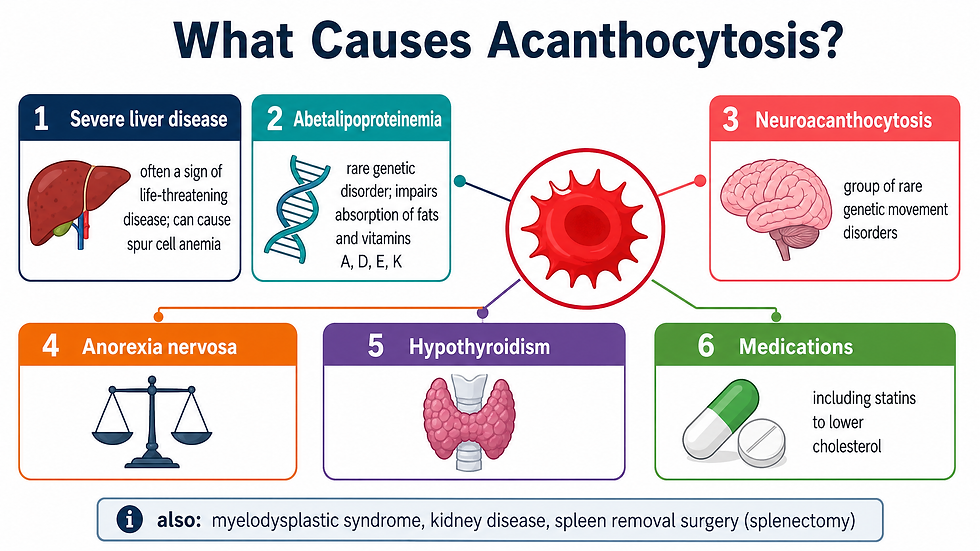
The Three Most Common Causes
Severe liver disease. Acanthocytes are often a sign of life-threatening liver disease. Some people with liver disease develop spur cell anemia (SPA), a condition in which you have spur cells in your blood and a low red blood cell count.
Abetalipoproteinemia. This is a rare genetic disorder you inherit from a biological parent. It makes it harder for your body to absorb fats and the fat-soluble vitamins A, D, E, and K.
Neuroacanthocytosis. This refers to a group of rare genetic disorders that cause you to lose control of how your body moves. Types include chorea-acanthocytosis, McLeod syndrome, pantothenate kinase-associated neurodegeneration (PKAN), and Huntington's disease-like 2.
Other Causes
Anorexia nervosa: Eating disorder affecting nutrition and blood cell production
Hypothyroidism: Underactive thyroid
Myelodysplastic syndrome: Blood and bone marrow disorder
Kidney disease: Impaired kidney function
Splenectomy: Surgery to remove your spleen
Certain medications: Including statins used to lower cholesterol
How Is Acanthocytosis Diagnosed?
Your healthcare provider can tell if you have acanthocytosis by doing a peripheral blood smear (PBS). They examine a blood sample beneath a microscope and check for cells with uneven spikes.
To find out what's causing acanthocytosis, you may need other blood tests:
Complete blood count (CBC): Overall red blood cell levels
Liver function tests: Liver disease, the most common cause
Kidney function tests: Kidney disease
Thyroid tests: Hypothyroidism
Lipid panel: Fat-related disorders like abetalipoproteinemia
Genetic tests: Gene variations associated with inherited conditions
You may need other tests too, like imaging to check for tissue or organ damage.

How Is Acanthocytosis Treated?
Treatment for acanthocytosis depends on the cause. Usually, your red blood cells return to normal once you get treatment for the underlying condition.
Liver disease and neuroacanthocytosis. Medications help manage symptoms for both conditions. These aren't usually reversible — they typically worsen over time. Severe liver disease is curable, but only with a liver transplant.
Abetalipoproteinemia. This usually requires eating less unhealthy fats while getting enough calories. You may need supplements to get the vitamins needed to make healthy red blood cells — vitamins A, D, E, and K.
Anorexia and hypothyroidism. Acanthocytosis related to these conditions is reversible with treatment.
Medications. Stopping a medication that's causing acanthocytosis usually reverses it.
What Is the Outlook?
In some cases, acanthocytosis is reversible with treatment.
But with many causes, your prognosis depends on how quickly you get diagnosed and treated. For example, both neuroacanthocytosis and abetalipoproteinemia can cause long-term tissue damage — but early treatment may slow symptom progression.
The most serious scenario involves the liver. Acanthocytosis in liver disease is usually a sign that things are serious, and most people with spur cell anemia die within months.
Ultimately, your outlook depends on your overall health and what's causing the acanthocytes. Your healthcare provider is your best resource for explaining what acanthocytosis means for you.
Can Acanthocytosis Be Prevented?
There's no way to prevent having a genetic disorder that causes acanthocytosis. But in some cases, adopting certain behaviors can reduce your risk:
Avoid alcohol or drink only in moderation: Reduces your risk of alcohol-related liver disease
Eat nutritious foods: You need enough nutrients to make red blood cells; a dietitian can help you choose the right foods
Seek early treatment: Some causes worsen quickly without treatment; early diagnosis helps you maintain your health
Living With It
Follow your healthcare provider's treatment plan to manage the condition causing your acanthocytosis. If you have a genetic disorder that causes acanthocytosis, consider genetic counseling — a counselor can advise you on how your condition may impact you and your family members, and discuss the likelihood of passing on the gene variation.
Questions to ask your healthcare provider: Should I be concerned about having acanthocytes in my blood? What tests will I need to determine the cause? What treatments do you suggest? What outcomes can I expect? Should I see a genetic counselor?
Conclusion
Acanthocytosis itself isn't a disease — it's a finding. Spiky red blood cells on a blood smear tell your provider something is affecting the cell membrane, whether that's a failing liver, a rare genetic disorder, a hormonal imbalance, or a medication side effect. Some cases, like those caused by hypothyroidism or a drug, reverse completely once the cause is addressed. Others, like spur cell anemia from severe liver disease, signal an urgent situation.
The two takeaways that matter most: the microscope finding is a clue, not the final answer — it should always trigger testing for the underlying cause; and timing changes outcomes — the genetic causes can be slowed by early treatment, and the liver-related cause is the one where delay is measured in months, not years.
Had a blood smear that showed acanthocytes or spiky red blood cells? Bring the result to your healthcare provider for a full workup — liver, thyroid, kidney, lipid, and possibly genetic tests — and ask directly what the finding means for your health and what the next step is.
Frequently Asked Questions
What is acanthocytosis?
Acanthocytosis means you have acanthocytes — abnormal red blood cells with uneven, thorn-like projections — in your blood. It is pronounced "uh-kan-thoh-sigh-TOH-sis."
Is acanthocytosis dangerous?
Not by itself — most people have a few acanthocytes with no problems. But too many of them can cause hemolytic anemia, and the finding can signal serious conditions like severe liver disease.
What causes spiky red blood cells?
Conditions that damage the red blood cell membrane (made of fats and proteins). The most common causes are severe liver disease, abetalipoproteinemia, and neuroacanthocytosis; others include anorexia, hypothyroidism, myelodysplastic syndrome, kidney disease, spleen removal, and some medications like statins.
What is spur cell anemia?
Spur cell anemia (SPA) happens when your spleen blunts the spikes on acanthocytes, creating "spur cells" — and your red blood cell count drops low. It most often follows severe liver disease, and most people with spur cell anemia die within months.
How is it diagnosed?
With a peripheral blood smear (PBS): a provider examines a blood sample under a microscope and looks for cells with uneven spikes. Additional tests — CBC, liver, kidney, thyroid, and lipid panels, plus genetic tests — identify the cause.
Is it curable or reversible?
It depends on the cause. Cases from anorexia, hypothyroidism, or medications are usually reversible with treatment or by stopping the drug. Severe liver disease is curable only with a transplant, and the genetic causes aren't reversible but can be slowed with early treatment.
Can it be prevented?
Genetic causes can't be prevented, but you can reduce risk of the liver-related cause by limiting alcohol, eating nutritious foods, and seeking early treatment for conditions before they worsen.
References
This article is based on medically reviewed clinical information from Acanthocytosis, which draws on the clinical literature surrounding red blood cell membrane disorders, including Chorea-Acanthocytosis (GeneReviews) and peer-reviewed work on spur cell anemia and advanced liver disease.
This article is for educational purposes only and is not a substitute for professional medical advice. A finding of acanthocytes on a blood smear should be evaluated by a healthcare provider, as it can indicate conditions that require prompt treatment.
Comments