Absence Seizures: What They Look Like, Who Gets Them, and How They Are Treated

Updated: 2 days ago
Medically reviewed by Dr. Baraa Alnahhal, MD · Last reviewed: September 2026
Editorial note: This article is provided for educational purposes only. It is not medical advice. Always consult a qualified healthcare professional for diagnosis and treatment of any condition.
TL;DR
Absence seizures (once called "petit mal" seizures) are brief episodes of staring and unresponsiveness lasting only a few seconds, most common in children between ages 4 and 14. They can be mistaken for daydreaming, but they start and stop abruptly and the person has no memory of the episode. Most children outgrow them by their teenage years, and the condition is usually well controlled with anti-seizure medication.
Quick Answer
An absence seizure is a brief, generalized seizure marked by a sudden lapse in awareness — the person stops what they are doing, stares blankly, and does not respond, typically for 5 to 15 seconds. It resolves as suddenly as it starts, with no confusion or memory of the event afterward. They are most common in children and are usually diagnosed with an EEG showing a characteristic 3-Hz spike-and-wave pattern. First-line treatment is ethosuximide or valproic acid, and many children outgrow the condition entirely.
What is an absence seizure?
An absence seizure is a type of generalized seizure that causes a brief lapse in awareness and responsiveness. It was formerly called a "petit mal" seizure — French for "little illness" — a term still occasionally used but now considered outdated.
During the episode, a person suddenly stops their activity, develops a blank, vacant stare, and becomes unresponsive to their surroundings. There is no falling, no convulsing, and typically no warning. The episode ends just as abruptly as it began, and the person resumes what they were doing with no memory of the seizure and no postictal confusion.

How is an absence seizure different from daydreaming?
Because the two can look alike, absence seizures are frequently mistaken for inattention, boredom, or daydreaming — especially in a classroom setting. A few distinguishing features usually separate the two.
Feature | Absence seizure | Daydreaming |
Onset | Sudden, mid-activity | Gradual |
Duration | Usually 5–15 seconds | Variable, often longer |
Response to touch/voice | No response during the episode | Usually responds if prompted |
Automatisms | Eye fluttering, lip smacking, or subtle movements possible | Absent |
Recall afterward | No memory of the episode | Aware of drifting off |
Frequency | Can occur dozens to hundreds of times per day | Occasional |
That last row often provides the biggest clue: a child having many episodes a day, each just a few seconds long, is far more suggestive of a seizure disorder than ordinary inattention.
Who gets absence seizures?
Absence seizures are a childhood-predominant condition. Onset most commonly occurs between the ages of 4 and 14, with peak onset around ages 5 to 7. They are somewhat more common in girls than boys.
Childhood absence epilepsy is one of the most common forms of epilepsy in children, and in many cases the seizures diminish and resolve on their own with age.
Factor | What is typical |
Age of onset | 4–14 years old; peak around 5–7 years |
Sex distribution | Slightly more common in girls |
Family history | Genetic predisposition is common; family history of epilepsy raises risk |
Outlook by adolescence | Many children outgrow absence seizures by their teenage years |

What causes absence seizures?
Absence seizures result from abnormal electrical activity in the brain that briefly disrupts normal consciousness. The exact trigger for any single episode is often unclear, but several contributing factors are recognized.
Contributing factor | Notes |
Genetics | A family history of epilepsy or absence seizures raises risk |
Age-related brain development | Peak onset coincides with specific developmental windows |
Sleep deprivation | Can lower seizure threshold and provoke episodes |
Hyperventilation | A known trigger; sometimes used deliberately during EEG testing to provoke a seizure for diagnosis |
Flashing lights | Can trigger episodes in photosensitive individuals |
What are the symptoms of an absence seizure?
The core symptom is a brief, sudden lapse in awareness, but several accompanying features can appear alongside the blank stare.
Symptom | Description |
Blank stare | Vacant, unresponsive expression during the episode |
Sudden stop in activity | Speech, walking, or a task halts mid-motion |
Eyelid fluttering | Rapid blinking during the episode |
Lip smacking or chewing motions | Subtle automatic movements |
Slight head or hand movements | Minor, repetitive motions |
No memory of the event | The person cannot recall the seizure afterward |
No confusion afterward | Unlike some other seizure types, recovery is immediate |
Because episodes are so brief and leave no obvious aftermath, absence seizures can go unnoticed for months, often coming to attention only when a parent or teacher notices a pattern of repeated brief lapses, or when schoolwork begins to suffer from missed information during frequent episodes.
How are absence seizures diagnosed?
Diagnosis relies on a combination of the clinical history and a specific EEG finding.
Diagnostic step | What it involves |
Clinical history | Detailed account from parents, teachers, or the patient about episode frequency and appearance |
EEG (electroencephalogram) | The key test; shows a characteristic generalized 3-Hz spike-and-wave pattern during an episode |
Hyperventilation provocation | Often used during EEG to help trigger a seizure for observation |
MRI brain imaging | Sometimes ordered to rule out structural causes, though usually normal in absence epilepsy |
Blood tests | May be used to rule out metabolic causes |
The 3-Hz spike-and-wave EEG pattern is considered the hallmark diagnostic finding and helps distinguish absence seizures from other seizure types and from non-epileptic staring spells.
How are absence seizures treated?
Absence seizures are generally well controlled with medication, and treatment goals focus on eliminating seizures while minimizing side effects.
Treatment | Role |
Ethosuximide | Often the first-choice medication specifically for absence seizures |
Valproic acid (valproate) | Effective first-line option, particularly if other seizure types are also present |
Lamotrigine | An alternative option, sometimes used when first-line drugs are not well tolerated |
Regular follow-up EEGs | Used to monitor treatment response |
Avoiding known triggers | Adequate sleep and trigger avoidance support seizure control |
Most children respond well to a single medication, and many can eventually taper off treatment under medical supervision once they have been seizure-free for an extended period.
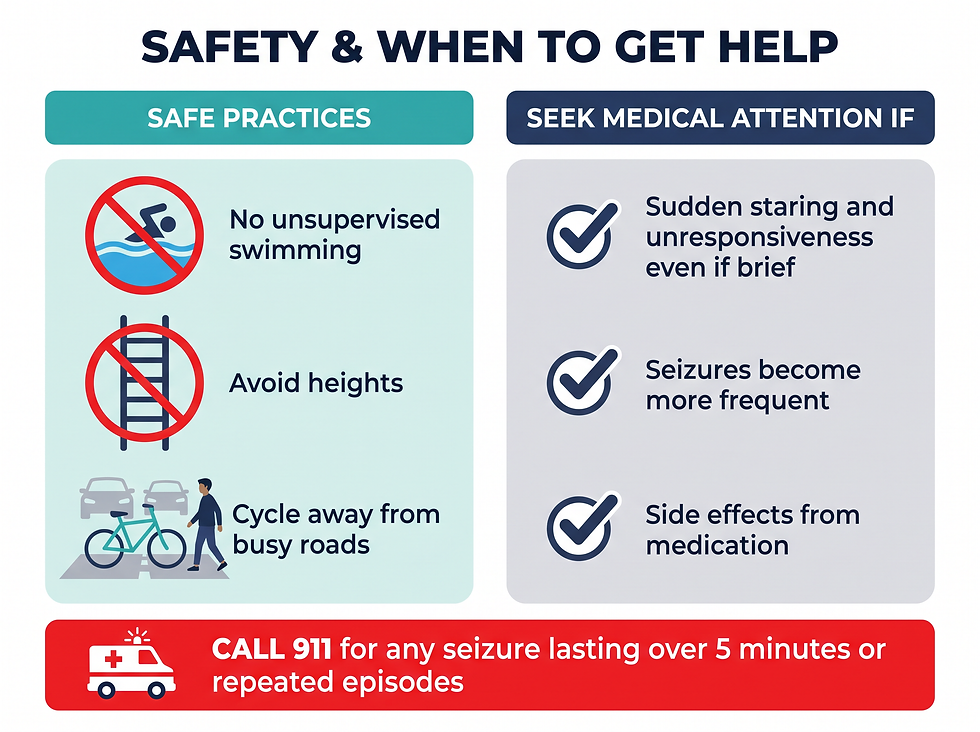
What safety precautions should be taken?
Because absence seizures cause a brief loss of awareness without warning, a few practical safety measures reduce risk during daily activities.
Situation | Precaution |
Swimming or bathing | Always supervise; never swim alone |
Cycling or climbing | Use protective gear; adult supervision for young children |
School | Inform teachers so episodes are recognized rather than mistaken for inattention |
Driving (adolescents/adults) | Follow local licensing regulations regarding seizure control before driving |
Sleep | Maintain a consistent, adequate sleep schedule to reduce triggers |
What is the long-term outlook?
The prognosis for childhood absence epilepsy is generally favorable. A large proportion of children outgrow the condition by their teenage years, especially when seizures are well controlled with medication from an early age.
A minority of children continue to have seizures into adulthood, or the condition can evolve into another seizure type over time, which is why ongoing follow-up with a neurologist is recommended even after seizures appear to have stopped.
Related reading: For a broader look at seizure disorders, see our Epilepsy Guide: Symptoms, Causes, Diagnosis, and Treatment. Some patients also experience overlapping neurological symptoms — our guide to Migraine Headaches: What Causes Them and How to Treat Them covers another common condition that can accompany seizure disorders.
Bottom line: what every reader should remember
Absence seizures are brief, sudden lapses in awareness — not daydreaming — most common in children between 4 and 14. The tell-tale signs are a sudden stop mid-activity, a blank stare lasting seconds, and no memory afterward. An EEG confirms the diagnosis, and most children respond very well to medication and eventually outgrow the condition.
Take action today: If you notice a child having repeated brief staring spells, especially several times a day, write down the frequency and describe what you observe, then schedule an evaluation with a pediatrician or neurologist. Early diagnosis and treatment help protect learning and daily safety. For education and information purposes only; this is not a substitute for professional medical care.
Frequently Asked Questions
1. Are absence seizures the same as petit mal seizures?
Yes. "Petit mal" is the older French term for what is now called an absence seizure. The terms describe the same condition.
2. How long does an absence seizure last?
Most absence seizures last only 5 to 15 seconds. They begin and end abruptly, with no warning and no confusion afterward.
3. Can adults have absence seizures?
Absence seizures are most common in children, but a minority of cases persist into adulthood or the seizure type evolves as the person ages.
4. Do absence seizures cause brain damage?
There is no evidence that typical absence seizures themselves cause brain damage, though frequent unrecognized episodes can interfere with learning if they go untreated.
5. Will my child outgrow absence seizures?
Many children outgrow absence seizures by their teenage years, particularly with good seizure control. A minority continue to have seizures or develop another seizure type.
6. What triggers an absence seizure?
Common triggers include sleep deprivation, hyperventilation, and flashing lights. In many cases, no clear trigger is identified for a given episode.
7. How is an absence seizure diagnosed?
Diagnosis is based on the clinical history plus an EEG showing a characteristic 3-Hz spike-and-wave pattern, sometimes provoked with hyperventilation during testing.
8. What is the best medication for absence seizures?
Ethosuximide and valproic acid are the typical first-line medications. Lamotrigine is an alternative option when first-line drugs are not well tolerated.
References
Cleveland Clinic. "Absence Seizures (Petit Mal Seizures)." my.clevelandclinic.org
StatPearls (NIH/NCBI Bookshelf). "Absence Seizure." ncbi.nlm.nih.gov
Epilepsy Foundation. "Absence Seizures." epilepsy.com
Mayo Clinic. "Absence seizure - Symptoms and causes." mayoclinic.org
MedlinePlus (U.S. National Library of Medicine). "Absence seizure." medlineplus.gov
Mayo Clinic. "Absence seizure - Diagnosis and treatment." mayoclinic.org
Johns Hopkins Medicine. "Absence Seizures." hopkinsmedicine.org
Comments