Abscessed Tooth: Symptoms, Causes, Diagnosis, and Treatment

Updated: 2 days ago
Medically reviewed by Dr. Baraa Alnahhal, MD · Last reviewed: September 2026
Editorial note: This article is for educational purposes only and is not a substitute for professional dental or medical advice. A swollen face, high fever, confusion, or trouble swallowing with a toothache is a medical emergency — seek care immediately. Information reflects current published clinical sources as of August 2026.
TL;DR
A tooth abscess is a pocket of pus caused by a bacterial infection in your gums or tooth. It usually appears as a red, swollen bump or boil, causes severe shooting or throbbing pain, and can spread to the jawbone, face, neck, and beyond — in extremely rare cases to the heart or brain. Three types exist: gingival, periapical, and periodontal. A tooth abscess will never heal on its own — even if the pain stops, the bacteria keep spreading. Treatment (drainage, root canal, extraction, sometimes antibiotics) from a dental provider is essential.
Quick Answer: What is an abscessed tooth?
A pocket of pus from a bacterial infection, usually appearing as a red, swollen bump, boil, or pimple on the gums.
Caused by bacteria entering a tooth through a severe cavity, crack, fracture, gum disease, or injury.
It will not go away on its own — it requires treatment from a dental healthcare provider.
Seek a dentist right away; go to the emergency room for facial swelling, fever of 100.4°F (38°C) or higher, confusion, trouble swallowing, or a rapid heart rate.
What Is a Tooth Abscess?
A tooth abscess is a pocket of pus from a bacterial infection in your gums. An abscess usually looks like a red, swollen bump, boil, or pimple. It affects the involved tooth, but the infection can also spread to surrounding bone and neighboring teeth.
A tooth abscess happens when bacteria enter your tooth, causing an infection. Without treatment, the infection can damage the tooth and spread to other tissues.

Abscesses can occur in various places around a tooth for different reasons.
The Three Types
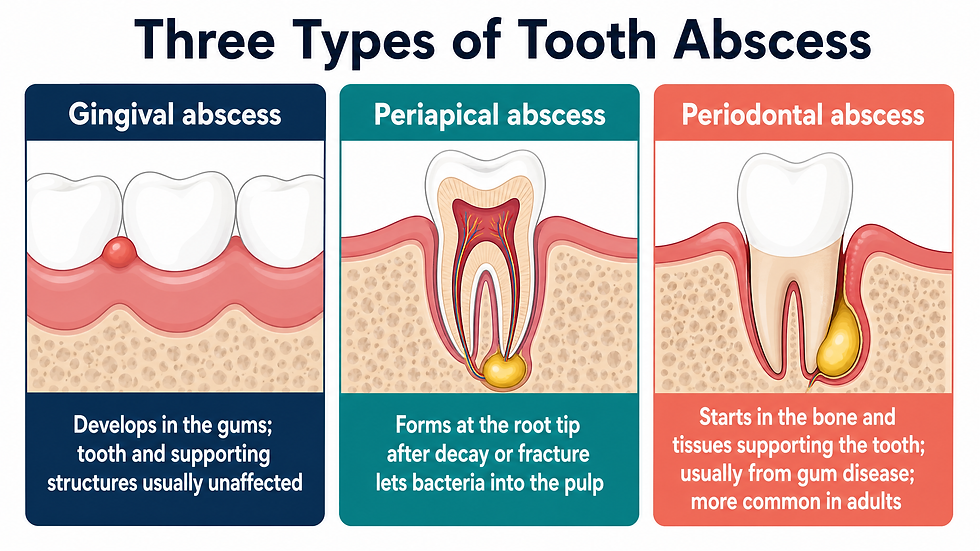
Three types of tooth infections can cause abscesses:
Type | Where it forms | What causes it |
|---|---|---|
Gingival | In the gums | Doesn't usually affect the tooth or supporting structures |
Periapical | At the tip of the tooth root | Decay or fracture lets bacteria into the pulp, spreading down the root to surrounding bone |
Periodontal | In the bone and tissues supporting the teeth | Usually results from gum disease; more common among adults |
Why It Matters: How Far Can It Spread?
Left untreated, a tooth abscess can spread to your jawbone, the soft tissues of your face and neck, and beyond. In extremely rare cases, the infection can travel to your heart (endocarditis) and brain (bacterial meningitis).
This is why it's so important to see a dentist as soon as possible if you have symptoms of a tooth abscess.
What Are the Symptoms?
A tooth abscess can cause severe tooth pain. It may feel shooting, throbbing, or like it's radiating to your ear, jaw, or neck. It may hurt all the time or only when you're chewing.
Other symptoms include bad breath or a bitter taste in your mouth, gum redness and swelling, loosening of the affected tooth, swelling in your upper or lower jaw, swollen lymph nodes, an open draining sore on the side of your gums, and fever.
Symptom | What to notice |
|---|---|
Severe tooth pain | Shooting, throbbing, radiating to ear, jaw, or neck; constant or when chewing |
Visible bump | Red, swollen bump, boil, or pimple on the gums |
Taste and breath | Bad breath or a bitter taste in your mouth |
Gum changes | Redness, swelling, or an open draining sore |
Tooth mobility | Loosening of the affected tooth |
Jaw and neck | Swelling in the upper or lower jaw; swollen lymph nodes |
Systemic signs | Fever |
What Causes an Abscessed Tooth?
Anything that creates an opening for bacteria to get into a tooth or surrounding tissues can lead to an abscess.
Cause | Mechanism |
|---|---|
Severe cavities | Decay destroys the hard tooth surface; bacteria break down sugars into acid that attacks enamel |
Broken, chipped, or cracked teeth | Bacteria seep into any opening and spread to the pulp |
Gum (periodontal) disease | Infection and inflammation of tissues around the teeth; as it progresses, bacteria access deeper tissues |
Injury to a tooth | Trauma can injure the inner pulp even with no visible crack, making it susceptible to infection |
Who Is at Higher Risk?
You're more likely to develop an abscessed tooth if you smoke — people who smoke are about twice as likely to get tooth abscesses as people who don't. Risk also rises if you have dry mouth (bacteria thrive in a mouth with low saliva), poor oral hygiene (bacteria build up without regular brushing, flossing, and dental cleanings), or a weakened immune system from diseases or some medications.
How Is It Diagnosed?
In addition to examining the tooth and surrounding tissue for signs of infection, your dentist may recommend a dental X-ray, which can identify sources of dental disease that may have led to the abscess and show if the infection has spread.
If the infection has spread to other areas within your neck, your dentist may recommend a CT scan to identify the extent of the infection.
Your dentist may also tap and press on your teeth — a tooth with an abscess is often sensitive to touch or pressure — and perform thermal tests to assess the health of your tooth pulp.
Test | What it shows |
|---|---|
Dental X-ray | Source of disease; whether the infection has spread |
CT scan | Extent of infection if it has spread into the neck |
Tap and pressure | Sensitivity typical of an abscessed tooth |
Thermal tests | Health of the tooth pulp |
How Is a Tooth Abscess Treated?
The goals of treatment are to eliminate the infection and prevent complications.
Treatment | How it works |
|---|---|
Incision and drainage | A small incision drains the pus; a small rubber drain may keep the area open |
Root canal | Removes the infected pulp and fills the space; tooth returns to normal, often with a crown; with proper care, the restored tooth can last the rest of your life |
Tooth extraction | Done when the tooth is damaged beyond repair |
Antibiotics | Help fight remaining bacteria — but won't remove the cause, which is the affected tooth |

How Soon Will You Feel Better?
A tooth abscess should clear up after treatment. Temporary sensitivity is common, and it may take a few days to feel completely back to normal. As every case is unique, healing times can vary — ask your dentist what to expect.
When Should You See a Dentist?
If you develop mouth pain, a toothache, or a red, swollen bump on your gums, schedule an appointment with a dentist right away. The sooner you get treatment, the less likely it is that the infection will spread beyond your tooth.
Head to your nearest emergency room if you have a tooth abscess accompanied by any of the following:
Emergency sign | Threshold |
|---|---|
Fever | 100.4°F (38°C) or higher |
Confusion | Any altered mental state |
Difficulty swallowing | Trouble moving food or liquid down |
Elevated heart rate | Rapid heartbeat |
Facial swelling | Visible swelling of the face |
Can a Tooth Abscess Go Away by Itself?
No. A tooth abscess won't go away on its own.
Pain may stop if the infection causes the pulp inside your tooth to die. The pain stops because the nerves in the pulp aren't working anymore, so you may not be able to feel it. But the bacteria will continue to spread and destroy surrounding tissue.
If you have tooth abscess symptoms, seek care even if you no longer have pain.
Left untreated, a tooth abscess will eventually spread to the surrounding tissues and beyond, harming your oral and overall health. It can take days, weeks, or months for the infection to spread — and it's impossible to know exactly how long that will take.
Can Home Remedies Help?
Tooth pain is a sign that you should see your dentist. While you wait for your appointment, warm saltwater rinses and over-the-counter pain relievers (such as acetaminophen, naproxen, or ibuprofen) can ease discomfort.
It's important to remember that there isn't a tooth abscess home remedy that can permanently solve the issue.
Can It Be Prevented?
You can reduce your risk of developing a tooth abscess by seeing your dentist routinely and getting regular check-ups and cleanings. It's also important to see your dentist if a tooth becomes loose or chipped.
Proper oral hygiene is essential for dental health: at home, brush your teeth twice a day and floss once a day.
What's the Difference Between an Infected Tooth and an Abscessed Tooth?
All tooth abscesses are also infections. But not all tooth infections lead to an abscess (a pocket of pus).
Think of an abscessed tooth as a sign of a severe tooth infection. The pocket of pus contains dead tissue and dead or dying white blood cells — your body's infection fighters. Pus is like the rubble that remains after your immune system does battle with a major infection.
But the pus contains bacteria that are still around and ready to do even more damage. It can spread without treatment. This is why you want to get treatment for dental infections so they don't become abscessed.
Conclusion: Don't Wait Out a Tooth Abscess
A tooth abscess is never something to sit out. It's a pocket of pus that forms when bacteria find their way into a tooth — through a cavity, a crack, gum disease, or trauma — and it can quietly spread to the jaw, the face, the neck, and, in extremely rare cases, to the heart or brain.
The three warning signs that should send you to the dentist right away are severe throbbing pain, a red swollen bump on the gums, and jaw swelling with fever. Remember: if the pain suddenly stops, the problem isn't gone — the nerve may have died while the infection keeps spreading.
Treatment is effective and aims to save your tooth whenever possible: drainage, root canal (often with a crown, lasting a lifetime with good care), or extraction when repair isn't possible. Antibiotics alone never solve the problem, because the affected tooth itself remains the source.
Have a toothache that's throbbing, a swollen bump on your gums, or jaw swelling with fever? Book a dental appointment today — and go to the emergency room immediately if facial swelling, confusion, trouble swallowing, a rapid heartbeat, or a fever of 100.4°F (38°C) or higher accompany it.
Frequently Asked Questions
1. What is a tooth abscess? A pocket of pus from a bacterial infection in the gums or tooth, usually appearing as a red, swollen bump, boil, or pimple. It won't heal on its own and requires dental treatment.
2. What does an abscessed tooth feel like? Severe tooth pain that feels shooting, throbbing, or radiating to the ear, jaw, or neck — constant or only when chewing — often with bad breath, a bitter taste, gum swelling, a loose tooth, or fever.
3. Can an abscessed tooth go away on its own? No. Even if the pain stops (because the nerve has died), the bacteria continue spreading and destroying tissue.
4. How long can it go untreated? It can take days, weeks, or months to spread — and it's impossible to predict how long. Left untreated, it will eventually spread beyond the tooth into the jaw, face, neck, and beyond.
5. How is it treated? Incision and drainage, root canal (often with a crown — a well-cared-for restored tooth can last a lifetime), or extraction if the tooth is beyond repair. Antibiotics help fight remaining bacteria but don't remove the cause.
6. What home remedies work? Warm saltwater rinses and over-the-counter pain relievers (acetaminophen, naproxen, ibuprofen) ease discomfort while you wait — but no home remedy permanently solves the problem.
7. When is it an emergency? Go to the emergency room for a tooth abscess with facial swelling, fever of 100.4°F (38°C) or higher, confusion, difficulty swallowing, or an elevated heart rate.
References
This article is based on medically reviewed clinical information, including Abscessed Tooth — Cleveland Clinic, supplemented by the peer-reviewed literature cited therein, including Dental Abscess — StatPearls, 2025, the American Association of Endodontists' patient guide on abscessed teeth, the American Dental Association's MouthHealthy entry on abscess, and Effects of tobacco product use on oral health — Tobacco Induced Diseases, 2023.
Comments