Abrasion (Scrape): What It Is, When It Becomes Dangerous, and How to Treat It at Home

Updated: 2 days ago
Medically reviewed by Dr. Baraa Alnahhal, MD · Last reviewed: September 2026
Editorial note: This article is provided for educational purposes only. It is not medical advice. Always consult a qualified healthcare professional for diagnosis and treatment of any injury or condition.
TL;DR
An abrasion (scrape) is a superficial skin injury where the outer layer is rubbed off by friction or impact — the single most common childhood injury, accounting for about 70% of all reported injuries in children. Most scrapes heal at home in about a week with basic cleaning and a bandage, but debris-laden scrapes, animal-caused scrapes, and large road rash wounds need medical attention to prevent infection.
Quick Answer
An abrasion is a superficial skin injury caused by rubbing or scraping against a rough surface, removing only the outermost skin layers. Most are minor: wash gently with soap and water, remove visible debris, apply an antibiotic ointment, and cover daily until healed. Small scrapes typically heal in about a week without scarring. Seek care if the wound contains embedded dirt or glass, was caused by an animal, shows signs of infection (pus, spreading redness, fever), or has not healed after one week.
What exactly is an abrasion?
An abrasion is a superficial injury in which the outermost layer of skin (the epidermis) is rubbed or scraped away by friction, impact, or pressure. Because only the surface is involved, abrasions usually cause little bleeding and are among the mildest forms of wound.
The word "abrasion" comes from the Latin for "scraping away." In everyday language, people call them scrapes, skinned knees, or carpet burns. A deep abrasion from falling off a bicycle onto pavement is often called road rash.
Feature | What the research says |
Tissue involved | Outermost skin layer (epidermis) only in most cases |
Bleeding | Usually minimal or none |
Most common mechanism | Friction, followed by impact |
Typical scarring | Majority heal without scars; deeper abrasions reaching the dermis may scar |
Age pattern | Occur at any age; most common injury in children |
One important caveat: people rarely seek medical care for minor scrapes, so published figures likely undercount how common abrasions really are.
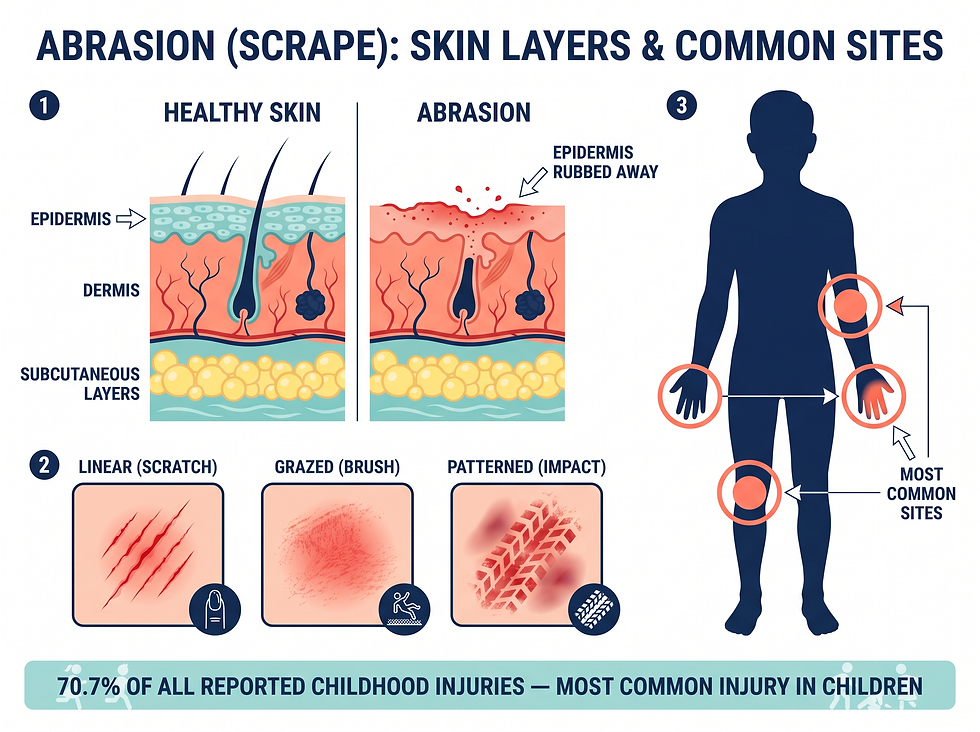
What are the three types of abrasions?
Clinicians classify abrasions into three types based on how the skin was damaged. Knowing which type you have helps predict healing time and scarring risk.
Type | How it happens | Common example | Healing outlook |
Linear (scratch) | A tangential force strips the epidermis in a line | A thorn or fingernail scratch | Simplest type; typically heals cleanly |
Grazed (brush) | The body is dragged across a broad rough surface | A skinned knee from falling on gravel | Can cover a large area; deeper versions are sometimes called "brush burns" |
Patterned (impact) | Perpendicular force presses an object's shape into the skin | A cat scratch marking or a ligature mark | Can carry additional medicolegal significance |
Linear abrasions usually heal by what clinicians call "primary intention" — the edges come together on their own without sequelae. Grazed abrasions vary in depth depending on the surface roughness and the speed of the fall, and they are the type most often seen after road traffic accidents and sports falls.
What does an abrasion look like?
A fresh abrasion typically appears lighter than the surrounding natural skin, with dark or red borders around the injured area. The raw surface often looks spotty or speckled, slightly shiny, and moist.
As it heals, the skin may peel or clump together and eventually fall off. This shedding is part of the normal healing process, not a sign of a problem — as long as the wound is otherwise improving.
Appearance sign | Usually normal | Concerning |
Color | Pink wound bed, lighter than surrounding skin | Deep red, purple, or black tissue |
Moisture | Slight pink or clear fluid leakage | Pus or cloudy, foul-smelling drainage |
Pain | Mild stinging or burning | Pain that is worsening instead of improving |
Progress | Peeling and clumping skin over days | No improvement after one week |
Abrasion vs. laceration: what is the difference?
People often confuse scrapes with cuts. The distinction matters because the two injuries are treated differently.
An abrasion removes a layer of skin surface — tissue is rubbed away. A laceration is a cut in which the skin is broken apart or separated, with no skin missing.
Feature | Abrasion (scrape) | Laceration (cut) |
Mechanism | Friction or scraping against a rough surface | Skin is broken apart or separated |
Skin loss | Yes — the outer layer is rubbed off | No — skin is split, not removed |
Bleeding | Usually light | Often heavier |
Typical closure | Heals with cleaning and bandaging | May require stitches |
Most common in | Children's falls and sports | Sharp-object and tool injuries |
A small linear scratch under about two inches usually does not need a bandage at all, while larger wounds may need stitches and professional closure.
What causes an abrasion?
Friction is the driving force behind nearly every abrasion. The most frequent scenarios fall into a few clear patterns.
Cause | Typical scenario |
Falls on rough ground | Falling on a rocky or gravel surface; skinned knees and elbows |
Sports slides | Sliding into home plate or falling during athletic play |
Road rash | Falling off a bicycle or motorcycle onto pavement |
Carpet or floor friction | Carpet burns from slides or roughhousing |
Sharp-pointed contact | Thorns, nails, or scratching objects producing linear scratches |
Because knees and elbows are bony areas where skin sits close to the ground during a fall, they are the most common scrape sites. But abrasions can occur anywhere — including the cornea of the eye (a corneal abrasion) and the inside of the mouth (a dental abrasion).
One stat puts children's exposure in perspective: abrasions are the most common form of injury in children, accounting for approximately 70.7% of all reported injuries in that age group, according to a 2023 forensic medicine review. The head and torso together account for half of all recorded abrasions, with the lower limbs (~34.6%) more often involved than the upper limbs (15.4%).
What are the symptoms of an abrasion?
Abrasions produce a small, predictable set of symptoms because the injury stays in the outermost skin layer.
The most common symptoms are mild stinging or burning pain, light bleeding that stops quickly, slight skin discoloration around the wound, and a small amount of pink-to-clear fluid weeping from the surface.
Deeper or contaminated scrapes — especially road rash — can embed dirt, debris, and germs forcefully into the skin, which raises both the infection risk and the risk of permanent "traumatic tattooing" (pigment from asphalt or dirt left trapped in the healing skin).
What are the warning signs of an infected abrasion?
Infection is the most common complication of an abrasion — and it can develop in even a minor scrape if the wound is not properly cleaned.
Seek medical care promptly if the wound shows any of the following:
Warning sign | What it means |
Increasing pain | Normal sting improves; worsening pain is a red flag |
Swelling around the wound | Possible early infection |
Pus or foul-smelling drainage | Yellow or cloudy fluid indicates infection |
Fever | Go to the emergency room if a scrape is accompanied by fever |
Wound not healing | See a provider if a scrape has not healed after one week |
Debris still in the wound | Dirt, glass, or gravel left inside feeds infection |
The debris point deserves emphasis. A single small pebble can be tweezed out at home, but a scrape loaded with gravel or multiple glass fragments is an emergency-department wound, because embedded material cannot be adequately cleaned at home.

How is an abrasion diagnosed?
In most cases, no formal diagnosis is needed — the injury identifies itself.
When a person does see a provider, the evaluation is visual and rapid. The clinician examines the wound and assesses its type, size, shape, location, and depth, and checks whether any foreign debris remains inside.
For wounds suspected of holding embedded material, X-rays can detect radiopaque foreign bodies such as glass or metal, while ultrasound can identify non-radiopaque material. The provider also asks about the time, cause, and mechanism of injury, and checks tetanus vaccination status.
Evaluation step | Purpose |
Visual inspection | Identify type, size, shape, location, depth |
Debris check | Find remaining dirt, glass, or gravel |
Tetanus status | Determine if a booster is needed |
X-ray (when indicated) | Detect radiopaque foreign bodies |
Ultrasound (when indicated) | Detect non-radiopaque foreign bodies |
Animal-caused scrapes get one extra step: if the injury came from an animal bite or scratch, see a provider within 24 hours, because tetanus shots or preventive antibiotics may be offered.
How do you treat an abrasion at home?
Home treatment follows a simple five-step sequence, and evidence shows that plain tap water irrigation is just as effective as sterile saline for cleaning wounds.
Step | What to do |
1. Wash | Gently clean with soap and water |
2. Remove debris | Use tweezers for visible material; ER for lots of gravel or glass |
3. Dry | Pat dry with a clean washcloth |
4. Protect | Apply a topical antibiotic ointment |
5. Cover | Use a bandage or dressing, changed daily with fresh cleaning |

Keep cleaning and re-covering the wound every day with a fresh bandage until it is fully healed. And resist the urge to pick at the forming scab — picking irritates the wound, delays healing, and raises the chance of infection.
How long does an abrasion take to heal?
Healing speed depends almost entirely on size and depth. Small scrapes under about two inches typically heal in roughly a week, often leaving no scar at all. Larger abrasions can take two weeks or more and may leave a mark.
The broader wound-healing research frames what happens underneath the bandage. Wounds generally heal within 4 to 6 weeks; anything still open beyond that window is considered a chronic wound. The final remodeling phase, in which the scar matures, can continue for up to 12 months, and the resulting scar never regains the full strength of the original skin — it plateaus at about 80% of the original tensile strength.
Abrasion size | Typical healing time | Scarring risk |
Small (under ~2 inches) | About 1 week | Often none |
Larger surface area | Up to 2 weeks or more | Possible mark or scar |
Deep (reaches dermis) | Up to 4–6 weeks | Likely scar |
Chronic (unhealed at 4–6 weeks) | Needs medical evaluation | Higher |
What treatments does a provider offer?
Most abrasions need no professional treatment. When the injury is more than superficial, providers can intervene in a few specific ways.
Treatment | When it is used |
Professional cleaning | Embedded debris, gravel, glass |
Stitches or closure | Large wounds or those combined with other injuries |
Tetanus booster | If vaccination status is out of date |
Preventive antibiotics | Animal-caused scrapes; high-risk contamination |
X-ray / ultrasound | To locate embedded foreign bodies |
For context on infection risk, research on similar minor wounds shows that about 5% of simple hand lacerations become infected, and wounds closed with tissue adhesive or sterile strips run infection rates around 2%. These figures illustrate why cleaning quality — not the closure method — is the main lever patients control at home.
Can an abrasion be prevented?
Abrasions are mostly accidental, but several practical habits reduce exposure.
Being aware of surroundings around animals, sharp surfaces, and rough objects matters, as does wearing protective gear during sports and work. Removing tripping hazards near frequently used walking areas, avoiding uneven surfaces, and resting rather than pushing through fatigue when tired all lower fall risk.
Prevention habit | What it prevents |
Protective gear in sports and work | Grazed abrasions from falls and slides |
Removing tripping hazards | Home falls, the top cause in older patients |
Situational awareness around animals | Animal-bite and scratch wounds needing 24-hour care |
Resting when fatigued | Falls from pushing through tiredness |
Avoiding rough or sharp surfaces | Linear scratches and friction burns |
What is the long-term outlook?
The prognosis for an abrasion is excellent. The majority of scrapes heal completely without leaving any scar, because the injury never reaches the deeper dermis layer where scar-forming tissue develops.
The main long-term risks are confined to specific situations: debris-laden road rash can leave permanent traumatic tattoos, deeper grazes can leave a visible mark, and the small subset of wounds that fail to heal within 4 to 6 weeks should be evaluated as possible chronic wounds.
People with diabetes, smokers, and those with malnutrition or poor circulation heal more slowly and should monitor their wounds more carefully.
Bottom line: what every reader should remember
An abrasion is the most common of all injuries — and one of the most self-treatable. The formula is simple: clean it, cover it, and watch it. If it contains embedded debris, came from an animal, is spreading red and painful, or still looks raw after a week, hand it to a professional instead of managing it alone.
Take action today: Wash out any current scrapes with soap and water, stock a basic first-aid kit with antibiotic ointment and bandages, and schedule a tetanus checkup if yours is out of date. If a wound worries you — or a child's scrape shows signs of infection — contact a healthcare provider. For education and information purposes only; this is not a substitute for professional medical care.
Frequently Asked Questions
1. What is the difference between an abrasion and a cut?
An abrasion removes a layer of skin surface through friction, while a cut (laceration) breaks the skin apart without removing any of it. Scrapes are cleaned and bandaged; cuts may need stitches.
2. How long does a skinned knee take to heal?
A small scrape under about two inches typically heals in roughly a week, often with no scar. Larger scrapes can take two weeks or more and may leave a mark.
3. Should I cover a scrape or leave it uncovered?
Cover most scrapes with a bandage changed daily after cleaning. Only very small linear scratches under about two inches can safely skip the bandage.
4. When should I go to the emergency room for a scrape?
Go to the ER if the wound contains lots of embedded gravel or glass, was caused by an animal and shows infection signs, or is accompanied by a fever.
5. Can road rash leave a permanent mark?
Yes. Road rash can embed dirt, debris, and pigment forcefully into the skin, creating both infection risk and permanent "traumatic tattooing".
6. Do I need a tetanus shot after a scrape?
Tetanus status should be checked with any wound. Providers may offer a booster — and animal-caused scrapes warrant a provider visit within 24 hours.
7. Is it okay to pick the scab off a healing scrape?
No. Picking irritates the wound, delays healing, and raises infection risk. Let the skin peel or clump and shed on its own.
8. How do I know if my scrape is infected?
Watch for increasing pain, swelling, pus or foul-smelling yellow drainage, and fever. Any scrape that has not healed after one week also needs evaluation.
References
Cleveland Clinic. "Abrasion (Scrape): How To Treat." Medically reviewed; last updated June 16, 2023. my.clevelandclinic.org
StatPearls (NIH/NCBI Bookshelf). "Abrasion" (Shrestha R, Krishan K, Ishaq H, Kanchan T). Last update: August 17, 2023. ncbi.nlm.nih.gov
Cleveland Clinic. "Road Rash Treatment & Prevention." Last updated February 26, 2025. my.clevelandclinic.org
StatPearls (NIH/NCBI Bookshelf). "Wound Healing Phases" (Wallace HA, Basehore BM, Zito PM). Last update: June 12, 2023. ncbi.nlm.nih.gov
PMC/NIH. "The risk of wound infection after simple hand laceration." pmc.ncbi.nlm.nih.gov
Qiu F et al. "Traumatic lacerations: what are the risks for infection and has the 'golden period' of wound closure been disproved?" Emergency Medicine Journal (2013). pmc.ncbi.nlm.nih.gov
Merck Manual, Professional Version. "Abrasions." merckmanuals.com
MedlinePlus (U.S. National Library of Medicine). "Scrape." medlineplus.gov
American Academy of Dermatology Association. "Proper Wound Care: How To Minimize A Scar." aad.org
Merck Manual, Consumer Version. "Wounds." merckmanuals.com
Comments