ABO Incompatibility in Pregnancy: Causes, Symptoms, and What to Expect

Updated: 2 days ago
Medically reviewed by Dr. Baraa Alnahhal, MD · Last reviewed: September 2026
Editorial note: This article is for educational purposes only and is not a substitute for professional medical advice. Yellowing of a newborn's skin within the first 24 hours of life should be evaluated by a healthcare professional promptly. Information reflects current published clinical sources as of August 2026.
TL;DR
ABO incompatibility happens during pregnancy when the mother's blood type (A, B, AB, or O) differs from the fetus's. The most common combination is a mother with type O blood carrying a baby with type A, B, or AB. It occurs in about 15 out of 100 pregnancies, making it fairly common — but it doesn't usually pose risks. In the rare cases (under 1% of pregnancies) where the mother's immune system attacks the fetus's red blood cells, the baby can develop hemolytic disease of the newborn, with anemia and jaundice. Screening is part of routine prenatal care, and treatment for jaundiced newborns is simple and effective: phototherapy. A blood type mismatch should not alarm expectant parents — it is common, mild, and well managed.
Quick Answer: What is ABO incompatibility?
A blood type mismatch between a pregnant mother and her fetus — the mother has one ABO type (A, B, AB, or O) and the fetus has a different one.
It occurs in about 15 in 100 pregnancies, most often with a type O mother and a type A, B, or AB baby.
It rarely causes problems; harmful immune attacks happen in under 1% of pregnancies.
Screening is part of routine prenatal care, and newborn jaundice is treated effectively with phototherapy.
What Is ABO Incompatibility During Pregnancy?
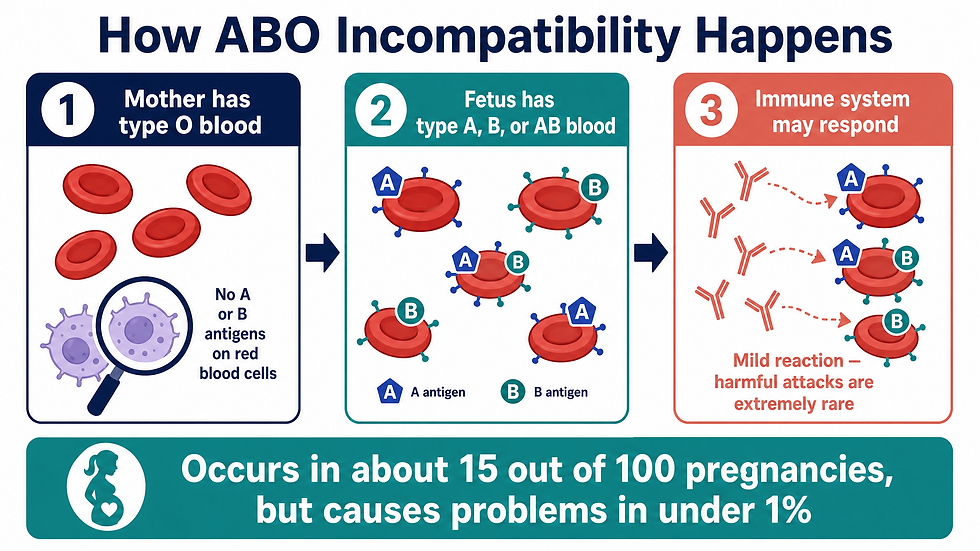
ABO incompatibility is when you're pregnant and the fetus has an ABO blood type that doesn't match yours. The mismatch can cause your body to have a mild reaction to the fetus's blood.
It's most common if you have type O blood and the fetus has type A, B, or AB blood. It happens in about 15 out of 100 pregnancies — fairly common, and it doesn't usually pose risks.
What Are the Symptoms?
Babies born with ABO hemolytic disease may not have symptoms. Sometimes, they have jaundice that starts within the first 24 hours of birth. This is a sign that some of their red blood cells are breaking down too soon.
When red blood cells break down, they release a substance called bilirubin that makes skin look yellow. But many infants are born with jaundice. Whether your baby needs treatment depends on how severe it is.
Sign | What it means |
|---|---|
Jaundice in the first 24 hours of life | Red blood cells may be breaking down too soon |
Yellow skin (from bilirubin) | Released when red blood cells break down |
No symptoms at all | Possible — some affected babies show nothing |
What Causes ABO Incompatibility?
ABO incompatibility happens when the mom has one blood type within the ABO blood group (A, B, AB, or O) and the fetus has a different type. Each blood type has unique antigens on red blood cells. Antigens are like name tags that let your immune system know that a red blood cell belongs. A has "A" antigens on red blood cells. B has "B" antigens on red blood cells, and so forth. Your immune system won't attack if it recognizes an antigen.
If the fetus's blood cells have an antigen your immune system doesn't recognize, it may flag them as a threat. It may make antibodies that attack the fetus's red blood cells.
But ABO incompatibility doesn't usually cause your immune system to launch harmful attacks.
ABO vs. Rh Incompatibility
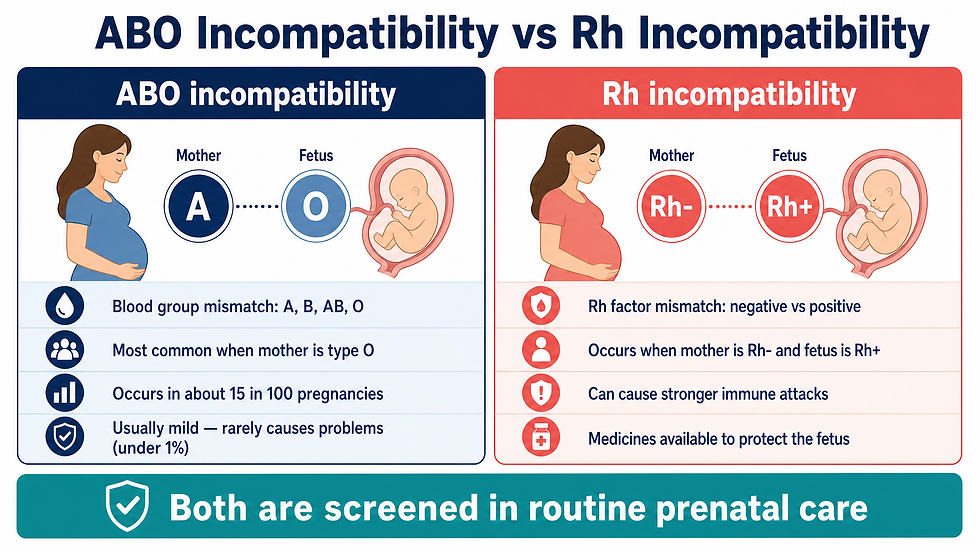
The more consequential mismatch is Rh incompatibility. Rh factors determine whether you have a positive or negative blood type. Harmful attacks with Rh incompatibility can happen when the mother has blood type with Rh- and the fetus has Rh+ blood type.
If there's a chance that you and the fetus have Rh incompatibility, you can take medicines to keep the fetus safe.
How Common Is It?
ABO incompatibility happens in about 15 out of 100 pregnancies. That makes it fairly common — one of the most frequent blood type mismatches in pregnancy.
Yet the serious form of the condition is extremely rare. When ABO mismatch causes the mother's immune system to attack the fetus's red blood cells — a condition called hemolytic disease of the newborn (HDN) — it happens in under 1% of pregnancies. Affected babies have anemia and jaundice.
Measure | What happens |
|---|---|
Blood type mismatch (ABO) | About 15 out of 100 pregnancies |
Usual outcome | No problems — mild or no immune reaction |
Hemolytic disease of the newborn | Under 1% of pregnancies |
Baby's signs if affected | Anemia and jaundice, sometimes none |
How Is It Diagnosed?
In the U.S., screening for blood type incompatibility is part of routine prenatal care. This lets your healthcare provider know if there's a chance of blood type incompatibility that may pose risks to your pregnancy.
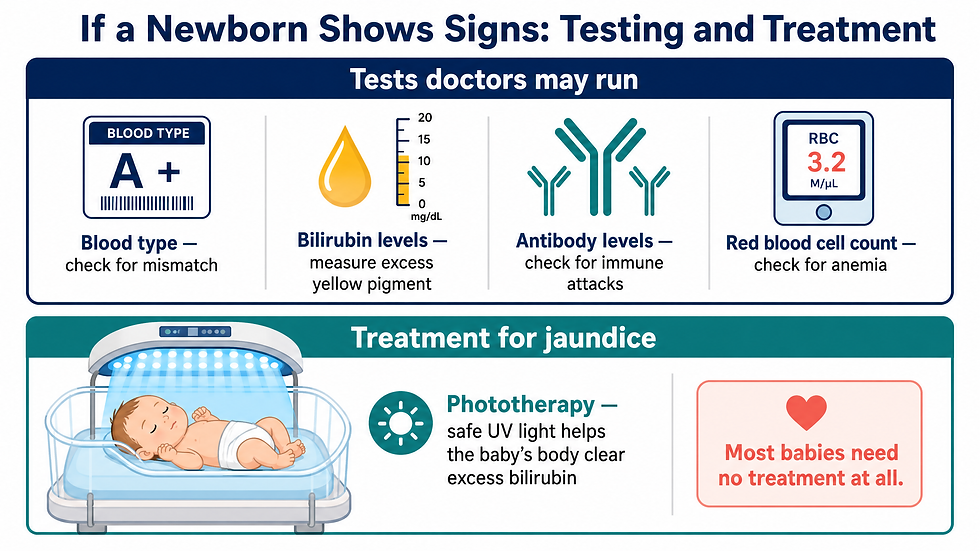
If your baby is born with signs of disease, your healthcare provider may do tests to check their blood type (to see if incompatibility may be what's causing issues), bilirubin levels (to see if levels are high enough to need treatment), antibody levels (to see if your immune system is launching attacks), and red blood cell levels (to see if the baby has anemia).
Test | What it checks |
|---|---|
Blood type | Whether a mismatch may be the cause |
Bilirubin levels | Whether yellow pigment is high enough to need treatment |
Antibody levels | Whether the immune system is attacking red cells |
Red blood cell count | Whether the baby has anemia |
If your baby is born with signs of severe disease, your provider will look for causes other than ABO incompatibility.
How Is It Treated?
Neither you nor the fetus will likely need treatment.
If your baby develops jaundice, their healthcare provider may suggest phototherapy. This treatment uses safe UV (ultraviolet) lights to help your baby's body get rid of excess bilirubin.
Scenario | What to expect |
|---|---|
No symptoms in baby | No treatment needed |
Jaundice develops | Phototherapy (safe UV lights clear excess bilirubin) |
Severity determines care | Treatment depends on how severe the jaundice is |
What Is the Outlook?
ABO incompatibility rarely causes problems during pregnancy.
With other blood type incompatibilities — like those related to Rh factor — your provider may need to closely monitor your pregnancy. You may need to take medicines to keep the fetus safe.
The most important thing to know is that providers go to great lengths to keep pregnancy safe for you and your baby. A blood type incompatibility doesn't prevent most women from delivering healthy newborns.
Having a mismatched blood type during pregnancy is common. But just because there's a mismatch between you and the fetus doesn't mean there'll be problems. This is usually the case with ABO incompatibility — common, but rarely causes issues. If there's a chance of an incompatibility leading to serious disease, your provider will keep close tabs on your pregnancy and may give you medicines to protect it.
Conclusion: A Common Mismatch, Rarely a Problem
A blood type mismatch between mother and baby is one of the most common findings in pregnancy — it shows up in about 15 out of 100 pregnancies — and one of the least worrisome. The immune system's reaction to different ABO types is typically mild, and the serious form, hemolytic disease of the newborn, affects well under 1% of pregnancies.
The safety net is already built into your care: blood type screening is a standard part of prenatal visits, and providers distinguish ABO mismatch from the Rh factor mismatch that deserves closer monitoring and medication. If a baby does develop early jaundice, phototherapy is a simple, safe, and effective treatment.
Expectant parent, take heart: different blood types between you and your baby usually mean nothing at all. Keep every prenatal appointment so your blood type and antibody screening stay on schedule, and after birth, mention it to the pediatrician if the baby's skin turns yellow in the first day — early jaundice deserves a bilirubin check.
Frequently Asked Questions
1. What is ABO incompatibility? A blood type mismatch during pregnancy when the mother and fetus have different ABO blood types (A, B, AB, or O). It most often involves a mother with type O blood and a baby with type A, B, or AB.
2. How common is it? About 15 out of 100 pregnancies involve an ABO blood type mismatch, making it fairly common.
3. Is it dangerous? Usually not. It rarely causes problems during pregnancy, and the serious form — hemolytic disease of the newborn — occurs in under 1% of pregnancies.
4. What are the symptoms in a newborn? Babies may have no symptoms at all. When affected, jaundice can start within the first 24 hours of birth as red blood cells break down and release bilirubin, which yellows the skin. Anemia can also occur.
5. How is it different from Rh incompatibility? ABO incompatibility involves the A, B, AB, O blood groups and is usually mild. Rh incompatibility involves positive versus negative blood types — harmful attacks happen when the mother is Rh- and the fetus is Rh+ — and it can cause stronger immune attacks, managed with medicines.
6. How is it treated? Most mothers and babies need no treatment. If a newborn develops jaundice, phototherapy — safe UV light — helps the baby's body clear excess bilirubin.
7. Does it affect delivery or the baby's health long-term? No. A blood type incompatibility doesn't prevent most women from delivering healthy newborns, and providers screen for it routinely as part of prenatal care.
References
This article is based on medically reviewed clinical information, including ABO Incompatibility — Cleveland Clinic, supplemented by the peer-reviewed literature cited therein, including Red Blood Cell Alloimmunization in Pregnancy: A Review of the Pathophysiology, Prevalence, and Risk Factors — Cureus, 2024, Estimation of ABO hemolytic disease of the fetus and newborn through gene frequency study — Transfusion and Apheresis Science, 2025, Hemolytic Disease of the Fetus and Newborn — StatPearls, 2025, and the Nelson Textbook of Pediatrics, 22nd edition (Elsevier, 2025).
Comments