Abetalipoproteinemia: What It Is, How It Is Diagnosed, and How It Is Treated

Updated: 2 days ago
Medically reviewed by Dr. Baraa Alnahhal, MD · Last reviewed: September 2026
Editorial note: This article is for general education only and is not medical advice. Always consult a qualified healthcare professional for diagnosis and treatment decisions. Primary sources cited below include publication and review dates for verification.
TL;DR
Abetalipoproteinemia is a rare genetic disorder that prevents the body from producing lipoproteins, so fats and fat-soluble vitamins (A, D, E, K) cannot be absorbed. Babies show fatty stools, vomiting, and poor growth in the first months of life. Without treatment it can cause blindness, nerve and muscle damage, and death by the twenties — but a strict low-fat diet plus high-dose vitamins A and E can let treated patients live into their 70s. Fewer than 1 in 1 million people are affected, and it affects men and women equally.
Quick Answer
Abetalipoproteinemia is a rare autosomal recessive disorder (under 1 in 1 million people) caused by MTTP gene mutations that stop the body making lipoproteins, blocking absorption of fat and vitamins A, D, E, and K. Infants develop fatty stools, vomiting, and poor growth; untreated patients typically suffer nerve damage, retinitis pigmentosa, and often death by their 20s. There is no cure, but a low-fat diet (under 15–20 g fat/day in adults) plus high-dose fat-soluble vitamins — especially vitamins E and A — can prevent or slow complications, and patients treated early can live into their 70s.
What is abetalipoproteinemia?
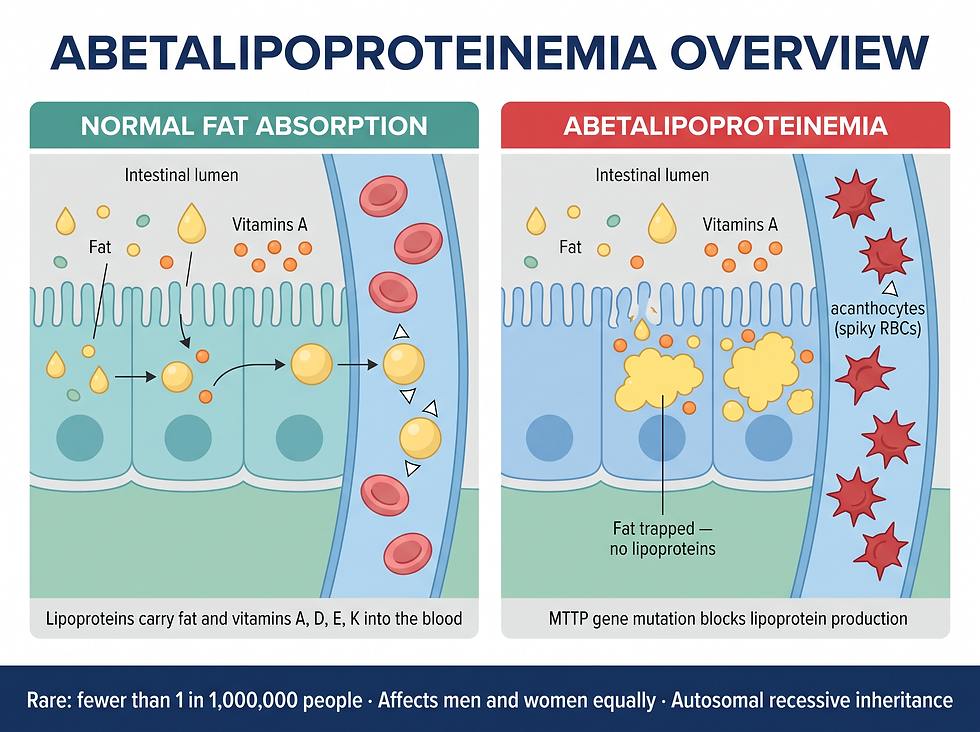
Abetalipoproteinemia is a rare genetic disorder that affects how the body absorbs fat and fat-soluble vitamins. The body cannot produce lipoproteins — the particles that transport fat through the bloodstream — which means dietary fat and the vitamins A, D, E, and K cannot be absorbed properly.
The condition is also known as Bassen-Kornzweig syndrome, first reported in 1950. Without treatment, the vitamin deficiencies progressively damage the nerves, retina, and other organs.
Feature | Detail |
Also known as | Bassen-Kornzweig syndrome |
Gene involved | MTTP (makes the microsomal triglyceride transfer protein) |
Inheritance | Autosomal recessive (both parents must be carriers) |
Estimated frequency | Less than 1 in 1,000,000 |
Sex distribution | Roughly equal (about 1:1) |
Cases reported worldwide | More than 100 published cases |
What causes abetalipoproteinemia?
Abetalipoproteinemia is caused by mutations in the MTTP gene. This gene provides instructions for making the microsomal triglyceride transfer protein (MTP), which the liver and intestines need to assemble lipoproteins. Without functioning MTP, lipoproteins never form, so fat and fat-soluble vitamins stay trapped instead of entering the bloodstream.
The condition is inherited in an autosomal recessive pattern. Both parents must carry a copy of the mutated gene, and carriers themselves show no symptoms. When both parents are carriers, each child has a 25% chance of being affected, a 50% chance of being an asymptomatic carrier, and a 25% chance of being neither.
Inheritance scenario (both parents are carriers) | Probability |
Child affected | 25% |
Child is a carrier, no symptoms | 50% |
Child unaffected, not a carrier | 25% |
Consanguineous (related) marriages are strongly implicated, with about one-third of reported patients coming from consanguineous families. A founder mutation known as Gly865X has been identified in people of Ashkenazi Jewish descent, with carrier frequency estimated at about 1 in 203 in recent Ashkenazi cohorts.
What are the symptoms of abetalipoproteinemia?
Symptoms begin in infancy, typically appearing shortly after birth when breastfeeding starts. In adults, the loss of deep-tendon reflexes is often the first sign.
In infants, the body cannot absorb breast milk fat. Signs include repeated vomiting, diarrhea, and stools that are fatty, greasy, and foul-smelling (steatorrhea), combined with poor weight gain and failure to thrive.
As it progresses without treatment, vitamin and fat deficiencies cause problems across the body:
Body system | Symptoms |
Reflexes & nerves | Loss of reflexes first; muscle cramps, weakness, and pain; gradually increasing brain damage |
Movement & balance | Ataxia (loss of coordination), lordosis, kyphoscoliosis (spinal curvature) |
Speech | Dysarthria (difficulty speaking) |
Energy & heart | Fatigue, shortness of breath, palpitations |
Eyes | Vision problems, strabismus, nystagmus (uncontrolled eye movements), retinitis pigmentosa, poor night vision |
Blood & liver | Anemia, jaundice, swollen abdomen |
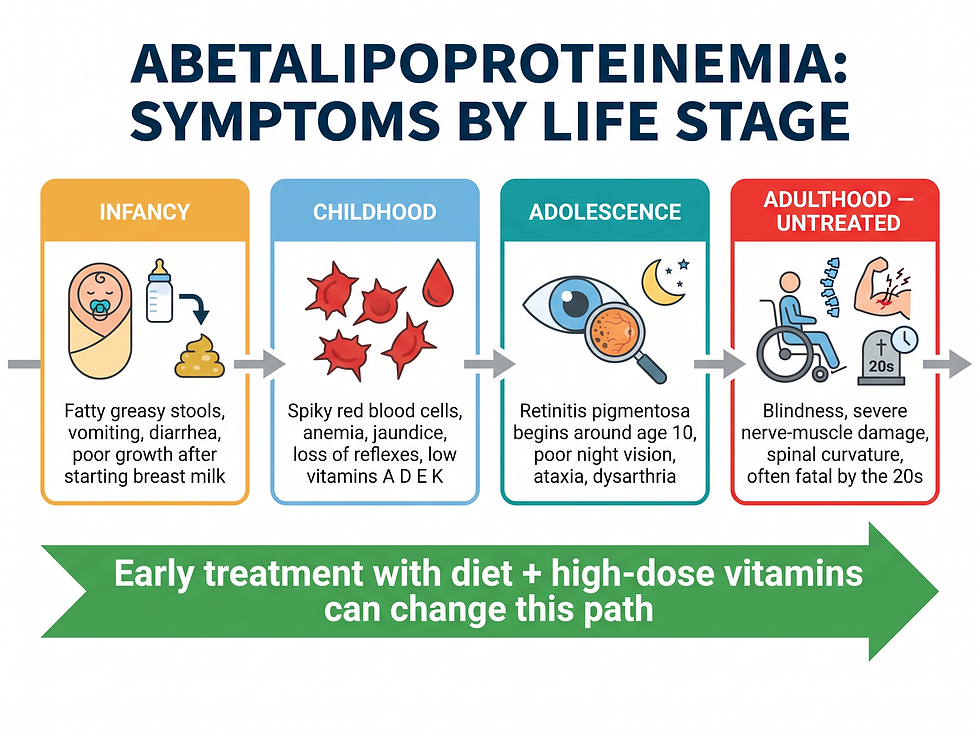
Retinitis pigmentosa typically appears by adolescence and is linked to vitamin A deficiency; untreated, it can progress to virtual blindness by the fourth decade. Importantly, intelligence is usually normal in people with abetalipoproteinemia, although developmental delays have been reported in some cases.
Symptoms by life stage
Life stage | Typical symptoms |
Infancy (first months) | Vomiting, diarrhea, fatty stools, failure to thrive after starting breast milk |
Childhood | Loss of reflexes, anemia, jaundice, low vitamin levels |
Adolescence | Retinitis pigmentosa begins (~age 10), neurological signs emerge (ages 2–20) |
Adulthood (untreated) | Ataxia, speech difficulty, spinal curvature, night blindness progressing to severe vision loss |
How is abetalipoproteinemia diagnosed?
Diagnosis combines physical examination, specialized blood tests, and genetic confirmation. Blood work shows the hallmark of the disease: extremely low or absent cholesterol, LDL, and VLDL — in practice, an LDL-C below 15 mg/dL with apolipoprotein B below 15 mg/dL is the standard screening threshold.
The red blood cells often take on an abnormal, spiky, thorn-like shape (acanthocytosis), and because these misshapen cells cannot form rouleaux stacks, the erythrocyte sedimentation rate (ESR) can be very low.
Test | What it checks |
Lipid panel | Very low or absent cholesterol, LDL, and VLDL |
Red blood cell shape | Spiky acanthocytes |
Fat-soluble vitamin levels | Deficiencies in vitamins A, D, E, and K |
Liver function tests | Possible elevation of ALT/AST; hepatomegaly; cirrhosis reported |
Endoscopy | Lipid-laden intestinal cells; "snow-white duodenum" |
Eye exam | Retinitis pigmentosa, nystagmus |
Neurological exam | Reflex loss, ataxia, dysarthria |
Stool test | Fat loss in stool |
Liver ultrasound | Hepatomegaly assessment |
Genetic testing | Confirms MTTP gene mutation |
At least 74 different MTTP mutations have been reported as causing the disease. Because so few patients exist worldwide, no randomized clinical trials have ever been conducted — treatment evidence comes from case reports and observational studies.
How is abetalipoproteinemia treated?
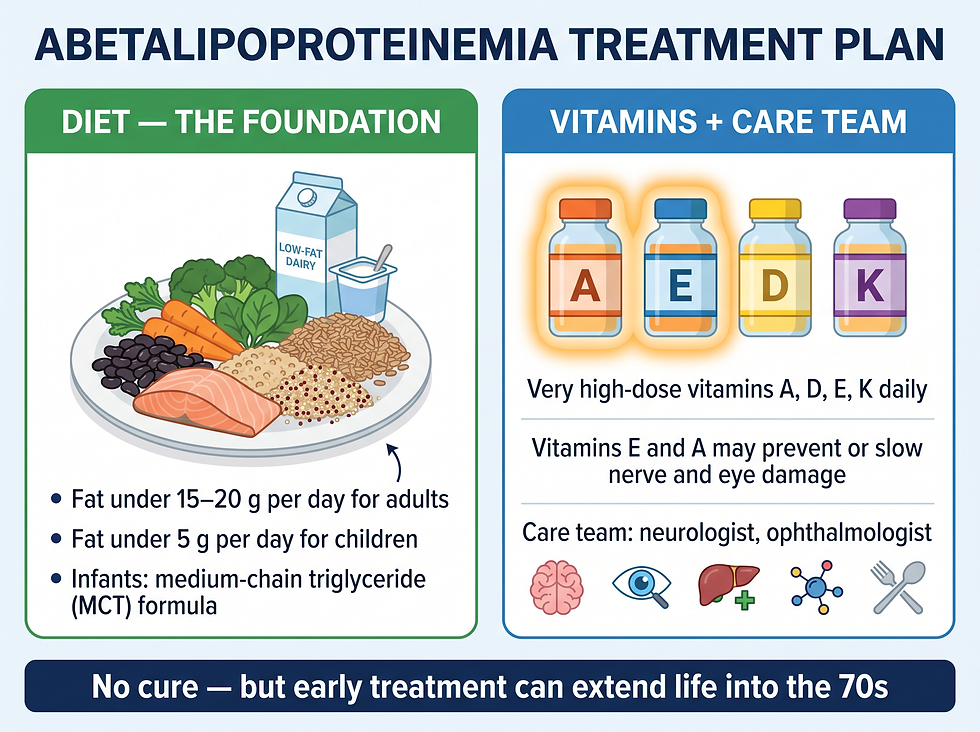
There is no cure for abetalipoproteinemia, but treatment can prevent or substantially delay complications. Care involves a coordinated team — neurologists, hepatologists, ophthalmologists, lipidologists, cardiologists, bone specialists, gastroenterologists, and dietitians.
Diet is the foundation. Patients must follow a diet very low in long-chain saturated fatty acids — typically under 15–20 grams of fat per day for adults and under 5 grams per day for children — built around lean meats, fish, beans, low-fat dairy, fruits, vegetables, and whole grains. Medium-chain triglycerides (MCTs) are preferred for infants because they bypass the lipoprotein pathway.
High-dose fat-soluble vitamins are the other pillar. Very high doses of vitamins A, E, D, and K are required to correct the absorption block. Vitamins E and A are especially important — they may prevent or slow the neurological and retinal complications that otherwise dominate the disease course. Notably, high-dose vitamin E only marginally raises blood levels, while high-dose vitamin A can achieve normal serum levels.
Treatment component | Details |
Fat restriction | Under 15–20 g/day (adults); under 5 g/day (children) |
Infant formula | High medium-chain triglyceride (MCT) diet |
Vitamin E | Very high doses; may prevent/slow neurological and retinal damage |
Vitamin A | High doses; can reach normal serum levels |
Vitamins D and K | Replenished per deficiency |
Therapies | Physical, occupational, and speech therapy as needed |
Care team | Neurologists, ophthalmologists, hepatologists, lipidologists, dietitians and others |
Can abetalipoproteinemia be prevented?
Because the condition is genetic, abetalipoproteinemia itself cannot be prevented. However, families with a known history can pursue genetic counseling before pregnancy, and carriers can be identified through genetic testing. The disease cannot be transmitted by contact or behavior — it requires inheriting two copies of the mutated MTTP gene.
What is the prognosis?
Prognosis depends heavily on how early treatment begins and on the specific MTTP mutation involved.
Scenario | Outcome |
Untreated | Debilitating by the third decade: blindness, nerve-muscle disease, respiratory failure; often lethal |
Untreated (classic teaching) | Often death by the twenties |
Treated early | High-dose vitamin supplementation can prevent, delay, or alleviate complications; some patients live to their eighth decade (70s) |
Visual outcome (untreated) | Virtual blindness by about age 40 |
The prognosis improves dramatically with early diagnosis and strict adherence to the diet and vitamin regimen — which is why newborn screening and early pediatric evaluation of fatty stools matter so much.
What the research says
"Although high-dose vitamin supplementation is the mainstay of treatment, it can prevent, delay, or alleviate complications, and some patients live to the eighth decade." — Takahashi et al., Journal of Atherosclerosis and Thrombosis, 2021
Evidence caveat: no randomized clinical trials exist for abetalipoproteinemia; all outcome data come from case reports and observational series.
Conclusion: Act Early, Stay Strict
Abetalipoproteinemia is a rare but serious disorder — fewer than 1 in 1 million people are affected — where the difference between childhood blindness and a normal lifespan is early diagnosis and unwavering adherence to a low-fat, high-vitamin regimen. If your baby has persistent fatty stools, vomiting, and poor weight gain, ask your pediatrician about lipid and vitamin testing right away.
If you or your child has unexplained fatty stools, poor growth, or vision changes, talk to a doctor about lipid and fat-soluble vitamin testing — early treatment changes everything.
Frequently Asked Questions
1. What is abetalipoproteinemia in simple terms?
Abetalipoproteinemia is a rare inherited disorder where the body cannot make lipoproteins, the particles that carry fat and fat-soluble vitamins (A, D, E, K) through the blood. As a result, fats and these vitamins cannot be absorbed from food, causing progressive nerve, eye, and blood problems unless treated early.
2. What are the first signs of abetalipoproteinemia in a baby?
The first signs usually appear within months of birth when breastfeeding starts: repeated vomiting, diarrhea, and stools that are fatty, greasy, and foul-smelling, along with poor weight gain and failure to thrive.
3. Is abetalipoproteinemia curable?
No. There is no cure because it is a genetic disorder caused by MTTP gene mutations. However, a strict low-fat diet plus high-dose vitamins A and E can prevent or significantly delay the serious complications.
4. Can you live a normal life with abetalipoproteinemia?
With early diagnosis and strict adherence to treatment, yes — many treated patients live into their 70s and lead relatively normal lives. Without treatment, the disease typically becomes disabling by the third decade and often fatal by the twenties.
5. What diet should someone with abetalipoproteinemia follow?
A diet very low in long-chain saturated fats: under 15–20 grams of fat per day for adults (under 5 grams for children), emphasizing lean meats, fish, beans, low-fat dairy, fruits, vegetables, and whole grains, with medium-chain triglycerides used for infants.
6. What vitamins are needed for abetalipoproteinemia?
Very high doses of all four fat-soluble vitamins — A, D, E, and K. Vitamins E and A are particularly important because they may prevent or slow the nerve damage and retinitis pigmentosa that characterize the untreated disease.
7. How is abetalipoproteinemia inherited?
It is autosomal recessive: both parents must carry a mutated MTTP gene. Carriers have no symptoms. Two carrier parents have a 25% chance of an affected child, a 50% chance of a carrier child, and a 25% chance of an unaffected child.
8. How common is abetalipoproteinemia?
It affects fewer than 1 in 1,000,000 people, with only around 100 reported cases worldwide. It affects males and females equally, and about one-third of patients come from consanguineous families. A founder mutation occurs in Ashkenazi Jewish populations with a carrier frequency of about 1 in 203.
References
Cleveland Clinic. "Abetalipoproteinemia." Medically reviewed; last updated Aug. 22, 2024. my.clevelandclinic.org
National Organization for Rare Disorders (NORD). "Abetalipoproteinemia." Last updated Feb. 17, 2023. rarediseases.org
Junaid SZS, Patel K. "Abetalipoproteinemia." StatPearls Publishing, updated July 31, 2023. ncbi.nlm.nih.gov
MedlinePlus Genetics. "Abetalipoproteinemia." Last updated Feb. 1, 2018. medlineplus.gov
Takahashi S, et al. "Abetalipoproteinemia." Journal of Atherosclerosis and Thrombosis, 2021;28(10):1009–1019. pmc.ncbi.nlm.nih.gov
Comments